Trump Agrees To Cease Fire on Iran’s Terms
No significant U.S. war aims were achieved.
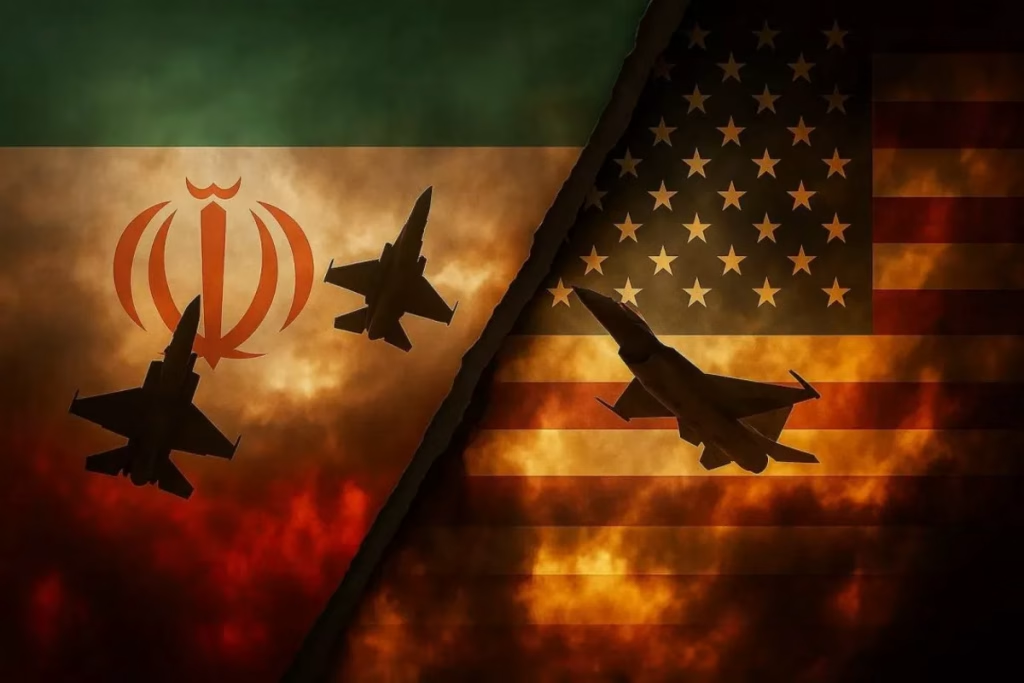
WaPo (“Trump agrees to suspend attacks for two weeks if Iran opens Strait of Hormuz“):
Just 90 minutes before President Donald Trump’s 8 p.m. deadline to wipe out “a whole civilization” with massive strikes on Iran’s energy infrastructure and bridges, he granted a two-week extension for diplomacy to continue.
“Subject to the Islamic Republic of Iran agreeing to the COMPLETE, IMMEDIATE and SAFE OPENING of the Strait of Hormuz,” Trump said Tuesday on social media, “I agree to suspend the bombing and attack of Iran for a period of two weeks.”
“We have already met and exceeded all Military objectives, and are very far along with a definitive Agreement concerning Longterm PEACE with Iran,” Trump said. A 10-point proposal received from Tehran, he said, was a “workable basis on which to negotiate.”
Trump added, “This will be a double-sided CEASEFIRE!”
After Trump’s announcement, a statement posted by Iranian Foreign Minister Abbas Araghchi, which he attributed to the Supreme National Security Council, said it too was responding to Pakistan’s request and Trump’s “acceptance of the general Framework of Iran’s 10-point proposal for negotiations.”
“If attacks against Iran are halted,” it said, “our Powerful Armed Forces will cease their defensive operations.” For two weeks, it added, “safe passage through the Strait of Hormuz will be possible via coordination” with the Iranian military.
[…]
In the 10-point proposal Trump said was a basis for negotiations, Iran demanded a permanent end to the war as well as an end to any attacks against the “Axis of Resistance,” as it calls its proxy groups in the region, including Hezbollah. According to a government statement reported by Iranian media late Tuesday, demands also included establishment of a formal protocol for passage through the Strait of Hormuz “that ensures an oversight role for Iran.”
The list called for recognition of Iran’s right to uranium enrichment, “withdrawal of U.S. combat forces from all bases and military deployment points in the region,” full compensation for war damage, the lifting of all sanctions against Iran and the release of all Iranian assets held abroad.
David Sanger, NYT (“Trump Finds His Offramp With Iran. But the Causes of War Remain Unresolved.“) assesses this outcome correctly, in my view:
At 8:06 a.m. on Tuesday, President Trump delivered an apocalyptic threat to Iran, declaring that unless his demand to open the Strait of Hormuz was fulfilled by nightfall, “a whole civilization will die tonight, never to be brought back again.”
Ten hours and 26 minutes later, at 6:32 p.m. Eastern time, he lifted the threat, for now. He said an intervention by the Pakistani government had led to a two-week cease-fire in a war that has wracked the world economy and showed off American technological dominance and unexpected Iranian resilience.
Mr. Trump’s tactic of escalating his rhetoric to astronomical levels certainly helped him find an offramp he had been seeking for weeks. That success alone may fuel his belief that the tactics he learned in the New York real estate world — ignore old conventions, make maximalist demands — works in geopolitics as well.
Without question, it was a down-to-the-wire tactical victory, one that should, at least temporarily, get oil, fertilizer and helium flowing again through the Strait of Hormuz, and calm markets that feared a global energy shock would lead to a global recession.
But it resolved none of the fundamental issues that led to the war.
It leaves a theocratic government, backed by the vicious Islamic Revolutionary Guard Corps, in charge of a cowed population that has been pummeled by missiles and bombs, and finds itself still under the thumb of a familiar regime, even if under new management. It leaves Iran’s nuclear stockpile in place, including the 970 pounds of near-bomb-grade material that was, in theory, the casus belli of this war.
It left Gulf allies reeling, with the discovery that the glass skyscrapers of Dubai and the desalination plants that make wealthy enclaves in Kuwait livable can be taken out by Iranian missiles and drones. Gas prices have soared, and are about to test Mr. Trump’s promise that they will fall again to old levels as soon as the fighting stops.
[…]
Now Mr. Trump faces the challenge not only of reaching a more permanent settlement but proving to the United States and the world that this conflict was worth flighting in the first place. And to do so, he will have to demonstrate that he has removed Iran’s death-grip on the 21-mile channel that makes up the strait, and its chances of ever building a nuclear weapon.
[…]
“Iran remains in the control of the Strait, which was not the case before the war,” said Richard Fontaine, the chief executive of the Center for a New American Security, a Washington think tank. “I find it hard to believe that the United States and the world could accept a situation in which Iran remains in control of a key energy checkpoint indefinitely. That would be a materially worse outcome than existed before the war.”
So might a final agreement. Four weeks ago Mr. Trump was demanding Iran’s “unconditional surrender,’’ saying he would determine when the country had been completely defeated. On Tuesday evening his tone was different. He agreed to base the next two weeks of talks on a 10-point plan Iran submitted to the Pakistanis. Mr. Trump called it “a workable basis on which to negotiate.”
“Have you looked at Iran’s plan?” asked Mr. Fontaine. “It reads like a Tehran wish list from before the war, calling for a global recognition of Iran’s right to enrich uranium, the removal of all American forces from the region and a lifting of economic sanctions. And it calls for the payment of reparations to Iran for damage caused in the war.”
[…]
If he fails to get the 970 pounds of 60-percent enriched uranium out of the country, along with far larger quantities of lower-enriched nuclear fuel, he will have accomplished less in the billion-dollar-a-day war than Mr. Obama accomplished 11 years ago. In that agreement, Iran shipped 97 percent of its nuclear stockpile out of the country.
If he fails to win agreement that Iran will limit the size of its battered arsenal of missiles, or the distance they can travel, he will have fallen short on one of his top objectives.
And if his talks with a government led by the new Supreme Leader, Mojtaba Khamenei, who is believed to be recovering from injuries in the bombing that killed his father, Ayatollah Ali Khamenei, end up cementing the new government’s authority, he risks selling out the Iranian people.
It was only a little more than five weeks ago that Mr. Trump was urging the Iranian people to rise up and overthrow their government. Now he is doing business with that government. On Tuesday he repeated his claim that the new Supreme Leader is part of a generation of “different, smarter, and less radicalized” leaders. American intelligence agencies have their doubts.
“Maybe this will work out,” said Mr. Fontaine, a former aide to the late Senator John McCain. “But there is a chance that this ends with the U.S. and the world in a worse situation than when it started.”
I would say that’s close to a certainty.
Absent major concessions in the next two weeks that Iran has zero incentive to make, the security situation in the region is markedly worse. An Iranian regime still reeling from the humiliation of multiple Israeli and U.S. strikes against itself and its proxies has stood up to the best the United States and Israel could deal out and survived. Instead of being led by a feeble 86-year-old with no succession plan, his 56-year-old son is now in place.
Certainly, the regime’s military apparatus is considerably weakened. Its navy and air force have been heavily targeted. But the IRGC has shown itself to be markedly resilient. And, of course, they now control the Strait of Hormuz.
In exchange, thousands of innocents across the region, including Israel, and a baker’s dozen of American servicemen are dead. Our flagship aircraft carrier is offline. Several planes have been shot down or otherwise destroyed. We’ve expended much of the magazine depth of some of our most exquisite weapons. We’ve spent untold tens of billions of dollars.
Oh, and world oil prices are up, to the detriment of American consumers and the benefit of Russia and Iran.
Other than that, it was a spectacular victory.

TACO it is.
Well better then the nuke thing.
I think the willingness of the Iranian people to form human shields around power plants showed everyone who likes to evaluate what “the Iranian people” want, through the lens of western sensibilities will come to understand that it’s a bit more complicated than tic tac toe.
Right now it seems like there will be no way to even get a deal that just gets us back to the JCPOA that Trump tore up.
I posted Trumps death-of-civilization screed on my FB page and in response, one FB friend who is what Mehdi would describe as PEP (Progressive Except Palestine.. I know several such people) posted numerous graphic memes of people executed/lashed/raped by the Irani government, as if regime change was a specific aim of the US.
Also, how much can Iran rebuild its missile and drone reserves over the next 2 weeks? I imagine China and Russia will be trucking over a LOT.
The ceasefire also gives Trump 2 weeks to gin up another distraction from the TRUMP-EPSTEIN files. Squirrel!
Besides, he needs to turn his attention back to demonizing Democrats before the midterms or the focus of the country will swing back to his corruption and misdeeds, as new committees are formed in the new Congress for just that purpose.
See, this Straits-of-Hormuz-Global-Economy-Crash debacle (The Great Trump Hormuz Debacle) is exactly why we need moral, rational civilian oversight over military affairs and particularly war-like actions. Guess that disqualifies this permutation of the Republican Party. Most tragic for the 3,000 dead Iranians including 200 school girls, and the 13 American service personal killed. This is on the Republican Party, full stop.
Have you noticed the oft repeated nugget here?
The gnawing thought that he’s actually not too bright seems to rattle around endlessly in Trump’s head, causing him to cast aspersions on everyone else’s intelligence. He’s a dumb guy who thinks he is smart, and a paranoid who thinks everyone is trying to take advantage of him. Future historians will wonder why Trump’s multiple psychopathologies weren’t addressed by the GOP and the media.
@Assad K:
In a production war between drones and interceptors, drones win. Russia produces its own Shaheds, Iran has its own factories, and if China were to decide to ramp up they could be cranking out drones at a rate of thousands a day. Meanwhile:
And,
And,
We have a bit of a Germans in WW2 problem. The Russians made mass quantities of the crude and cheap T-34, we made mass quantities of the basic and easy-to-produce Sherman, and the Germans made exquisite Tigers that were too heavy, broke down a lot and were impossible to repair.
We simply cannot beat tens of thousands of drones with hundreds of million dollar interceptors. The Russians must have a dilemma, whether to save all their drones for Ukraine, or fuck with the Americans and strengthen ties with Iran.
Most people refuse to think of Michael Cohen as credible, but he has known Trump for a really long time and worked closely with him. I find his takes interesting:
“Michael Cohen”
…
The paragraph I bolded is plainly an exaggeration, as the Wajeeh Lion posts I put up in the forum point out.
“David Sanger, NYT (“Trump Finds His Offramp With Iran. But the Causes of War Remain Unresolved.“) assesses this outcome correctly, in my view:”
His headline, IMHO, is a lie.
We had a working treaty and arrangement about nuclear materials.
Trump trashed it, and then declared the possession of nuclear materials to be justification for war.
I still want to know about the MEUs and the 82nd. Are we hearing that any of that ground force is being turned around? I’m hearing what I’m not hearing. I’ll believe Trump has given up on stealing the oil when the Marines and the Paratroopers stand down.
@charontwo: Cohen is describing, with much more detail, and based on a whole bunch more experience with Trump than I have, what is pretty much my read of the situation.
I really like his characterization of “The threat is the headline. The reversal is the strategy.”
ETTD. Let’s hope this is the nadir.
@Barry_D: I don’t understand your point. Trump’s stated objectives were not achieved. Whether pulling out of JCPOA was a good idea is irrelevant to the headline.
@Michael Reynolds: Everything I see says elements of the 82nd are deploying to “the Middle East”. And there are mentions of “scheduled rotation”. Does anybody know how many and where? Is this a real troop deployment, or a token? Are they somewhere relatively safe or in harm’s way?
A pyrrhic victory is one where the gains made aren’t really worth the cost.
A trumpic victory is one where the defeated enemy emerges with a stronger strategic position than it had before the war. Manypeoplesaythat it’s the best kind of victory. Noneverhadsuchavictory before!!11!1
@gVOR10:
Last week I read that in addition to whatever US forces were already in the gulf, there were 2 amphibious Marine battalions totaling approx 5000 troops, approx 2000 members of the 82nd Airborne and an unknown number of special ops.
To the surprise of no one, the day after a huge strategic defeat that leaves Iran more powerful than it was before, the God Emperor of Dung is pushing his crypto scheme.
You can be an authoritarian, fascist, and kleptocrat all at once. None of these are exclusive.
Wow, James. I usually experience you as very temperate and analytical in your remarks. This is very consistent with your day job, I should think. Most of this post matches that and then you are different toward the end.
I can definitely sense the depth of your feeling here. Thanks for letting us see a bit of that part of you.
Fatso did something to help Putin? I’m shocked, shocked…
There are 2 versions of Iran’s 10 points, Iran may think a different version is being negotiated than most observers do. Meanwhile, Trump is possibly not acceding much to either, just more of the process Michael Cohen described upthread, reversals upon reversal.
“Jay Kuo”
“Nick Anderson“
From The Hill:
Trump says he’s considering ‘joint venture’ with Iran for Strait of Hormuz tolls
”
“Earlier Wednesday, Trump wrote on Truth Social that there was “big money” to be made by the U.S. aiding in the “traffic buildup” in the Strait of Hormuz.
“We’ll be loading up with supplies of all kinds, and just ‘hangin’ around’ in order to make sure that everything goes well,” he wrote. “I feel confident that it will.”
”
https://www.yahoo.com/news/articles/trump-says-considering-joint-venture-132829597.html
I mean.. sure, for peace you have to make agreements with people you consider wrong/odious/worse. But this seems to stretch things a tad…
@Assad K: Are the families of the 13 dead servicemembers going to get a cut?
Fox News:
https://bsky.app/profile/atrupar.com/post/3miyrixatlr2o
So perhaps this whole meshuggah is just one more Trumpy nothingburger.
ETA:
Latest “ceasefire” news: Iran’s oil refinery facility on Lavan Island is burning, and Iran is blaming the UAE for the attack. In response, Iran just fired retaliatory missiles and drones at the UAE and Kuwait.
(As mentioned earlier, UAE, KSA etc. not all that happy or on board with taking Iran’s 10 point list seriously).
@Scott:
Maybe a cut in benefits.
The NYT Live Updates can be “interesting”
…
…
…
…
…
…
It seems the Strait of Hormuz is actually the Strait of Schrodinger-Hormuz.
Concerning the depleted missile stores, The Navy has just requested Congress for 7.3 billion for purchase of Tomahawk and SB-6 missiles.
Forgot the link Here
Per The Guardian:
https://www.theguardian.com/world/2026/apr/08/middle-east-ceasefire-doubt-israel-lebanon-iran-oil-tankers
So, it’s going great.
Also, Trump is muttering about pulling out of NATO again, because the ungrateful Europeans weren’t willing to wade into this idiotic war of choice.
That sentence certainly makes it look like the feeble 86-year-old had a succession plan.
I also agree with Sanger’s comments in general. The alterative would’ve been to do more pointless destruction. We did that in Afghanistan, and after decades the result was no better. At least Trump recognized he screwed up and found an off-ramp, and it actually might be for the best that he either doesn’t care or is unable to see how ridiculous he looks taking it.
IF it holds, of course. Not at all confident this is over.
Best snarky comment read: Shart of the Deal.
Politico probably has the rights of what’s going on:
It will be the famous Gaza Peace Plan on steroids, with Trump developing a wholly imaginary resolution to a war that he claims is the greatest military victory in US history. In reality, nothing much will have changed except that a few thousand more people are dead and more of the region lies in ruins.
The biggest US military failed op in decades also provided a special impetus to get this cease fire finished.
@Gavin:
Press TV is the Iranian government’s foreign news service in English. I recommend healthy skepticism.
On the other hand, a few days ago El Taco was rambling something about an abandoned aircraft in Iran, due to it landing on the wrong surface. This was in connection with the rescue of the F15 crew. I thought it was odd to involve an airplane, as opposed to a helicopter, landing in the middle of a rescue operation. So maybe El taco was letting on more than he should have.
An abandoned airstrip makes perfect sense, and the C-130 is known for its rough field capability.
@Kathy: The little bird helos don’t have much range and aren’t equipped for aerial refueling, so C130s are a typical way to get them close enough.
Will Schryver
Armchair Warlord
@Gavin:
The F-15 WSO was an O-6 colonel. WSO would normally be an O-3 or O-4, captain or major.
O-6 would only be an WSO if there to command some larger operation, such as your link described.