On the “Moderates” in the “Middle”
Some empirical insights into American partisan politics.
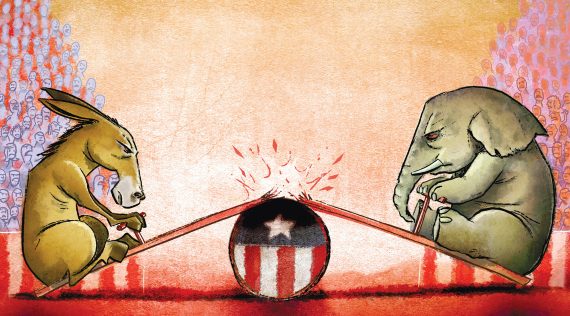
G. Elliot Morris has a very interesting post (Only 8% of “moderates” actually want moderation) on the question of voters who are often described as “moderates” in the “middle” of our politics. I place both terms in scare quotes because, as the post demonstrates, most self-identified “moderates” or people we think about as moderates don’t hold the moderate views we think they do. I also give “middle” the same treatment insofar as the grammar of American political language almost always positions these kinds of voters as being somehow between the left (Democrats) and the right (Republicans), and therefore drives discussion of political tactics into being about the battle for the “middle” where the swing voters supposedly live.
I have noted many times before (such as here) that this conception has some serious empirical and analytical problems, and Morris himself has empirically demonstrated that swing voters may have other characteristics, such as being low-information voters, that are not captured by conceptions of a moderate middle.
This is relevant for a variety of reasons, but is especially salient to debates about campaign strategy and the ubiquitous “messaging” argument, especially the favorite of many American pundits: the notion that all parties simply need to “moderate” to capture the “middle.”
I also think that the research adds more fuel to the fire that we have enough diversity of political opinion in the United States to support more than two parties, and we could access it if we would just engage in a modernization of our electoral system.
The whole piece needs to be read in full, but the first paragraph provides the basic finding:
When you ask voters to describe what kind of political party they want, in their own words, only 8% of self-identified “moderates” actually call for an ideologically moderate political party. Most instead want a party focused on affordability, political reform, or general left-leaning priorities — particularly economic ones.
In other words, what we find is, to use my own assessment of the situation, that we end up using the term “moderate” as simply a residual category (i.e., not R, not D). We then assume that said moderates are located, ideologically, between the two main categories. But, of course, there is no reason that it must be the case that this is where voters outside of the typical liberal/conservative frame should reside, ideologically.
As he notes later in the piece:
That’s right, only 8% of self-identified “moderates” fell into the Moderate cluster when asked what they want their party to fight for. The other 92% gave responses that clustered into left, right, affordability-focused, or anti-system camps. These voters describe their identity in ideological terms when forced to pick a label, but do not use centrist ideological language when they are allowed to think about politics in their own terms.
As I wrote in my original write-up, the right interpretation of this data is not “survey respondents are lying about their ideology” (although they might be, this data doesn’t land either way), it’s that the label moderate does not map cleanly onto what people actually say they want from a political party. A lot of voters probably use “moderate” to mean something like “I’m not an extremist,” or “I don’t like partisan conflict.”
This is a reminder, by the way, that one of the challenges of polling is that respondents do not all have the exact same understanding of a given word as other respondents and often think of the word differently than do the pollsters themselves or those who later attempt to interpret the results.
As Elliot notes, this has a practical and important implication.
That difference matters a lot for strategy. If “moderate” is mostly a weak or noisy label for what voters want from a party, then “win moderates” is not really a strategy; it’s a slogan.
Among swing voters — people who switched either from Biden to Trump or Trump to Harris from 2020 to 2024 — the biggest clusters were 25% left, 24% right, 23% anti-system, and 21% affordability. Just 8% were moderate. And among 2024 non-voters, even more were anti-system, and just 5% were labeled moderates.
The voters campaigns most want to persuade or mobilize are not sitting in some tidy centrist lane, waiting for a consultant to shave a few points off a laundry list platform document. They are much more likely to be angry about prices, alienated from institutions, or structured by concerns that do not fit cleanly on a left-right ideological spectrum. Or left-wing!
Together, the anti-system and affordability segments make up roughly 44% of swing voters and 50% of non-voters. The explicitly moderate segment is just 5% to 8%. The most parsimonious interpretation of this data is to spend more time campaigning on conditions and anti-system sentiment and less time on centrism.
The part of the post that is for paid subscribers discusses a paper by Broockman and Kalla.
And there is a deeper problem with the assumption underlying the whole “just moderate” framework. In Broockman and Kalla’s own data, fewer than 10% of respondents held consistent ideological positions across just five random issues. The electorate is not a clean left-right line with a big centrist bloc sitting in the middle. It is cross-pressured, inconsistent, and multidimensional — which is exactly what the Blue Rose segmentation found, too. A candidate who “moderates” on everything is not meeting voters where they are. They are appealing to a voter who barely exists.
Elliot largely concludes:
So my best guess is that the real-world effect of moderation is probably half the conjoint estimate, maybe smaller. Something like 0.5 to 0.7 points of vote share (so < 1.5 points on margin). That is my inference, not the paper’s formal estimate. But it is where I land after reading the study alongside the literature on persuasion and conjoint external validity. This effect is small enough that it could be dwarfed by model misspecification of non-sampling biases in the poll sample.
So now the takeaway from the literature is “moderation might help a little, but only in some circumstances, and the effect is dwarfed by other electoral context and candidate-specific factors in a particular race.”
In other words, as he notes in other places in the piece, things like the national political environment and incumbency factor far larger than moderation, but orders of magnitude.
He also makes an incredibly salient point, which is that moderates can’t further moderate/they still often lose:
I am not arguing that moderation never matters. But Democrats were not going to save, for example, Bob Casey’s seat in Pennsylvania in 2024 by nominating a moderate Senate candidate, because Casey was already moderate! In the hypothetical where Democratic candidates are moderate, you do not just get to add one point to every Democrat. The graveyard of Democrats who lost close House races is filled with moderates.
Note that all of this is in the context of a very public debate Elliot has been having with people like Matthew Yglesias:
I started writing about this because at the root of what I do (polling, election forecasting, political journalism) is voter psychology. It really matters that “we,” the class of political knowledge workers trying to inform readers about party strategy, actually get this right. On one side of this debate, you have a loud bunch of “analysts” and bloggers who get paid by the same pro-centrism Super PAC arguing that moderation is the only way forward for the Democratic Party — and on the other side, you have a small group of political scientists and data analysts trying to get the empirical strategy here correct.
While I am not a polling expert by any stretch, and indeed am not well versed in the sophisticated statistical analysis in which Elliot excels (no pun intended, and I am sure he doesn’t use Excel in any event), I fall into his camp. I think a lot about what I tend to call “messaging” arguments, which are based far more on gut than on reality. I am perhaps a bit less concerned with what the Democrats’ strategy ought to be and a bit more on getting people to understand how the system works, but the general intellectual convergence is the same.
Speaking of which, here is Elliot’s take on Democratic strategy.
My take is that Democrats don’t need a moderation strategy as much as they need a strategy for connecting with working-class voters on their economic anxieties and the biases of our political system. The data presented in this article shows voters want to vote for someone who understands what it is to be squeezed by rising costs, who thinks the system is failing the average person, and who is willing to fight for them to deliver a better tomorrow. That is a different task from scratching off affirmative action from your policy platform and declaring yourself a “centrist.”
The lesson is not that ideology no longer matters or that candidates should ignore positioning. It’s that the political middle is better understood as a problem of heterogeneous preferences and material conditions than as a simple demand for centrism. Campaigns that treat “moderation” as a vague brand attribute will learn less than campaigns that study where voters are cross-pressured, what conditions they’re reacting to, and which issue positions are genuinely out of step with public opinion.
Here is the shortest conclusion:
The more you look, the more it’s obvious that “just moderate” is too inexact to be helpful.
And the nerdier one:
To put this in terms that economics bloggers will understand, the median voter theorem is kind of like Ricardian equivalence: the idea seems devastatingly powerful right up until you notice that all of its predictive ability comes from making assumptions that are obviously false.
And the one for the less nerdy in the audience:
For now, the main lesson from these two new pieces of evidence is pretty clear. When you ask voters what they want from a party, very few describe anything like genuinely moderate politics. And when candidates do move to the middle, the payoff appears small, contingent, and easy to overstate.

“In other words, what we find is, to use my own assessment of the situation, that we end up using the term “moderate” as simply a residual category (i.e., not R, not D). We then assume that said moderates are located, ideologically, between the two main categories.”
Exactly! I think the one fatal flaw in politics is to even have parties republican/democrat/indy/moderate/conservative/liberal. On the sum of individual issues I average “liberal” but each issue has a weighted value. As you know, on crime and public safety, I am considered conservative and I would assign a weight of .8 on this (pretty strong). On immigration I am a liberal and would assign a weight of .7 on this. On universal healthcare I’m super liberal, assigning a weight of .9.
I wish there were no labels so it would force people and politicians to be more focused on issues.
I listened to this town hall with Graham Platner, the likely Democratic senate candidate in Maine, and he tunes his message around affordability and anti-system sentiment. He targets billionaires and lauds unions and community organizing. But he also gets big rounds of applause on protecting trans kids, and Roe v. Wade.
I watched the audience reactions and they were differentiated, some applauding more for this, some applauding more for that, but there was an overall sense of unity around Platner’s insistence that, ‘we all know we’re getting screwed,’ in contrast to the billionaires. He also quite cleverly draws a line between the Democratic Party we have, and the party we would have if it were defined by real Democratic voters in Maine.
So, to your point, he is not ‘moderate’ on social issues, he’s down-the-line liberal, and on economic issues, and class resentment, he’s Bernie. He is distinctly Left but manages to come across as transcending the labels by focusing on practical, ‘how do I pay my bills?’ messaging, on a bed of worker resentment of the billionaire class. I think he’s cracked the code. Take that messaging, adding some Telarico in the South and Midwest, and you’ve got something powerful.
@HelloWorld:
The conclusion that I reach is that I wish there were more labels, specifically party labels, to help voters better understand where they could find politicians who better align with their policy preferences.
@HelloWorld: My personal reaction to your wish that we wouldn’t have labels is:
1. I share your dream.
2. I am aware that I am more likely to see a blizzard in the Bay Area than I am to see people stop using labels.
So yeah, more labels, and more accurate labels. Like Steven said.
Wow, Morris is really hitting it these days, isn’t he?
We have come to count on honesty in labelling in the food we consume, the cars we drive, the drugs we take.
We could use need the same honesty in our politics and not the bullshit we are fed daily.
Ask a MAGAt and they will tell you that they are a Conservative when in fact MAGA is as radical as any party in our history.
Even talking strictly about policies gets you nowhere because it turns out that starting a pointless war on the other side of the planet is “Putting America First.” And winning is actually losing, victory is actually defeat.
The low information “moderates” are so bombarded with crap they don’t stand a chance.
Then when/if they figure it out they are too wed to their decision to ever admit that they f’ed up.
Thanks for highlighting Morris’ work. I have my own opinions about how voters really divide up, but could well be wrong as it is just based on my personal experience.
For example, I believe that the largest single block of voters (30%?) are people who feel obligated to vote but really just want a strong man in charge who will assure them that the strongman and his friends a) know everything and b) can fix anything and it’s easy, because all problems are created by the idiots who preceded them. They are attracted to liars, because truth-tellers will have to at least occasionally say they don’t have an answer or they made a mistake.
The second biggest (equally big?) are people who will simply vote what they believe is their personal financial interest. They don’t mind voting for a liar or a crook as long as they believe they will personally do financially better. And then the next largest group after that (15%?) is comprised of people who want punishment for those they don’t like, whether it’s minorities, or majorities they feel slighted by, or religious or regional rivals, etc.
No matter what these three groups of people say (or even believe) about themselves, they will not be swayed by policy positions of any sort, or calls for fairness or equity.
The amount of people who actually understand policy and care about it is almost certainly under 20% and are as likely to be on the “bad” end of an issue as the “good” one.
@Jay L. Gischer:
I’m reminded of Bible scholar Dan McClellan’s motto: Data over dogma.
@Steven L. Taylor: LOL, why am I not surprised you disagree with me! What you describe is essentially what they have in slow moving, fragmented Sweden. The result is almost no independence, and rising – not decreasing – polarization.
@HelloWorld: It is not simply that I disagree with you; I have decades of studying the subject under my belt. Sure, one can pluck some example that is supposed to counter an entire argument, but that is like being diagnosed with a disease and rejecting your doctor’s prescribed course of remedy because you read that one person who supposedly had the same ailment did the same course of treatment and it didn’t work, so you want to do some alternative remedy.
It may well be, BTW, that the doctor is wrong, but the likelihood is the opposite.
Regardless, I realize that the burden is on me, ultimately, to make my case.
Let me counter with this: it is as close to a sociological/political science law that I can generate, that representative systems create parties. Even systems that ban labels. We have “non-partisan” elections in any number of American municipalities, and yet it is usually possible to discern hidden parties (i.e., the Rs and Ds are pretty obvious, just not on the ballot). Or, sometimes the “parties” are formed around election-specific issues (like the time my town had a clearly pro-school funding “party” and an “anti”).
If you can find me a functional example of a representative system without parties, lay it on me. But even if you can find one (and I can’t think of one), it will be a clear aberration.
I would further note that party labels give voters information. One of the problems of our system is that it has to shove all of politics into two baskets. More parties create more differentiated information for voters.
The thing is, as it pertains to your position, it is a fantasy world (and I am not being derogatory; I think it is an accurate, empirical description) in which all citizens are highly informed and base their choices solely on clear policy preferences, which they could associate with candidates.
This world does not exist. We all use party labels to help us parse choices.
If you truly do know, based on the name of the candidates alone and their policy preferences, for the numerous state, county, and local offices, then you are truly an outlier in the vast universe of voters.
Party labels provide signals to voters about policy preferences and governance.
Ergo, more parties mean more information.
Parties may well suck, but they are fundamental to representative democracy.
Yes, it would be nice if we all just “vote for the person, not the party,” but there is nothing in over a century of data from the global experience with electoral democracy to suggest that model has any efficacy whatsoever.
BTW: I say all of that not because I am trying to win an argument. I say it all because I think it to be true and that a greater understanding of those truths is essential for helping to fix the American government.
I continue to be naive enough to hope that education and understanding can help us move forward.
And I remain open to figuring out if, and where I am wrong, and to adjust my positions accordingly.
In regard to Sweden v. the US, the recent Freedom House score for the US is 81/100, down from 84 last year. Sweden is at 99/100.
The political rights score for the US is 32/40, while Sweden’s is 40/40.
Meanwhile, V-Dem classified Sweden as a Liberal Democracy, but shows the US as an Electoral Democracy (a step down), and it is shown as trending downward.
So, if I have to choose based on democratic health, give me Sweden’s system.
Is it all about parties? Of course not, but it is about democratic responsiveness and representativeness, which is very much linked to parties.