On the “Moderates” in the “Middle”

Some empirical insights into American partisan politics.

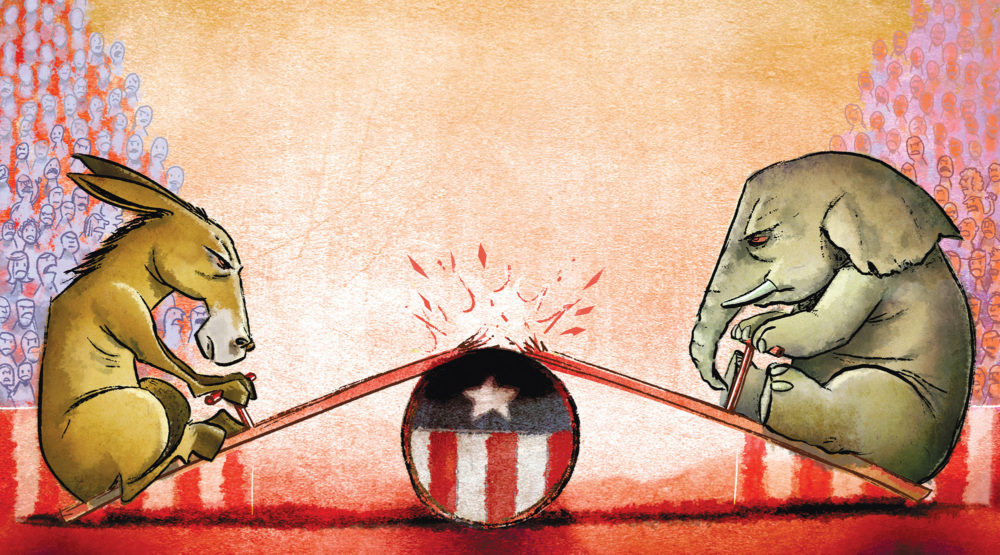
G. Elliot Morris has a very interesting post (Only 8% of “moderates” actually want moderation) on the question of voters who are often described as “moderates” in the “middle” of our politics. I place both terms in scare quotes because, as the post demonstrates, most self-identified “moderates” or people we think about as moderates don’t hold the moderate views we think they do. I also give “middle” the same treatment insofar as the grammar of American political language almost always positions these kinds of voters as being somehow between the left (Democrats) and the right (Republicans), and therefore drives discussion of political tactics into being about the battle for the “middle” where the swing voters supposedly live.

I have noted many times before (such as here) that this conception has some serious empirical and analytical problems, and Morris himself has empirically demonstrated that swing voters may have other characteristics, such as being low-information voters, that are not captured by conceptions of a moderate middle.

This is relevant for a variety of reasons, but is especially salient to debates about campaign strategy and the ubiquitous “messaging” argument, especially the favorite of many American pundits: the notion that all parties simply need to “moderate” to capture the “middle.”

I also think that the research adds more fuel to the fire that we have enough diversity of political opinion in the United States to support more than two parties, and we could access it if we would just engage in a modernization of our electoral system.

The whole piece needs to be read in full, but the first paragraph provides the basic finding:

When you ask voters to describe what kind of political party they want, in their own words, only 8% of self-identified “moderates” actually call for an ideologically moderate political party. Most instead want a party focused on affordability, political reform, or general left-leaning priorities — particularly economic ones.

In other words, what we find is, to use my own assessment of the situation, that we end up using the term “moderate” as simply a residual category (i.e., not R, not D). We then assume that said moderates are located, ideologically, between the two main categories. But, of course, there is no reason that it must be the case that this is where voters outside of the typical liberal/conservative frame should reside, ideologically.

As he notes later in the piece:

That’s right, only 8% of self-identified “moderates” fell into the Moderate cluster when asked what they want their party to fight for. The other 92% gave responses that clustered into left, right, affordability-focused, or anti-system camps. These voters describe their identity in ideological terms when forced to pick a label, but do not use centrist ideological language when they are allowed to think about politics in their own terms.

As I wrote in my original write-up, the right interpretation of this data is not “survey respondents are lying about their ideology” (although they might be, this data doesn’t land either way), it’s that the label moderate does not map cleanly onto what people actually say they want from a political party. A lot of voters probably use “moderate” to mean something like “I’m not an extremist,” or “I don’t like partisan conflict.”

This is a reminder, by the way, that one of the challenges of polling is that respondents do not all have the exact same understanding of a given word as other respondents and often think of the word differently than do the pollsters themselves or those who later attempt to interpret the results.

As Elliot notes, this has a practical and important implication.

That difference matters a lot for strategy. If “moderate” is mostly a weak or noisy label for what voters want from a party, then “win moderates” is not really a strategy; it’s a slogan.

Among swing voters — people who switched either from Biden to Trump or Trump to Harris from 2020 to 2024 — the biggest clusters were 25% left, 24% right, 23% anti-system, and 21% affordability. Just 8% were moderate. And among 2024 non-voters, even more were anti-system, and just 5% were labeled moderates.

The voters campaigns most want to persuade or mobilize are not sitting in some tidy centrist lane, waiting for a consultant to shave a few points off a laundry list platform document. They are much more likely to be angry about prices, alienated from institutions, or structured by concerns that do not fit cleanly on a left-right ideological spectrum. Or left-wing!

Together, the anti-system and affordability segments make up roughly 44% of swing voters and 50% of non-voters. The explicitly moderate segment is just 5% to 8%. The most parsimonious interpretation of this data is to spend more time campaigning on conditions and anti-system sentiment and less time on centrism.

The part of the post that is for paid subscribers discusses a paper by Broockman and Kalla.

And there is a deeper problem with the assumption underlying the whole “just moderate” framework. In Broockman and Kalla’s own data, fewer than 10% of respondents held consistent ideological positions across just five random issues. The electorate is not a clean left-right line with a big centrist bloc sitting in the middle. It is cross-pressured, inconsistent, and multidimensional — which is exactly what the Blue Rose segmentation found, too. A candidate who “moderates” on everything is not meeting voters where they are. They are appealing to a voter who barely exists.

Elliot largely concludes:

So my best guess is that the real-world effect of moderation is probably half the conjoint estimate, maybe smaller. Something like 0.5 to 0.7 points of vote share (so < 1.5 points on margin). That is my inference, not the paper’s formal estimate. But it is where I land after reading the study alongside the literature on persuasion and conjoint external validity. This effect is small enough that it could be dwarfed by model misspecification of non-sampling biases in the poll sample.

So now the takeaway from the literature is “moderation might help a little, but only in some circumstances, and the effect is dwarfed by other electoral context and candidate-specific factors in a particular race.” 

In other words, as he notes in other places in the piece, things like the national political environment and incumbency factor far larger than moderation, but orders of magnitude.

He also makes an incredibly salient point, which is that moderates can’t further moderate/they still often lose:

I am not arguing that moderation never matters. But Democrats were not going to save, for example, Bob Casey’s seat in Pennsylvania in 2024 by nominating a moderate Senate candidate, because Casey was already moderate! In the hypothetical where Democratic candidates are moderate, you do not just get to add one point to every Democrat. The graveyard of Democrats who lost close House races is filled with moderates. 

Note that all of this is in the context of a very public debate Elliot has been having with people like Matthew Yglesias:

I started writing about this because at the root of what I do (polling, election forecasting, political journalism) is voter psychology. It really matters that “we,” the class of political knowledge workers trying to inform readers about party strategy, actually get this right. On one side of this debate, you have a loud bunch of “analysts” and bloggers who get paid by the same pro-centrism Super PAC arguing that moderation is the only way forward for the Democratic Party — and on the other side, you have a small group of political scientists and data analysts trying to get the empirical strategy here correct.

While I am not a polling expert by any stretch, and indeed am not well versed in the sophisticated statistical analysis in which Elliot excels (no pun intended, and I am sure he doesn’t use Excel in any event), I fall into his camp. I think a lot about what I tend to call “messaging” arguments, which are based far more on gut than on reality. I am perhaps a bit less concerned with what the Democrats’ strategy ought to be and a bit more on getting people to understand how the system works, but the general intellectual convergence is the same.

Speaking of which, here is Elliot’s take on Democratic strategy.

My take is that Democrats don’t need a moderation strategy as much as they need a strategy for connecting with working-class voters on their economic anxieties and the biases of our political system. The data presented in this article shows voters want to vote for someone who understands what it is to be squeezed by rising costs, who thinks the system is failing the average person, and who is willing to fight for them to deliver a better tomorrow. That is a different task from scratching off affirmative action from your policy platform and declaring yourself a “centrist.”

The lesson is not that ideology no longer matters or that candidates should ignore positioning. It’s that the political middle is better understood as a problem of heterogeneous preferences and material conditions than as a simple demand for centrism. Campaigns that treat “moderation” as a vague brand attribute will learn less than campaigns that study where voters are cross-pressured, what conditions they’re reacting to, and which issue positions are genuinely out of step with public opinion.

Here is the shortest conclusion:

The more you look, the more it’s obvious that “just moderate” is too inexact to be helpful.

And the nerdier one:

To put this in terms that economics bloggers will understand, the median voter theorem is kind of like Ricardian equivalence: the idea seems devastatingly powerful right up until you notice that all of its predictive ability comes from making assumptions that are obviously false.

And the one for the less nerdy in the audience:

For now, the main lesson from these two new pieces of evidence is pretty clear. When you ask voters what they want from a party, very few describe anything like genuinely moderate politics. And when candidates do move to the middle, the payoff appears small, contingent, and easy to overstate.

FILED UNDER: Democracy, Democratic Theory, Electoral Rules, US Politics, , , , , , , , , , , , , ,
Steven L. Taylor
About Steven L. Taylor
Steven L. Taylor is a Professor Emeritus of Political Science and former College of Arts and Sciences Dean. His main areas of expertise include parties, elections, and the institutional design of democracies. His most recent book is the co-authored A Different Democracy: American Government in a 31-Country Perspective. He earned his Ph.D. from the University of Texas and his BA from the University of California, Irvine. He has been blogging since 2003 (originally at the now defunct Poliblog). Follow Steven on Twitter and/or BlueSky.

Comments

  1. HelloWorld says:

    “In other words, what we find is, to use my own assessment of the situation, that we end up using the term “moderate” as simply a residual category (i.e., not R, not D). We then assume that said moderates are located, ideologically, between the two main categories.”

    Exactly! I think the one fatal flaw in politics is to even have parties republican/democrat/indy/moderate/conservative/liberal. On the sum of individual issues I average “liberal” but each issue has a weighted value. As you know, on crime and public safety, I am considered conservative and I would assign a weight of .8 on this (pretty strong). On immigration I am a liberal and would assign a weight of .7 on this. On universal healthcare I’m super liberal, assigning a weight of .9.

    I wish there were no labels so it would force people and politicians to be more focused on issues.

    5
  2. Michael Reynolds says:

    Together, the anti-system and affordability segments make up roughly 44% of swing voters and 50% of non-voters.

    I listened to this town hall with Graham Platner, the likely Democratic senate candidate in Maine, and he tunes his message around affordability and anti-system sentiment. He targets billionaires and lauds unions and community organizing. But he also gets big rounds of applause on protecting trans kids, and Roe v. Wade.

    I watched the audience reactions and they were differentiated, some applauding more for this, some applauding more for that, but there was an overall sense of unity around Platner’s insistence that, ‘we all know we’re getting screwed,’ in contrast to the billionaires. He also quite cleverly draws a line between the Democratic Party we have, and the party we would have if it were defined by real Democratic voters in Maine.

    So, to your point, he is not ‘moderate’ on social issues, he’s down-the-line liberal, and on economic issues, and class resentment, he’s Bernie. He is distinctly Left but manages to come across as transcending the labels by focusing on practical, ‘how do I pay my bills?’ messaging, on a bed of worker resentment of the billionaire class. I think he’s cracked the code. Take that messaging, adding some Telarico in the South and Midwest, and you’ve got something powerful.

    6
  3. @HelloWorld:

    I wish there were no labels so it would force people and politicians to be more focused on issues.

    The conclusion that I reach is that I wish there were more labels, specifically party labels, to help voters better understand where they could find politicians who better align with their policy preferences.

    5
  4. Jay L. Gischer says:

    @HelloWorld: My personal reaction to your wish that we wouldn’t have labels is:

    1. I share your dream.
    2. I am aware that I am more likely to see a blizzard in the Bay Area than I am to see people stop using labels.

    So yeah, more labels, and more accurate labels. Like Steven said.

    2
  5. Jay L. Gischer says:

    Wow, Morris is really hitting it these days, isn’t he?

    3
  6. Daryl says:

    We have come to count on honesty in labelling in the food we consume, the cars we drive, the drugs we take.
    We could use need the same honesty in our politics and not the bullshit we are fed daily.
    Ask a MAGAt and they will tell you that they are a Conservative when in fact MAGA is as radical as any party in our history.
    Even talking strictly about policies gets you nowhere because it turns out that starting a pointless war on the other side of the planet is “Putting America First.” And winning is actually losing, victory is actually defeat.
    The low information “moderates” are so bombarded with crap they don’t stand a chance.
    Then when/if they figure it out they are too wed to their decision to ever admit that they f’ed up.

    10
  7. MarkedMan says:

    Thanks for highlighting Morris’ work. I have my own opinions about how voters really divide up, but could well be wrong as it is just based on my personal experience.

    For example, I believe that the largest single block of voters (30%?) are people who feel obligated to vote but really just want a strong man in charge who will assure them that the strongman and his friends a) know everything and b) can fix anything and it’s easy, because all problems are created by the idiots who preceded them. They are attracted to liars, because truth-tellers will have to at least occasionally say they don’t have an answer or they made a mistake.

    The second biggest (equally big?) are people who will simply vote what they believe is their personal financial interest. They don’t mind voting for a liar or a crook as long as they believe they will personally do financially better. And then the next largest group after that (15%?) is comprised of people who want punishment for those they don’t like, whether it’s minorities, or majorities they feel slighted by, or religious or regional rivals, etc.

    No matter what these three groups of people say (or even believe) about themselves, they will not be swayed by policy positions of any sort, or calls for fairness or equity.

    The amount of people who actually understand policy and care about it is almost certainly under 20% and are as likely to be on the “bad” end of an issue as the “good” one.

    3
  8. Kathy says:

    @Jay L. Gischer:

    I’m reminded of Bible scholar Dan McClellan’s motto: Data over dogma.

    3
  9. HelloWorld says:

    @Steven L. Taylor: LOL, why am I not surprised you disagree with me! What you describe is essentially what they have in slow moving, fragmented Sweden. The result is almost no independence, and rising – not decreasing – polarization.

    1
  10. @HelloWorld: It is not simply that I disagree with you; I have decades of studying the subject under my belt. Sure, one can pluck some example that is supposed to counter an entire argument, but that is like being diagnosed with a disease and rejecting your doctor’s prescribed course of remedy because you read that one person who supposedly had the same ailment did the same course of treatment and it didn’t work, so you want to do some alternative remedy.

    It may well be, BTW, that the doctor is wrong, but the likelihood is the opposite.

    Regardless, I realize that the burden is on me, ultimately, to make my case.

    Let me counter with this: it is as close to a sociological/political science law that I can generate, that representative systems create parties. Even systems that ban labels. We have “non-partisan” elections in any number of American municipalities, and yet it is usually possible to discern hidden parties (i.e., the Rs and Ds are pretty obvious, just not on the ballot). Or, sometimes the “parties” are formed around election-specific issues (like the time my town had a clearly pro-school funding “party” and an “anti”).

    If you can find me a functional example of a representative system without parties, lay it on me. But even if you can find one (and I can’t think of one), it will be a clear aberration.

    I would further note that party labels give voters information. One of the problems of our system is that it has to shove all of politics into two baskets. More parties create more differentiated information for voters.

    The thing is, as it pertains to your position, it is a fantasy world (and I am not being derogatory; I think it is an accurate, empirical description) in which all citizens are highly informed and base their choices solely on clear policy preferences, which they could associate with candidates.

    This world does not exist. We all use party labels to help us parse choices.

    If you truly do know, based on the name of the candidates alone and their policy preferences, for the numerous state, county, and local offices, then you are truly an outlier in the vast universe of voters.

    Party labels provide signals to voters about policy preferences and governance.

    Ergo, more parties mean more information.

    Parties may well suck, but they are fundamental to representative democracy.

    Yes, it would be nice if we all just “vote for the person, not the party,” but there is nothing in over a century of data from the global experience with electoral democracy to suggest that model has any efficacy whatsoever.

    12
  11. BTW: I say all of that not because I am trying to win an argument. I say it all because I think it to be true and that a greater understanding of those truths is essential for helping to fix the American government.

    I continue to be naive enough to hope that education and understanding can help us move forward.

    And I remain open to figuring out if, and where I am wrong, and to adjust my positions accordingly.

    10
  12. In regard to Sweden v. the US, the recent Freedom House score for the US is 81/100, down from 84 last year. Sweden is at 99/100.

    The political rights score for the US is 32/40, while Sweden’s is 40/40.

    Meanwhile, V-Dem classified Sweden as a Liberal Democracy, but shows the US as an Electoral Democracy (a step down), and it is shown as trending downward.

    So, if I have to choose based on democratic health, give me Sweden’s system.

    Is it all about parties? Of course not, but it is about democratic responsiveness and representativeness, which is very much linked to parties.

    5
  13. Gustopher says:

    @Steven L. Taylor:

    The conclusion that I reach is that I wish there were more labels, specifically party labels, to help voters better understand where they could find politicians who better align with their policy preferences.

    The “non-partisan” offices in Seattle drive me crazy. They were instituted to take politics out of politics or something, but just mean that you have to dig to figure out which candidate is the secret Republican who wants to use their seat on the Port Authority board to enact white supremacy.

    (That example might be hyperbole, but they have started painting the cranes in the harbor white…)

    I suspect the main effect of the non-partisan offices — which force one to “vote for the candidate, not the party” — is just to decrease the chance someone will vote for those offices. I don’t have any data to back this up, though.

    6
  14. drj says:

    @Steven L. Taylor:

    Is it all about parties? Of course not, but it is about democratic responsiveness and representativeness, which is very much linked to parties.

    Without wanting to dispute that labels are good, especially when parties are in control of them, one thing that started plaguing proportional electoral systems, especially in the last quarter century or so, is that more labels do not necessarily increase democratic responsiveness.

    In many European countries, for instance (as you undoubtedly know), quite a few of these new labels/parties are basically purity ponies. They will end up in the legislature, but not in the actual government.

    And even apart from the purity pony aspect, creating a government coalition out of six or seven parties (or even more) is logistically challenging, to say the least.

    So what tends to happen is that while voter preferences change and the number of parties increases, the same few parties somehow always end up in the ruling coalition due to lack of viable alternatives – something that is exacerbated by the fact if 40 years ago you could create a viable coalition out of two parties, you may now need four or five.

    In other words, voters get the legislature they want, but not the government they want. Because the new government generally resembles the old one quite a bit. And most of the change is in the political groups that won’t make it into the government anyway.

    This isn’t to say that proportional representation and clear party labels suck, but it does create problems, too, sometimes.

    Also, “more labels” will have a different ring to it if you have 10+ already instead of just two.

    1
  15. Gustopher says:

    @Michael Reynolds: I really hope the former Blackwater mercenary who worked at Abu Ghraib and had a Nazi tattoo for 20 years and made racist posts to the internet and has never held office before doesn’t turn out to be some kind of right winger who is just saying what people want to hear.

    12
  16. HelloWorld says:

    @Steven L. Taylor: “Sure, one can pluck some example that is supposed to counter an entire argument, but that is like being diagnosed with a disease and rejecting your doctor’s prescribed course of remedy” – or you can reject an actual example by painting some other analogy that is non-specific, but as Roger Waters once said “there are 3 sides to every opinion, yours mine and the truth”.

    No doubt you are wise and educated and yes, I learn a lot from your perspective. I’m a believer that labels create obstacles to understanding. Krishnamurti’s book Freedom From the Known dives deep into the complexities that labels of any sort can cause. But applied philosophy on a political level, I believe lack of labels would produce more caucuses designed to solve specific problems, creating more unity than division. But now, I’m the one giving a broad explanation of a theory.

  17. Michael Reynolds says:

    @Gustopher:
    My younger sister insists on sending me items from our childhood. Recently she sent me a tape I’d made at age 15 to send to our father who was in Vietnam. In it I talk about organizing the High School’s first ever Earth Day. At the time population growth was the big boogey man. I complained to my dad that the school would not allow me to advocate for the irrefutably necessary option: forced sterilization.

    Which is some Nazi-adjacent shit. Then, in 1972, I voted for Nixon. And a few years later I decided to become a criminal.

    We make mistakes in life. We learn from them. We change. I don’t want to be judged by what I did at 15 or 19 or even 25, I don’t deny past mistakes, but I would hope people would accept that learning happens, and maturing happens, and we are not necessarily the people we once were. Watch the tape and tell me whether you think he’s sincere.

    2
  18. Jc says:

    I consider myself moderate left. To me the PPACA was moderate legislation. To others it is a liberal takeover of the healthcare system and leads to communism….blah blah. A big part of the problem is one side has convinced so many that moderate legislation is just a seed for future leftist takeover etc… until that “side” returns to reality it is just more of the same to continue. They legislate nothing of importance and plant seeds of fear and hate towards anything meaningful like healthcare, immigration, wealth disparity etc…its working for them though. I cant remember where one party does absolutely nothing legislative. Complains about problems and offers zero legislative solutions. Even about 20 years ago Bush had a fairly moderate immigration overhaul he supported, it was killed of course, but that party is dead. Zero, absolutely zero ideas since

    6
  19. Scott F. says:

    @Gustopher:
    I believe in the possibility of redemption arcs, so like MR, I not inclined to find what Platner did in his past as predeterminative of who he is now or who he will be in office should the voters of Maine put him there.

    That said, even if he is cosplaying as a man of the people oysterman, I’ll take someone who preaches affordability pragmatism through a anti-system lens of “we’re being screwed by the billionaires” every day (and twice on Sunday). Even he is true to his word and image only a third of the time, he is picking the right fight with the right people.

    3
  20. gVOR10 says:

    @Steven L. Taylor:

    Even systems that ban labels. We have “non-partisan” elections in any number of American municipalities, and yet it is usually possible to discern hidden parties (i.e., the Rs and Ds are pretty obvious, just not on the ballot) …

    If you can find me a functional example of a representative system without parties, lay it on me.

    For which see this week’s state supreme court election in WI. The implicit party labels were national news.

    The only example I can come up with of a representative system without parties is about the first week under the U. S. Constitution. Which Madison should have anticipated as the British Whigs and Tories already existed.

    Come November I’m going to have to sort out which “non-partisan” school board candidates are MAGA.

    2
  21. HelloWorld says:

    @Steven L. Taylor: OK, good point, I like that. I also like the comment someone said about having to do research to figure out who the secret republicans are.

    2
  22. Gustopher says:

    @Michael Reynolds: if he had a few years of community service under his belt — elected or unelected — I would have a lot more confidence in him.

    Instead, we have stories of him being a bit of an edgelord dick (best case scenario, but let’s give it to him) and politically adrift looking for one thing after another, trying on identities like suits of clothes, looking for what fits. Is this the one that fits and that he keeps? I don’t know.

    And that’s if we actually believe he is not just telling people what they want to hear. And people are bending over backwards to excuse or dismiss things that no one other than a ruggedly handsome white man would get to gloss over.

    If he were on a city council for four years, dealing with the annoying parts of the job, and stuck with it, I’d be willing to overlook the past. But he wasn’t, and all we know is that he likes campaigning. That he finds community and acceptance in campaigning. When that excitement fades, and he’s in office, I think there’s a very good chance his politics become unmoored once again.

    There’s a really good chance that he becomes the next Sinema. Or shifts further to the right than she was. Or is literally just lying to everyone, possibly including himself.

    I just don’t think Senate should be an entry level job for someone flailing about in life flirting with fascism. A few years of something else useful first.

    The dude has a lot of red flags. Sometimes red flags turn out to be nothing. Since there’s a good chance he will be the next Senator from Maine, I hope these red flags ultimately mean nothing.

    10
  23. Michael Reynolds says:

    @Gustopher:

    I think there’s a very good chance his politics become unmoored once again.

    Always a possibility. But that’s a down-the-road possibility, and my interest is in his message. Look, for all any of us know, maybe Mamdani kicks dogs and Telarico secretly prays to Beelzebub and Peltola doesn’t even like fish. I don’t care much, I care about winning elections and saving the country. To that end we need fewer of the lawyers and academics and single-issue advocates who run the Democratic Party and suck at the billionaire teat, because right now the Democratic Party is less popular than herpes.

    You’re making an argument that he should have spent more time becoming homogenized, more ‘normal,’ and I don’t think you are hearing the voice of the people, who are not at all interested in a Dem with all the right endorsements and all the right connections.

    We’re up ~5 points in the generic polls. We should be up three times that and would be had we not let the Democratic Party become the party of Chuck Schumer and the fundraisers and the political hacks and the Twitter grievance-mongers. We need new blood desperately. We need a rebrand. There are few things that would do more for the party than to be seen as the home of oyster farmers, liberal Christians and people who care way too much about salmon.

    6
  24. SKI says:

    @Scott F.:

    I believe in the possibility of redemption arcs, so like MR, I not inclined to find what Platner did in his past as predeterminative of who he is now or who he will be in office should the voters of Maine put him there.

    That said, even if he is cosplaying as a man of the people oysterman, I’ll take someone who preaches affordability pragmatism through a anti-system lens of “we’re being screwed by the billionaires” every day (and twice on Sunday). Even he is true to his word and image only a third of the time, he is picking the right fight with the right people.

    What about what he did in January 2026? Going on the youtube channel/podcast (Valhalla VFT) of a white nationalist and proclaiming himself a “longtime fan”? The same channel that had a series of incredibly racist videos about Somalis in Minnesota? That regularly promotes antisemitic conspiracy theories?

    This is just a few weeks before he promoted the post of Stew Peters, a neo-Nazi, in February 2026.

    At what point do you just admit you don’t care about antisemitism or racism? That his repeated association with nazis, white nationalists and far-right bigots isn’t a deal-breaker for you?

    And what actual redemption are we talking about here? When has he ever admitted being wrong? All I’ve seen is weak, literally unbelievable denials that he didn’t know what his tattoo was (despite credible reports of his previously discussing totenkopfs on reddit and referring to his tattoo as “my totenkopf”) and repeated associations with bigots.

    8
  25. SKI says:

    @Michael Reynolds:

    You’re making an argument that he should have spent more time becoming homogenized, more ‘normal,’ and I don’t think you are hearing the voice of the people, who are not at all interested in a Dem with all the right endorsements and all the right connections.

    I’m making the argument that someone who repeatedly and recently associates himself with racists, white nationalists and neo-nazis is not f^*%$&^%$ acceptable. Period.

    I don’t care if a Nazi talks a good game. It is NOT ok. We don’t sell out minorities because the bigot criticizes billionaires.

    Explain to me why you think Mills is worse than a bigot?

    5
  26. Michael Reynolds says:

    @SKI:

    Explain to me why you think Mills is worse than a bigot?

    Losing Maine means we have zero chance of taking the Senate. Zero. And two years for Thomas to die and be replaced by Trump. Collins is even with Mills in the polls, while Platner is well ahead,

    ETA: https://www.realclearpolling.com/polls/senate/general/2026/maine/collins-vs-platner

    https://www.realclearpolling.com/polls/senate/general/2026/maine—3-electoral/collins-vs-mills

  27. Kathy says:

    @Jc:

    A big part of the problem is one side has convinced so many that moderate legislation is just a seed for future leftist takeover etc… until that “side” returns to reality it is just more of the same to continue.

    They’ve been at it since at least the Truman administration. Scaring people with socialism goes back to the XIX century.

    3
  28. wr says:

    @Michael Reynolds: “There are few things that would do more for the party than to be seen as the home of oyster farmers, liberal Christians and people who care way too much about salmon.”

    Agreed. And literally, all kinds of people. I don’t know about Platner, but I do know he’s not an 80 year-old lifelong politician. I don’t know much about Talaric, either, except that I’ve liked what I’ve heard. But what I really want is a party that embraces them both — and a gay ex-mayor and a trans woman in congress and even a fat billionaire governor. I want them all and more — I want to see a diverse, sprawling party that encompasses all of us, not just a bunch of identical lawyers all picked by the same consultants.

    9
  29. EddieInCA says:

    @wr:

    Wish I could upvote your comment more than once.

    1
  30. Gustopher says:

    @Michael Reynolds:

    You’re making an argument that he should have spent more time becoming homogenized, more ‘normal,’ and I don’t think you are hearing the voice of the people, who are not at all interested in a Dem with all the right endorsements and all the right connections.

    A couple years in the Senate and he’s going to be ‘homogenized’ — I would want someone who we have some idea what we’re actually going to get after that homogenization where the various members of the Senate body rub against each other while he figures out what holes he fits into. (no homo)*

    Either someone who has some record, or who has not been Nazi adjacent in the relatively recent past. Not a particularly high bar.

    *: actually, homo would be fine. What 1-535 consenting adults do in the privacy of their house(s) of congress is their own business.

    Anyone remember the Lou Reed song with the line “Senator, I heard you had an illegal congress with your mother!”?

    1
  31. gVOR10 says:

    Most voters have only vague ideas what L and R mean in politics. Anything based on their self-classification is dubious. Besides voters, many pundits claim to be moderate and centrist. They should know enough about politics to actually classify themselves. I suspect for them it’s more a matter of marketing. They believe they can grow their audience by appealing to self-described moderates. An extreme example would be David Brooks. He was always a Republican concern troll claiming to be a moderatecentrist. ‘I have Dems best interests at heart when I advise them not to push for {insert popular policy here}.’ But when Trump emerged, openly supporting Trump would have cost him his NYT audience and his cushy job.

    2
  32. DK says:

    Everything good and bad said about Platner was said about Fetterman, except Platner has even more red flags. We know how that turned out. If Platner had done weird or Nazi-adjacent stuff 55 years ago during Vietnam, redemption by 2026 would be believable. Platner was being weird in the last decade. He has earned suspicion.

    That said, either Mills or Platner would be an exponential upgrade over Susan Collins. Fetterman votes with Democrats over 90% of the time. Collins votes with Republicans 90% of the time. So, per usual, Blue No Matter Who is the ethical action.

    It’s still too early to start declaring Platner the new face of the Dem Party tho. Let him win in Maine, then try running for president in 2036 — and then let’s see how S. Carolina blacks feel about the Nazi tattoos, what Nevada women in Nevada think about his pro-rape posts. Then we’d know whether he has the political gifts the unfairly-maligned Schumer needed to rise to Majority Leader.

    A socialist mayor of New York City (pop. 8.5mil), Boston, or Seattle doesn’t dictate the direction of the Dem Party as a national whole. Neither does the governor of California (pop. 39 million). Less so a Senator from Maine (pop. 1.4 million).

    And yes, that Talarico guy is onto something. Green flags everywhere + sounds like a white Raphael Warnock. Sadly, Talarico’s path in Texas looks even tougher than our Maine candidates’. If he loses, maybe he can move to Wisconsin and run against Ron Johnson in 2028?

    8
  33. Scott F. says:

    @SKI:

    At what point do you just admit you don’t care about antisemitism or racism? That his repeated association with nazis, white nationalists and far-right bigots isn’t a deal-breaker for you?

    You’ve put me in an awkward position, I guess. Because if my only choices are to care about antisemitism/racism OR to associate with bigots who want as much as I do to bring down the oligarchy we live in, I’d have to choose caring about antisemitism/racism. I don’t vote in Maine, so I am relieved I don’t have to make such a binary decision.

    I admit, I was not aware of Platner’s visit to Valhalla VFT (never heard of it) or his promotion of Stew Peters (who I’ve heard of and find odious). OTOH, I listened to Platner on Pod Save America about a month ago and I found him compelling. (Do you suppose the bigots of Maine will find Platner unacceptable because they consider his association with Jon Favreau most indicative of his true self?)

    I’ve also listened to the town hall Michael Reynolds links to above where he states unequivocally ”I believe that a politics that’s willing to sell anyone out will eventually sell everyone out” and “ I have no patience with this kind of modern idea where we think, well, if we just sell out immigrants a little bit, we’ll get some more power. Or if we sell out trans kids a little bit, we’ll get some more power. That is not the answer. The answer is finding common ground on economic issues…” and I not only believe that’s right, I find him credible saying so.

    So, while I’m open to Gustopher’s premise that Platner may be faking it and he could end up as another Fetterman or Sinema, I think that risk is small. And therefore, I’m not going to reject out of hand someone who is guilty by association with deplorables, who also wants to forcefully claw back power from the billionaires. The oligarchs are the big problem and I don’t think it necessary to sell out anyone to take the fight to them.

    I’ve said as much to the family I have in Maine.

    3
  34. DK says:

    @Michael Reynolds:

    ETA: https://www.realclearpolling.com/polls/senate/general/2026/maine/collins-vs-platner

    https://www.realclearpolling.com/polls/senate/general/2026/maine—3-electoral/collins-vs-mills

    Sara Gideon infamously led every 2020 poll in the RCP average over Collins: https://www.realclearpolling.com/polls/senate/general/2020/maine/collins-vs-gideon

    Collins still won in 2020. In 2026, she’ll be backed by a billion dollar machine, dedicated to amplifying Platner’s red flags. No one should be overly sanguine about his chances based on April polling. Susan Collins understands Maine very well.

    Let’s hope Maine Dem primary voters finally understand Maine as well or better. But their track record has not been good, so we Dems outside of Maine — whose opinions about Mills v. Platner are largely irrelevant — should temper our expectations and hope for the best.

    7
  35. DK says:

    @wr:

    I don’t know about Platner, but I do know he’s not an 80 year-old lifelong politician.

    The best president of my lifetime so far fit this description. What in the data justifies the limerence for more youth in politics? I’m still in my 30s myself and even I don’t get our ageism. Looking around at my peers, especially the younger ones, I’m often alarmed.

    Yes, millennials have remained doggedly Dem since elder millennials started voting in 1998, growing even more liberal by some metrics in defiance of exceptions of aging into conservatism.

    Others have disappointed. Rebel Xers inexplicably became the Trumpiest generation. Boomers are somewhat lukewarm on Trump, but their errors paved his path.

    Any notion Zoomers would be the antidote went out the door in 2024. Should not be surprising, given their sociopolitics elevated freaks like Clavicular and Nick Fuentes, after they gave us Madison Cawthorn and made political heroes of asshats like Charlie Kirk and Hasan Piker.

    Should get a Platner style redemption arc from Gen Z, contrary to those who think they’re cooked. But right now, the kids are not alright.

    Youth won’t save us. We need ethics, decency, empathy, morals, and a dedication to labor. Aka Bidenism, but supercharged: unapologetic, belligerent, confident, willing to break things quickly to get universal healthcare, affordable housing, union building, clean energy, mass transit, Ukraine aid, etc.

    6
  36. wr says:

    @DK: “Everything good and bad said about Platner was said about Fetterman, except Platner has even more red flags. ”

    I’m not doctor, but even I saw a huge change in Fetterman after that stroke. Maybe he would have turned out the same way without it, but I have a hard time believing it.

    2
  37. wr says:

    @DK: “The best president of my lifetime so far fit this description.”

    Until he lost the ability to communicate.

    Beyond ability, I’m looking at what voters seem to want in candidates. And right now, politicians who have been part of the machine for decades are becoming less than popular. I find this truly regrettable when it comes to someone like Ed Markey, and I’ll root for him until he’s in the ground. But I want candidates who can seize attention, who can see how to communicate in this new age, and who aren’t stuck in the 1980s like both Trump and Schumer.

    3
  38. SKI says:

    Remind me how reliable polls this many months before an election are? Oh yeah, not very.

    Especially when the non-on-line voters haven’t had the nazi-associations trumpeted in 24/7 ads yet.

    If you are willing to support someone who is a “longtime fan” of a white nationalist because of polls (in an era that means that polls are much less reliable than they used to be) you are, at best amoral.

    More directly, you are flat out saying you are ok with white nationalism, antisemitism and bigotry. Pathetic.

  39. Michael Reynolds says:

    @wr:
    Voters say they want authenticity, though I’m not quite sure if they define that word the same way I do. Talarico, Mamdani, Peltola and Platner all read as authentic to me at least. Authentic to their terroir. I mean, Fish, Family and Freedom may be the most authentically Alaska political slogan ever. Maybe could have worked in bears but then you’d lose the alliteration.

    1
  40. SKI says:

    @Scott F.:

    So, while I’m open to Gustopher’s premise that Platner may be faking it and he could end up as another Fetterman or Sinema, I think that risk is small. And therefore, I’m not going to reject out of hand someone who is guilty by association with deplorables, who also wants to forcefully claw back power from the billionaires. The oligarchs are the big problem and I don’t think it necessary to sell out anyone to take the fight to them.

    And yet, you are indeed selling out those of us who will be targeted by the people who Plattner is a “longtime fan” of.

    Explain the math to me that leads you to believe that Plattner is a small risk? He had a Nazi tattoo for 15 years, lied about whether he knew it was a nazi tattoo, repeatedly associated with and promoted white nationalists, nazis and bigots – while actively running for Senate and knowing the spotlight was on him. But you think that all doesn’t matter because he gave a town hall talk about economic equality?

    Fetterman said the “right” things too.

    Why does a virtuous position on economics and a line in a speech in a town hall outweigh his actual actions and behavior for so many of you?

    2
  41. @gVOR10:

    representative system without parties is about the first week under the U. S. Constitution.

    FWIW, we had Federalists and Anti-Federalists, which were proto-parties on the topic of ratification.

    3
  42. Michael Reynolds says:

    @SKI:
    Right. That’s exactly what I’m about.

    We are at a bad point in history, here. Thing one: power. Because if you don’t have power you have all of us here today, powerless. Powerless to protect immigrants, powerless to stop the abuse of the justice system, powerless even to investigate the corruption, powerless to do a single thing for the people we are meant to protect.

    I don’t know about you, but I don’t enjoy being powerless. It’s large scale, but also small scale. I have people I care about whose lives are not as insulated as mine. We tried high-minded purity and it failed. I am willing to play a little dirtier to save my country and family. Platner can win. Right now that is literally all I care about. When we’re in a better place we can squabble amongst ourselves – we’re Democrats, it’s what we do. But right now: win. And fuck everything else.

    3
  43. DK says:

    Sounds like Americans want candidates who reflect who we’ve collectively become in this new age: unserious, needy, attention-seeking, perpetually angry narcissists. Not healthy. I blame social media.

    My prayer is that strong leaders emerge — who refuse to follow the mob further down, but who intend to lead the US towards decency and good governance. I’ve had my fill of attention-hungry US politicians who can’t stop barging onto my feed “communicating” every damn day, overpromising and under
    -delivering. Just leave me alone and go pass laws to improve my country, please. A liberal Calvin Coolidge would be nice.

    But my being in the minority on this is probably why I’m only a part-time US resident now, for now. At some point Americans must have the epiphany that our addiction to trite charisma and political infotainment is not making us happier, healthier, or wealthier. The subculture of GenZers eschewing screen addiction, going analog, and getting outside to touch grass is a small glimmer of hope.

    4
  44. Scott F. says:

    @SKI:

    Why does a virtuous position on economics and a line in a speech in a town hall outweigh his actual actions and behavior for so many of you?

    As I noted, I don’t live in Maine so I don’t have a vote and if you live in Maine, I feel no need to convince you to vote one way or the other.

    But, if you’re wanting to judge me (and my values) because I’m giving less weight to Platner’s social media presence and his tattoos than to his political pitch (BTW not just “a line in a speech” but a person-to-person campaign talking to working class Mainers, the way those voters are responding to him, his lengthy interview on Pod Save America, and other reporting I’ve read about the guy), you’ll have to excuse me if I won’t play along.

  45. SKI says:

    @Scott F.: love reducing repeated actions demonstrating connection and promotion of neo-nazis, white nationalists and antisemites to “social media presence”. Wonderful example of white washing.

  46. SKI says:

    @Michael Reynolds: I think electing Nazis is a loss. That you don’t is very telling.

    1
  47. @HelloWorld: I wholly accept that it is unlikely I will change your mind in this interaction. I do hope you will think about what I have said.

    No political system is perfect, given the fact that they all involve people and whatnot. But some are more effective at producing the outcomes we desire than others.

    I would note that I did not simply engage in some vague analogizing. I was attempting, perhaps poorly, to illustrate my position. The dynamics of how humans have been shown to organize elections in representative systems have been well studied, and we know that those patterns replicate themselves.

    Since it is an observable fact that parties (i.e., labels in the context of this conversation) are inevitable in systems of representative democracy, it is a fair question to ask what the optimal number is and how we might engineer the system in the direction that would be best.

    There is little doubt that the rules used to determine electoral outcomes directly influence the number of parties likely to arise. If you don’t believe me, see the works of Shugart, Taagepera, Lijphart, and Gallagher, to name some of the more prominent scholars of relevance.

    I understand the desire to have a system wherein people are well informed, politicians are understood as creatures of policy, and elections are simply about choosing the “right” person.

    But the reality is that that system does not exist, save arguably in very small towns (and even then, I would have caveats). It’s utterly untenable on the national level.

    And while I understand the revulsion that people have for parties, the grand irony is that representative democracy works best (but not perfectly!) when voters have a set of parties to choose from that help delineate the policy positions that exist in the country’s politics.

    Two is not enough.

    One is tyranny.

    None is confusion, and likely politics by personality.

    Optimally, the US needs at least 3 or 4 major larger parties (able to capture ~25%-35% of the vote) and maybe a handful of small parties (less than 10% of the vote).

    No doubt you are wise and educated and yes,

    Wise? Likely not. Educated on this subject material? This is likely the case, yes (obnoxiously so, in fact, I suspect).

    @HelloWorld: Thanks. I appreciate you saying so.

    3
  48. In re: Platner, I understand the political calculus of Platner v. Collins, which is where we appear to be headed.

    But I will note, as this case fits things I have observed many, many times about how our binary political system forces people to rationalize: if Platner was a Republican who was saying he had changed and that he didn’t know what the tattoo meant, I don’t think a single commenter on here would be accepting his position.

    8
  49. @drj:

    voters get the legislature they want, but not the government they want.

    Well, if the government has to be formed from the majority of the legislature, and the legislature is formed in a way that reflects the majority of the population, then that sounds a whole lot better than what we have, even if it requires negotiation and compromise amongst the parties in the legislature.

    There is a whole lot more that I could say, but I will simply note that most countries don’t have 10+ parties of equal size. Moreover, the electoral rules you choose help dictate how fragmented the party system is likely to be.

    Moderate PR in the US would likely produce a system with 4 larger parties (Progressives, Mainline Dems, Center-Right Reps, and Nationalists).

    I would much prefer a world in which the Mainline Dems and the Center-Right Reps would form the government over allowing the Nationalists to control the White House, as is currently the case.

    3






