The Veep, the Pope, and Just War Theory
Also, this Just In: WWII Was 80 Years Ago
Via the NYT: Vance Says the Pope Should Be More Careful When Talking About Theology.
Vice President JD Vance invoked World War II on Tuesday to defend the U.S. bombing of Iran from criticism by Pope Leo XIV, extending the Trump administration’s spat with the Catholic Church and underlining the White House’s struggle to justify an unpopular war.
Mr. Vance, who is Catholic, told a conservative audience at the University of Georgia that the pope was wrong to say that disciples of Christ are “never on the side of those who once wielded the sword and today drop bombs.”
“Was God on the side of the Americans who liberated France from the Nazis?” Mr. Vance said after referring to the pope’s comment. “I certainly think the answer is yes.”
As I have noted many times, if you have to go back to WWII to find the best example to justify contemporary military actions, you might want to pause and think about all the data you are ignoring to find an example that best fits your argument.
But the notion that the Vice President, an adult convert to Catholicism, should be lecturing the Pope on theology is rich. Moreover, to simply cite the best-case example for war is not a theological rebuttal. The Church makes a distinction between just and unjust wars. Further, it has historically been opposed to wars of choice or preemption.
For example, John Paul II, the anti-Communist Pope that Republicans tend to revere (at least the past), publicly criticized Bush’s war of choice in Iraq:
“NO TO WAR”! War is not always inevitable. It is always a defeat for humanity. International law, honest dialogue, solidarity between States, the noble exercise of diplomacy: these are methods worthy of individuals and nations in resolving their differences,” said John Paul II to the diplomatic corps at the Vatican on January 13, 2003, when the war against Saddam Hussein’s regime in Iraq already started to fray. He tried every means at his disposal to stop U.S. President George W. Bush and his administration from a war he considered a threat not only to the Middle East but also to world order(source).
Here are the conditions of just war as listed on the website of the Archdiocese for the Military Services, USA:
- The damage inflicted by the aggressor on the nation or community of nations must be lasting, grave, and certain;
- All other means of putting an end to it must have been shown to be impractical or ineffective;
- There must be serious prospects of success;
- The use of arms must not produce evils and disorders graver than the evil to be eliminated. The power of modern means of destruction weighs very heavily in evaluating this condition.”
FWIW, I have taught Just War Theory, although it has been a while. But let me note the following as it pertains to this list.
The first bullet point pretty much rules out preemptive war unless there is an actual, known threat that can only be stopped by launching an attack. This was not the case in regard to Iran.
In terms of the second bullet, note that negotiations were underway when the US decided to attack. By definition this condition for war was not met.
In regard to the third bullet, it remains utterly unclear if all of this disruption, death, and destruction is going to accomplish its goals (especially since those goals are poorly defined, to put it mildly).
And regarding the fourth point, since there was not an imminent threat and because the goals remain utterly unclear, it is hard to argue that the death that was dealt, not to mention the global economic pain that is possible, was worth the action. At the moment, we appear to be producing evils and disorders graver than the evil we attempted to eliminate.
Maybe the Vice President needs to step back and have a little think about all of this.
Side-note: this invocation of WWI reminds me of an NPR interview with John Bolton from the day the Iran war started:
INSKEEP: What do you say to Americans who look back on Iraq or Afghanistan or any number of examples and find that U.S. meddling in other countries has generally gone wrong?
BOLTON: Well, let’s start with Germany in 1945. I think our meddling in Germany worked out pretty well, particularly for the Germans. I think our meddling in Japan in 1945 and thereafter worked out pretty well.
Not only are we talking about events that are eight decades old, but there has also been a lot of other military activity, invasions, and attempts at regime change to draw from.
It is like saying that the Oklahoma Sooner won national titles back in the 70s with the wishbone offense, so let’s try that out now. It worked out pretty well for them!
It seems worth remembering that we waged total war against Germany and Japan as part of a large alliance. Moreover, we occupied those countries and then spent considerable amounts of money helping rebuild them (and all of Europe). Any discussion of how war brought peace and stability needs to look not just at the military actions, but the Marshall Plan, as well as the fact that we occupied Japan for roughly 7 years and Germany for roughly 10.
The notion that we simply beat them into submission, fixed things, and left is simply inaccurate.
Back to Bolton:
There’s a long history here. I think our overthrow of the Taliban regime in Afghanistan was a great success.
I think our biggest mistake there was withdrawing under the Trump agreement, then executed by Biden in 2021. And as for Iraq, I think the overthrow of Saddam Hussein, that part of it went extremely well. I think our mistake – and it was a mistake – was to engage in nation-building thereafter and not turn responsibility for creating the new Iraqi government, leaving that with the Iraqi people themselves.
Here we see a number of things. First, yes, the military action in Afghanistan was a success. Our ability to construct a functional liberal, pro-US state after roughly two decades was an utter failure.
And how the WWII examples led him to assert that we should have left Iraq to its own devices is magical thinking of the highest order.
I would also steer readers to my post from last September: How WWII Affects Contemporary Thinking.
One passing thought: the time between now and the end of WWII is roughly similar to the gap between WWII and the US Civil War. Just a bit of trivia to further contemplate.

I came back here after skimming NRO Corner, where discussion of Catholic philosophy has produced various folk theories of Just War, mostly revolving around evil regime and hypothetical nuke.
Just War Theory is a red herring used by Vance to sow confusion.*
Leo’s main point was that God never blesses armed conflict, which is a different statement than saying that war can never be just. According to Catholic doctrine, even just wars, as well as the actions taken as part of these, are regrettable.
Vance wants to be a Catholic and a follower of Glock-Carrying, Ripped Jesus(tm). Doesn’t work that way, but Vance doesn’t care.
* ETA: because now we’re debating whether the Iran war is just instead of the doctrinal point that wars ain’t good regardless – which is a far better discussion for the GOP to have.
People reference WW2 because they see it as the last morally clear war, good guys* vs. bad guys.
As a writer I reference it, and I imagine many others in my position reference it, because Americans only know Revolution, Civil War, WW2 and Vietnam, and they don’t really know much about any of those, and what they think they know isn’t really so.
*Like Curtis LeMay.
Vance’s blathering got me thinking about the grounds for excommunication. One, attacking the pope is in the ballpark but his statements aren’t threatening enough.
What’s ironic is that probably a significant chunk of MAGA think American entry into WWII was a mistake (or that it was “avoidable,” to use Pat Buchanan’s terminology). After all, a lot of the neo-isolationist viewpoint of MAGA hearkens back to the isolationist movement during WWII (which not incidentally also called itself “America First”), and, just like back then, a lot of it is driven by anti-Semitism. Even though Trump’s war in Iran and Bush’s war in Iraq never should have happened, the fact remains that there have long been portions of the right who have opposed these wars due to seeing them as Jewish conspiracies–in other words, arriving at correct conclusions for the wrong reasons.
@Michael Reynolds:
And, as we’ve discussed before, the popular image of the Nazis has had a significant impact on fictional villains in our culture, in part because a lot of the superhero comics were created by Jews from the WWII generation.
JD looks up and sees the undercarriage of the bus he’s been thrown under, hence his futile and intellectually bankrupt attempt to chastise the Pope and defend Donald J(esus) Trump. Vance’s WW2 analogy runs aground when he equates Trump’s illegal, immoral invasion of Iran with American (and allied) troops liberating the French from Germany’s illegal, immoral invasion of France. All of Vance’s history teachers must have issued a sigh of dismay. But, sadly, this defense of the indefensible is par for the JD course, given his insatiable ambition and the lust for power that propelled his shameless cats and dogs are disappearing in Springfield canard in 2024.
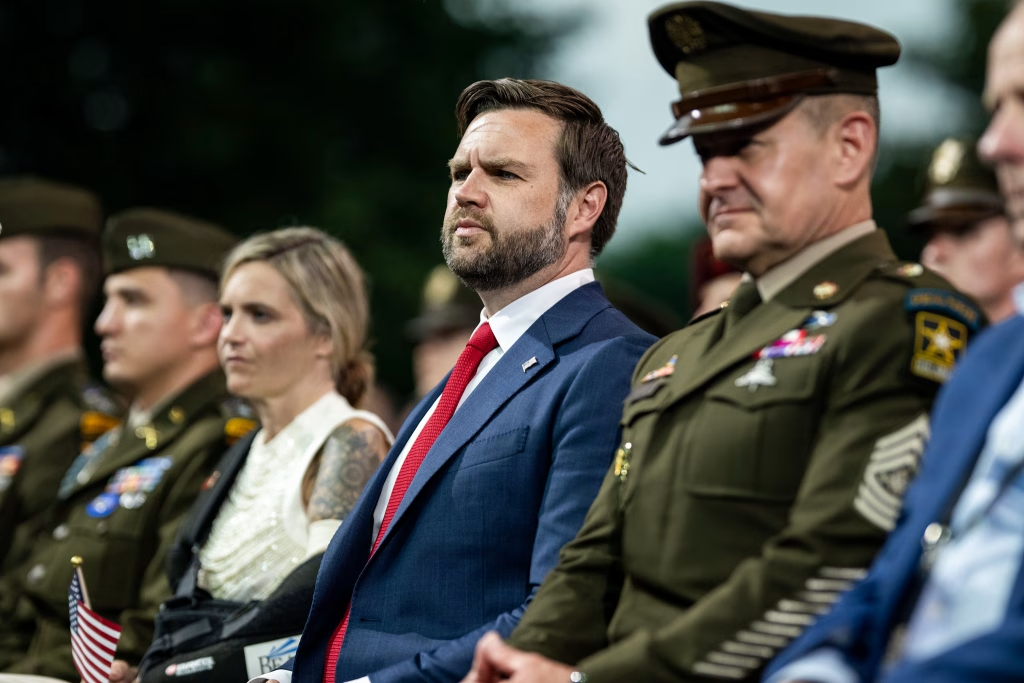
Off topic, but I liked the woman in the picture with the sleeveless dress, the top part of a tattoo sleeve showing, and what looks like a cover-up sleeve for the rest of her arm, standing there with the suits and uniforms.
@Michael Cain: I was struck by the, I think, command master sergeant. If he said jump, I wouldn’t waste time asking how high.
I think your argument is completely on the mark.
AND, I think it doesn’t work as retail political speech. I often ponder how to make ideas like this, which are inherently complicated, have simpler packaging, and simpler expression. I have a built-in audience in my head, which is the folks I grew up with (and still love).
I rather like this: If we are to choose to start a war, it is on us to make sure that what we are doing doesn’t make things worse.
I’m pretty happy with that. There are several writers here, perhaps some of them could do better. I’d love to see it.
Apropos of this, Peter Wehner wrote a piece in The Atlantic about misusing scripture to justify bloodthirstiness and brutality:
https://www.theatlantic.com/ideas/2026/04/pete-hegseth-unholy-war-iran/686789/
@Kingdaddy: Wehner is an interesting dude whom I’ve been following since the Bush years. While a conservative Christian, he has often pushed back against some of the excesses of the politicization of Christianity by the GOP. I remember him defending Obama’s Christianity against those on the right who questioned it.
The fundamental misuse of faith: Instead of using it for reflection and thought, using it to make ourselves feel powerful. Imagining oneself with a thunderbolt.
@Kylopod:
Nazis are brilliant villains – they’re white with top notch costumes, distincy but comprehensible accents, and they’re genuinely evil. I’d say there’s a direct line from Nazis to Darth Vader when it comes to impressively costumed bad guys. Sauron was just a big eye and Voldemort wears a nightgown.
As for comic books, Doom and Red Skull for sure. I don’t see the Japanese as having had a lasting effect, although by many accounts the actual Japanese field army was even more brutal than the Wehrmacht. Also, no Mussolini-themed villains.
The thing with Nazis is that they’re so over-the-top evil it’s hard to do a nuanced Nazi villain. I’ve written a lot of villains and they’re always layered with one exception, a villain I deliberately gave no backstory to, no redeeming features. Wiphand. So, just from the name you know: probably not a hero.
So, carrying water for the deranged whims of your mentally ill leader isn’t one of the approved reasons…? Shocking!
Arguing Catholic doctrine with the Pope does not seem like a good strategy.
There’s a time honored tradition of just ignoring the Pope when he speaks against your illegal and immoral war of choice (or the death penalty, or abortion, or serving the poor, or…)
And this all seems at odds with Vance’s team perpetually trying to get the NY Times to say that he was ‘skeptical’ about the war. This is a good, moral, just war that Vance secretly opposed — wait, did he oppose it because it was just? Is he the Antichrist? I’m just trying to follow the logic here.
Hey JD, actual Nazis are on your side now. Also white supremacists. And they’ve been mouthing some of the same old nasty memes while under your MAGA banner. Here’s something straight out of the Gospels: (paraphrasing) if you can’t trust a person with small matters, they cannot be trusted in large matters. You fail that test. Resign.
I’m not sure how popular the Pope is among Catholics worldwide. In Mexico he’s not just popular, he’s a superstar, regardless of which particular pope it is. When the last three visited here, it was a huge deal. Large crowds, people lining up for hours, cheering as he rode by, etc.
If he has a fraction of this popularity among Catholics elsewhere, including the US, then El taco just pissed off hundreds of millions of people (he’s very talented that way).
Also, it goes without saying*, that one can disagree and have an argument with someone else without resorting to insults and condescension. Of course, it would help is El Taco’s reasons for starting this war were known, and if the war aims were clearly expressed. More likely he has no clue. Or he thinks that leaving the objectives unsaid he can then claim any end result, no matter how bad, was the objective all along.
*the thing about stuff that goes without saying, is that someone inevitably says it.