American Political Violence Highest in Decades
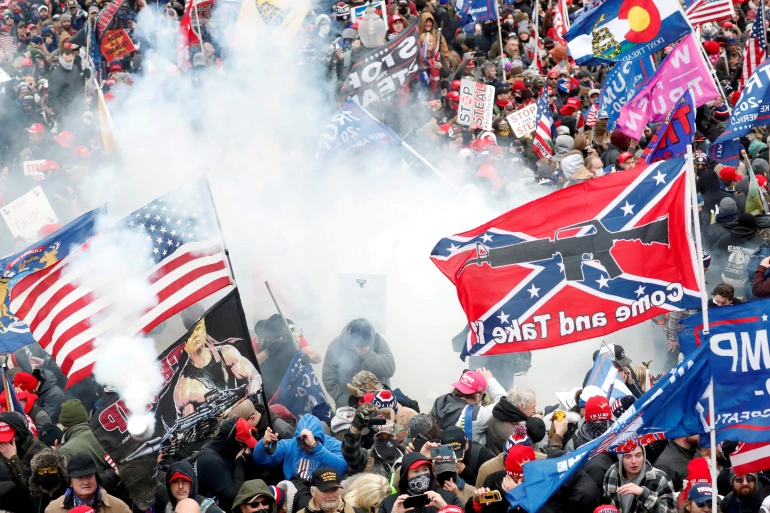
Sunday, reflecting on yet another assassination attempt on President Trump,* Steven Taylor noted that “We are Steeped in Violence.” He noted that mass shootings are on the rise, the Justice Department is talking of bringing back the firing squad, the Defense Department is hyping “lethality,” and radical rhetoric is everywhere.
The WSJ adds another data point in its report,”The Year of the Molotov Cocktail: American Antigovernment Violence Hits a 30-Year High.” After some scene setting, they note:
[D]omestic attacks and plots against the U.S. government are at their highest levels since at least 1994, according to data from the Center for Strategic and International Studies. For the first time in 20 years, they are coming from extremists on the left in greater numbers than the right, the center’s data shows. Of the 20 attacks and plots recorded in 2025, the center categorized 10 as originating from the extreme left and eight as coming from the extreme right.
Half the incidents from the extreme left last year appear to have been aimed at immigration officers or facilities in response to the Trump administration’s immigration crackdown. Another was an attempted attack on the Dickinson County Republican Committee Headquarters in Michigan.
Violence from the extreme-right has also climbed. A Democratic state lawmaker and her husband were killed in Minnesota last June. One police officer was killed in August after a man who had been critical of the Covid-19 vaccine fired 500 rounds outside the headquarters of the Centers for Disease Control and Prevention.
All told, three people were killed last year in attacks characterized as extreme right, while one died after an attack classed as extreme left. Classifying extremism attacks is a murky business. The CSIS data sorts attacks by political leanings where possible based on court documents and contemporaneous reporting. Perpetrators often don’t fit into neat categories. Some attacks on U.S. political figures, like the one on Democratic Pennsylvania Gov. Josh Shapiro, whose residence was set on fire last April, were allegedly motivated by events abroad.
D.C. police say the alleged attacker on Saturday night was carrying a shotgun, handgun and multiple knives. That fits a pattern: Firearms have increasingly been used to carry out plots and attacks, the data show.
However, last year’s weapon of choice was the Molotov cocktail. That crude, incendiary device (symbolic of revolutionary politics) featured in at least seven attacks or plots, including the one on Shapiro’s residence and two efforts to attack immigration agents.
Last January, a Massachusetts woman told Capitol Police that she planned to throw Molotov cocktails at the feet of then-Treasury Secretary nominee Scott Bessent. In another incident, a man set fire to a California post office, intending to “make a point to the United States government.”
They include this chart:
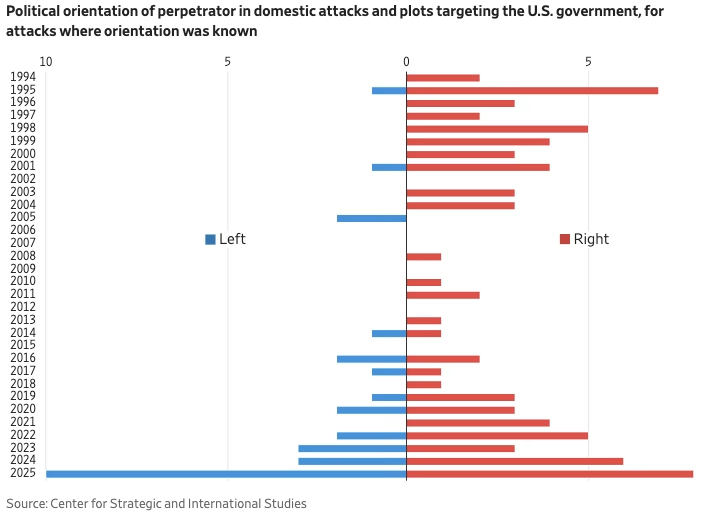
I’m dubious of assigning ideological motives to crackpots, but CSIS is a reputable, nonpartisan source. Regardless, the main point isn’t the ideological distribution of the violence but rather its frequency.
Like Steven, I both condemn the violence and understand it. We have increasingly cast our politics as existential. Every presidential election in my lifetime has been “the most important presidential election in our lifetimes.” And, as the parties have polarized and sorted, the stakes have certainly increased: every election is a referendum on the future of race relations, gay rights, trans rights, abortion rights, gun rights, etc.
At the same time, the safety valve that deligitimates violence in a democracy—elections—have become increasingly meaningless. Gerrymandered House seats mean few of the 435 districts are truly in play; the winner of the dominant party’s primary is all but assured of election. This is true for the Senate and Electoral College in all but a handful of states. So, for all practical purposes, most Americans have no real say come Election Day.
And that’s to say nothing of the counter-democratic, if not outright undemocratic, features that have been bolted onto the system. Voter suppression efforts by state legislatures to further skew outcomes. The routine use of the filibuster has made it almost impossible to pass legislation. A Supreme Court with an extreme partisan skew that tends to strike down policies enacted by Democrats at a much higher rate than those enacted by Republicans.
Violence is a tool of the powerless. And more and more people feel powerless.
*Granted that he was between terms the previous two attempts, they were still attempts to radically influence the shape of American politics through violence.

On 60 Minutes, Trump attributed political violence in general, and the WHCA incident in particular, to “Democrat hate speech.” That’s rich, coming from the guy who reacted to Charlie Kirk’s widow’s plea for love and forgiveness by saying he hates his enemies; deems Democrats and the media enemies of the people; and can’t go 5 minutes without blaming Joe Biden and Barack Obama for all of the country’s ills. The most divisive president EVER.
I’d argue that the people killed by ICE are victims of political violence. Apparently state sanctioned.
IMO at the root of the political violence lies wage stagnation and the impoverishment of the middle class.
Until recently there was, in addition at least, bread and circuses. But even the bread is becoming scarce, or at least stressful to get. The circuses come with ads, a streaming subscription, or both.
It’s one thing to be stressed out during an emergency, a rough patch, a natural disaster, etc. It’s quite another to be stressed out on a daily basis. Aside from also being fatigued for working long hours.
People who are satisfied with their lives don’t need violent solutions to their problems.
You know, the multiple knives I just don’t get. It really doesn’t make any sense to me. An odd detail to focus on, I know. But it’s strange. And the strange details are often the most informative.
@Charley in Cleveland:
Supporters of the lowlife thug who did this are super duper concerned about heated rhetoric and demonization:
Trump shares video of supporter saying “the only good Democrat is a dead Democrat” (CBS News)
Let’s never forget this gem from May 2020. As he soweth, so shall he reapeth.