The Enshittification of Everything
The rapid descent into AI-generated slop.
TechCrunch’s Sarah Perez proclaims, “Google Search as you know it is over.”
The era of the “ten blue links” is officially over.
At its Google I/O conference on Tuesday, Google unveiled an AI-powered overhaul of Search centered around a reimagined “intelligent search box” — what the company describes as the biggest change to this entry point to the web since the search box debuted more than 25 years ago.
Instead of returning a simple list of links, Google Search will drop users into AI-powered interactive experiences at times. Google is also introducing tools that can dispatch “information agents” to gather information on a user’s behalf, along with tools that let users build personalized mini apps tailored to their needs.
The resulting experience will no longer look much like how people envision Google Search, which has long been defined by ranked links to websites that have the information you need.
With the revamped Search experience, the new search box simply expands to accommodate longer, more conversational queries, rather than making you decide what type of search experience or mode you want to choose at the start of your query. It will also have a new AI-powered query suggestion system that goes beyond autocomplete to help people craft more complex and nuanced queries, Google says.
Google’s AI Overviews will also allow users to ask follow-up questions in AI Mode, beginning Tuesday, the company noted.
She goes into considerably greater detail, but you get the gist. I have mixed feelings about the move, as I prefer curating my own experience using trusted sources. But Google has already been moving in this direction in recent months. For example:
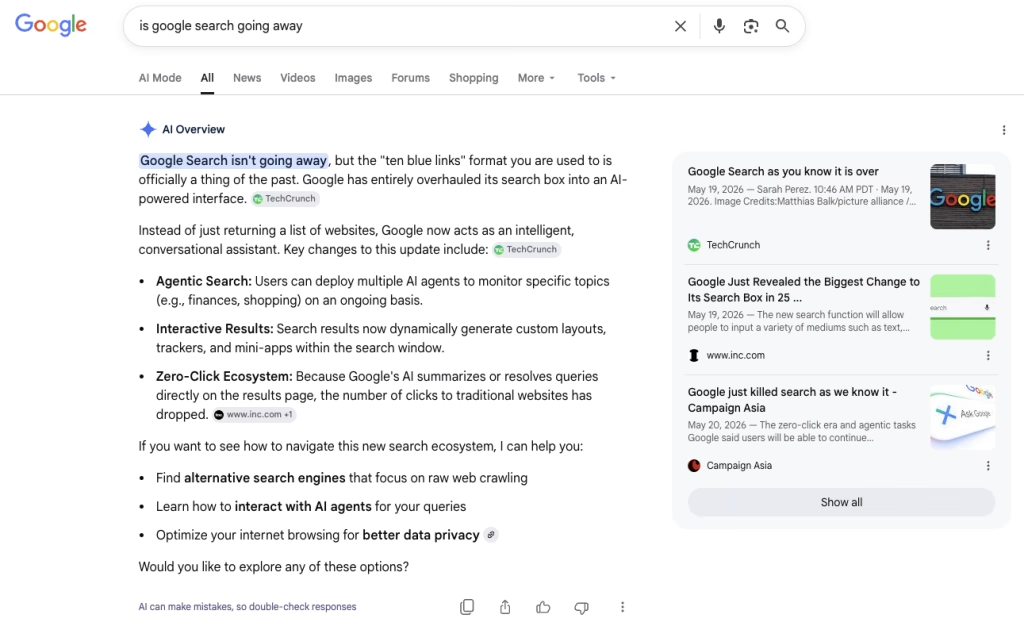
I suspect many, if not most, casual searchers would prefer this bulletized summary to actually having to comb through search results, click links, and read articles.
But it also highlights another concern that immediately came to mind. Perez addresses it late in her piece:
Combined, these changes will likely further decimate Google referrals to publishers, which have already been suffering from declining referrals due to AI Overviews. This has put some ad-dependent media operations out of business, and now things will likely get worse.
There’s little time left for publishers to adapt. The new search box is arriving this week, and generative UI is arriving this summer. Both are free. The mini-app-building feature and information agents will roll out first to Google AI Pro and Ultra subscribers this summer.
You’ll note that my search for “is google search going away” is already an AI summary of Perez’s report. While the report goes into greater detail than the summary, few searchers will bother to go through the trouble of finding and reading it.
On the one hand, Google is providing a transformative service here. Millions of people will get the information they need, quickly. On the other, it costs money to produce that information. TechCrunch, presumably, is paying Perez and others to do reporting and analysis. But Google and other AI-driven businesses are taking that information, without paying for it, and profiting from it. That, rather obviously, is not a sustainable model.
We’re already seeing reputable publishers relying on young, poorly paid staffers and removing editorial supervision in order to cut costs. Given the pressure to crank out large amounts of context, the quality is often quite low. And they’re already turning to AI to help them do it.
Soon, the Internet will be AI-generated summaries of AI-generated content.

Information should be free, dontcha know?
It’s predictable that search results will become less reliable over time. As some reliable sources disappear due to revenue declines and others, mostly the large media companies, begin to fence off their publications from the AI bots, the floodgates to low accuracy junk will begin to dominate.
Will have to see how this works. I very much like being able to find and read original literature. For stuff about which I have only casual interest this works fine. For example yesterday I had a cooking question and the pop-up AI answer was fine. I also had a question about a specific medical therapy. For that I wanted to read original stuff rather than the Ai interpretation.
As an aside, I have people here working on my house so I was trapped in one room reading and I got irritated with the current series I am reading so I turned on the TV and caught some interviews about AI. The people being interviewed are projecting changes much faster than I thought ie major changes in one year.
Steve
I have simply stopped using Google Search. I find Qwant.com superior now. (There are more options, though.)
The only downside is that Qwant lacks reviews and integration with Maps. But, of course, that is how Google deliberately tried to make their product irreplaceable. Still, Search and its associated AI slop are so unusable that I don’t care anymore.
I prefer a product that does at least one thing well.
Maybe the bigger point is that we, as consumers, don’t need to go along with the shit that the tech bros are pushing on us.
While they like to pretend otherwise, we don’t live in a company town.
As one Reddit user observed, the AI search removes the serendipitous discoveries of traditional search. That’s a net negative.
Yesterday on my office laptop, I stopped getting the AI summary when I searched Google (I do this a lot when programming, to find documentation and discussion of errors). Here at home though, I’m still getting it.
A bit of research suggested that Google had moved AI to an “opt-in” model. Where you go to google.com/ai to do your “ask the AI” thing.
This morning, though, I’m just getting AI responses. It’s a different computer. It’s very odd.
@Kingdaddy: I am more Google-positive and AI-positive than the median commenter here. I do agree with this take, though. Some noise in the results has a value. I mean, I would interpret how much noise there was as a measure of how much confidence to place in an answer, or how popular a particular answer was, in addition to the serendipity thing you have mentioned.