Stephen Colbert’s Swan Song
An epic finale.
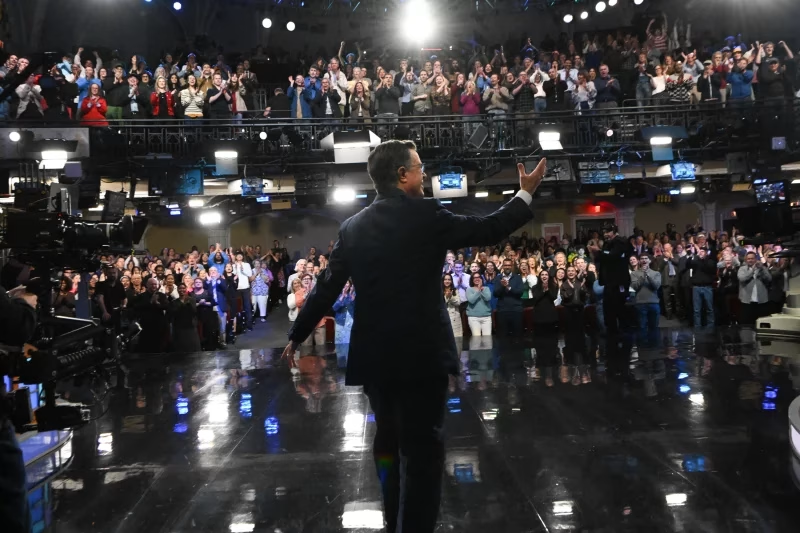
NPR’s Mandalit del Barco (“Stephen Colbert’s ‘Late Show’ ends with a swan song and a giant wormhole“):
Satirist Stephen Colbert ended the late night show he hosted for nearly 11 years on a whimsical and joyful note.
During his finale, he invited his audience, his crew and famous friends to dance with him onstage as he sang Hello, Goodbye with former Beatle Paul McCartney. Joining them was singer Elvis Costello, and musicians Louis Cato and Jon Batiste, the current and former band leaders for Colbert’s show.
And in the end, Colbert and McCartney together switched off the lights at New York’s Ed Sullivan Theater, where the Beatles made their American debut in 1964 and where the Late Show franchise was taped in front of audiences for close to 33 years.
Through the magic of visual effects, Colbert’s entire show and the theater were sucked into a giant green interdimensional wormhole that at times looked like the CBS logo to this reporter.
Joining Colbert for a bit earlier in the show were his late night host buddies Jon Oliver, Seth Meyers and the two Jimmies – Fallon and Kimmel – aka “Strike Force Five.”
“We came to say, we’re going to miss you,” Kimmel said. “Late night is not going to be the same without you.”
Meyers added, “Yeah, without you. Where will Americans turn to see a middle-aged white man make jokes about the news?”
NYT chief television critic James Poniewozik, whose first piece in that role was a review of Colbert’s “Late Show” debut, completes the circle (“End of a Colbert-a“):
When the CBS “Late Show” dies prematurely on May 21, Stephen Colbert will have been a late-night host for over two decades, long enough that this feels like the end of a cultural era. But what era exactly?
I’m loath to frame Colbert’s cancellation as “the death of late night” — that funeral has been going on for decades. The monoculture is long gone, the ratings smaller, the productions expensive. Yet the end of “The Late Show” still leaves us roughly where we were before David Letterman began the franchise in 1993, give or take a Jimmy Kimmel and sundry basic-cable shows.
[…]
But while his run lasted, Colbert presided over an era when political TV comedy could take a side and still succeed. Or actually, two eras, which almost perfectly coincided with his two shows: one that parodied politics, one made in a time when politics became a parody of itself.
COLBERT ARRIVED AS HOST of Comedy Central’s “The Colbert Report” in October 2005, with an eyebrow pointed like a javelin and a fully formed thesis statement.
“Stephen Colbert,” the conservative commentator Colbert had originated on “The Daily Show,” was the real Colbert’s own Bizarro reflection, a telegenic blowhard who knew nothing and said it as loud as he could. His first monologue introduced “truthiness,” a generation-defining coinage for the idea that it is more important for something to feel true than to be true.
[…]
In 2014, when Colbert was named to succeed Letterman at “The Late Show,” it seemed like one of those cultural handoffs in which the alternative goes mainstream. He would leave basic cable for the major leagues, becoming a normal host of a normal show in normal times. One of his first guests, it was announced, would be the early Republican presidential front-runner Jeb Bush.
But when late-night comics make plans, God laughs hardest of all.
A FUNNY THING HAPPENED while Colbert was between shows: Donald Trump rode down an escalator in Trump Tower and transacted his hostile takeover of the national spotlight. The run of Colbert’s “Late Show” would coincide with, as he described it on a recent episode, “10 years of Donald Trump worming his way into our brains.”
[…]
When he debuted in September 2015, Colbert resisted going wholeheartedly political.
[…]
Who could blame him? He’d spent years marinating in partisan commentary to satirize it. “To model that behavior, you have to consume that behavior on a regular basis,” he told me at the time. “It became very hard to watch punditry of any kind.” He seemed good and done with it, ready to show another side of himself as an entertainer and a person.
Besides, the wisdom of TV for decades was that political points of view were deadly on big-network late night. People liked “equal-opportunity offenders” like Johnny Carson or Jay Leno, but if you took a side, you’d lose half your audience — especially on Middle America’s TV home, CBS.
But for the first year or so, Colbert’s “Late Show” felt rudderless, avoidant. It wasn’t for the host’s lack of talent as a performer or interviewer. The show was upbeat and playful, but it lacked a focus.
President Trump gave it one. By early 2017, he was the star of every late-night show’s monologues. But there was a difference between Colbert’s jokes and his “Tonight Show” competitor Jimmy Fallon’s. Fallon seemed desperately to hope everyone could just laugh about the president’s hairdo and move on. Colbert’s jabs had a take guided by a moral compass. (That, incidentally, also helped define for viewers the “real” person hidden for years behind a persona.)
And that’s when another funny thing happened: “The Late Show” pulled ahead and away from “The Tonight Show” in the ratings. Credit Colbert’s talent but also a shift in the culture and media environment. The idea that political stances were poison in late night, it turned out, was a holdover of pre-cable, pre-internet TV. Carson could speak to everyone because there was an “everyone” to speak to.
[…]
If “The Colbert Report” was a lampoon of pundits who took themselves insufferably seriously, then “The Late Show” proved the right vehicle to make comedy of a politics of trolling and taunting. It was an old-fashioned talk show — with celebrities, musical guests and a band — taking on an era whose rhetoric was so extreme and aesthetics so garish as to be almost beyond parody. (Today, the White House social media regularly posts A.I. slop that makes the “Colbert Report” screaming eagle seem tasteful.)
[…]
Colbert began his “Late Show” analogizing Trump jokes to a sleeve of cookies; now we’re all like Homer Simpson in Hell’s Ironic Punishment Division, being force-fed doughnuts for eternity.
I was a regular viewer of The Colbert Report from maybe 2006 through its end in 2014. Despite being on the other side of the political aisle at the time, I found the show simultaneously funny and fair. The jokes were rarely cheap and, even in his fake blowhard persona, Colbert’s genuine decency shone through. His taking his show to Iraq in the summer of 2009 was a prime example. (And OTB made a cameo appearance in a March 2012 episode.)
Like the audience writ large, I’ve long since stopped watching the late-night shows. I gave Colbert’s initial few weeks at “The Late Show” a try, but gave up before he really found his footing there. But by that point, the entire enterprise was fraught. Donald Trump’s personality is so outsized that satirizing him is next to impossible. And the country is so polarized on him that even traditional comedy really doesn’t work: the jokes are just too easy and either get mean or redundant in a hurry.
Still, I hope this isn’t Colbert’s last act. He’s an enormously talented guy who, at 62, surely has more to give.

I rarely watched late night television, primarily because I’m an early to bed, early to rise person and always have been. But the brilliant decency of Colbert always appealed to me.
@Scott: For quite a number of years, I DVR’d both Colbert and Stewart. I gave up on the Trevor Noah incarnation of TDS pretty quickly, even though I very much like him both as a comic and personally.
I watch a fair bit of The Late Show with Colbert, but it’s all on YouTube the next day. Or maybe several days later.
@Scott:
Truth truthily truthed.
I usually red the Late Night roundup in The Guardian. Sometimes I watch the monologues on Youtube. But we don’t get US networks here (we did, long ago, through cable TV).