
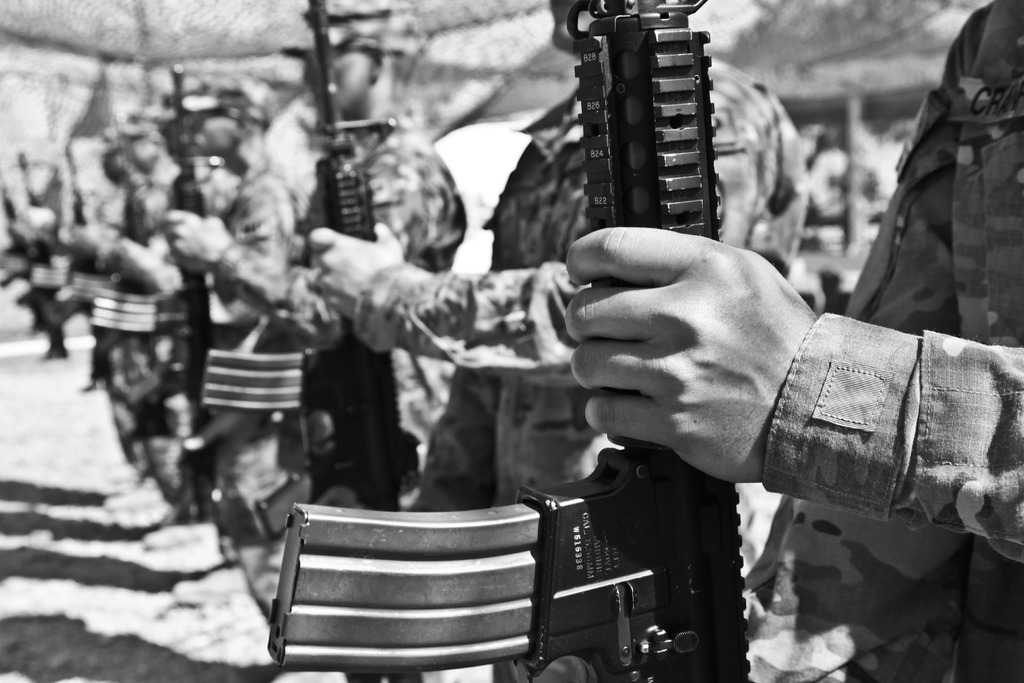
Unable to expand its roster sufficiently, the U.S. Army has quietly reorganized to maximize its combat power.
Army Reorganizes to Boost Its Combat Power (WaPo, A2)
The Army has embarked on a six-year plan to boost its combat power by 40,000 troops while reducing the number of noncombat jobs — essentially giving the nation more forces to deploy without a costly increase in the active-duty Army’s authorized strength of 482,000. But the plan is based on two key conditions that remain far from certain: That no major new demand will arise for U.S. soldiers at home or abroad, and that the Army will be able to recruit between 75,000 and 80,000 new soldiers each year through 2011 — a target the service missed this fiscal year, when 73,400 signed up.
Moreover, under the reorganization, the Army no longer plans to shorten tours for U.S. soldiers in Iraq from 12 months to six or eight. “We’ve found this year deployment to be optimum, and we don’t have any plans to change it,” Army Secretary Francis J. Harvey told reporters yesterday. Another reason for retaining year-long tours is that Army statistics show most casualties occur in the initial and final phases of the deployments, he said. Shorter deployments mean a greater number of soldiers will spend time in those dangerous periods.
The reorganization reflects an optimism within the Army leadership that progress in increasing the number of combat brigades — along with an anticipated “ramp down” of forces in Iraq — will allow a moderately sized Army to meet long-term global demands without undue strain. “Given our current missions as we understand it” — and barring the outbreak of a large-scale war or a domestic catastrophe — the Army will not ask Congress for an increase in its authorized troop level, Harvey said. Instead, the planned internal shifting of manpower “will give us the resources” the Army needs, he said.
The Army has increased the number of active-duty brigades — each with about 3,500 soldiers — from 33 in 2003 to 37 today, with plans to reach 43 by 2007. With those numbers, the active-duty Army, National Guard and Reserve units should be able to meet the goal set by the Army leadership of sustaining a pool of 20 brigades for worldwide missions.
The creation of the new brigades means that active-duty soldiers will replace many of the Army National Guard combat troops in the upcoming rotation in Iraq. Guard brigades in Iraq will fall from seven to two, Harvey said, as newly built brigades from the 101st Airborne Division, the 4th Infantry Division and other units flow in.
The plan is a pragmatic response to tight budgets — every 10,000 additional troops cost $1.5 billion a year — as well as to war-time recruiting difficulties that constrain efforts to expand the Army overall.
The Army’s divisional structure, which predates WWII, is now largely nominal, preserved mostly for the sake of heraldry. The fighting unit is now the brigade combat team, a much more flexible building block which allows the easy creation of joint task forces with skill sets appropriate for the particular mission.
Army Plans To Reorganize, Not Expand, To Meet Combat Needs (LAT)
Army Secretary Francis J. Harvey said Thursday that the Pentagon had no plans to ask Congress to permanently increase the size of the Army, saying that the service, strained by the wars in Iraq and Afghanistan, would be able to boost the number of available combat troops by reorganizing from within. Congress last year authorized a temporary increase of 30,000 troops in the Army, and senior military leaders suggested in recent months that they may try to make the increase permanent to help relieve the stress on the service. The Army has carried the heaviest burden since the Sept. 11 terrorist attacks. But Harvey said that by 2011, the Army plans to return to its previous troop level of 482,000 soldiers, barring another significant military commitment abroad.
Many in Congress have supported a permanent expansion for the Army. But Defense Secretary Donald H. Rumsfeld has long opposed an increase, in part because of the cost. The Pentagon estimates that permanently enlarging the Army by 30,000 would cost approximately $3 billion annually.
Army’s Plan for Growth Is Adequate, Secretary Says (NYT | RSS)
The Army can sustain current troop levels in Iraq and Afghanistan, even as it builds additional combat brigades, without personnel increases beyond the 30,000 already approved by Congress, the service’s senior civilian said Thursday. The senior civilian, Francis J. Harvey, the Army secretary, said in an interview with a small group of reporters that the number of active-duty personnel is scheduled to peak at 512,400 in 2007 before dropping back to 482,400 from 2008 to 2011. The number of people within the “operational” part of the Army – troops who can deploy to plan, command and carry out missions – will grow to 355,000 by 2007, from 315,000 in 2004, he said.
The increase in troops assigned to combat, combat service and combat support jobs will be accomplished through a variety of new personnel policies, including trimming the institutional and administrative branches to 75,000 people from 2008 to 2011, from 104,000 in 2004. Mr. Harvey also described plans to reduce the number of people assigned at any one time to training slots to 52,400 by 2011 from 63,400 in 2004.
Increasing the so called tooth-to-tail ratio has long been a goal of military reformers. We shall see how it goes. Certainly, many of the professional military education courses could be shortened, taken online, or eliminated altogether.









