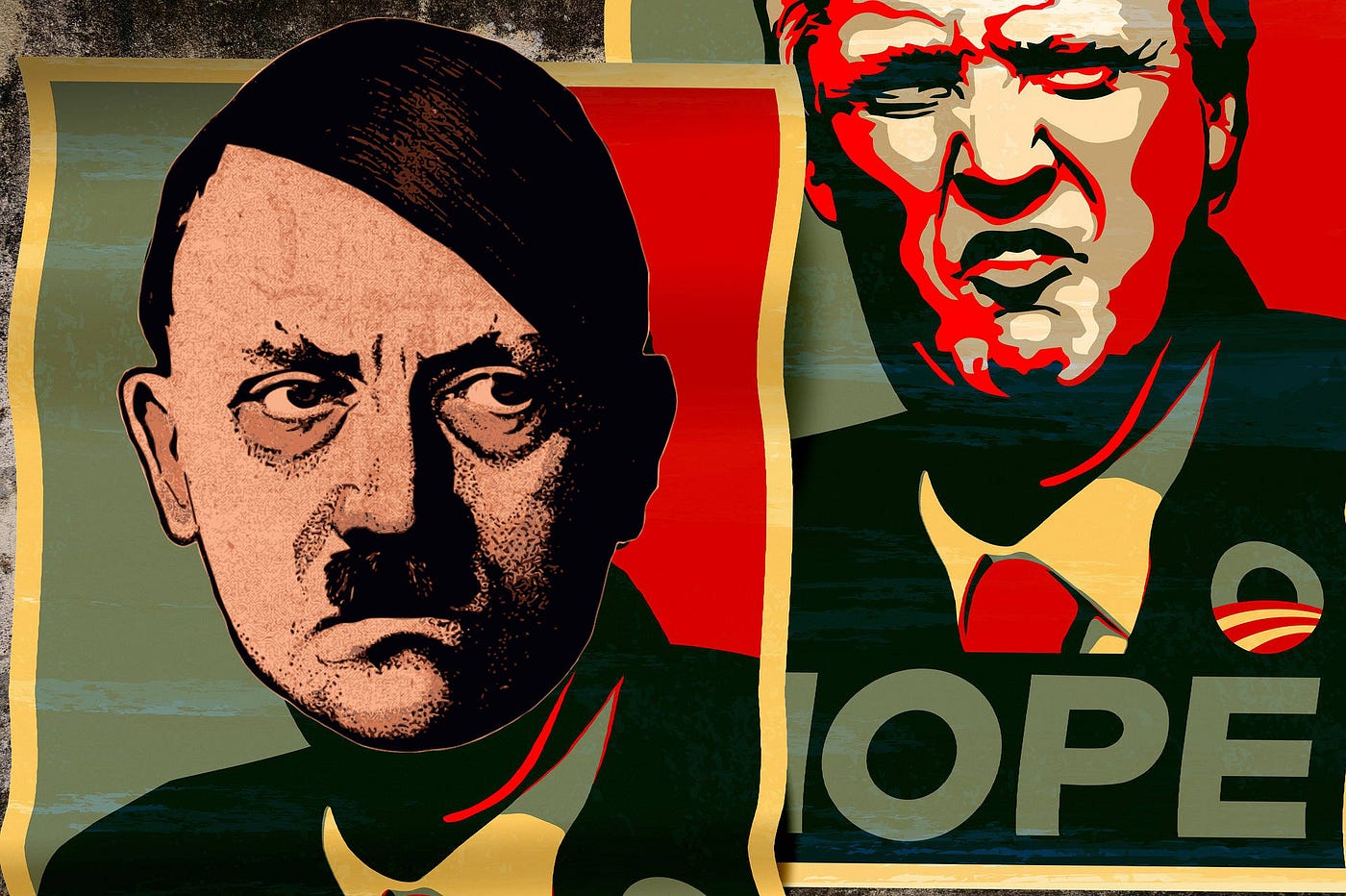

Famed Internet attorney Mike Godwin takes to the op-ed pages of the Washington Post to declare, “Yes, it’s okay to compare Trump to Hitler. Don’t let me stop you.“
The windup:
My very minor status as an authority on Adolf Hitler comparisons stems from having coined “Godwin’s Law” about three decades ago. I originally framed this “law” as a pseudoscientific postulate: “As an online discussion grows longer, the probability of a comparison involving Nazis or Hitler approaches one.” (That is, its likelihood approaches 100 percent.)
I first offered this axiom in 1990 as an observation about the discussions that had expanded like algal blooms in the nascent ecologies of online newsgroups. But within a handful of years, the law had taken on a life of its own, leaping beyond the internet and reaching into our broader popular culture.
I felt vindicated because I had designed Godwin’s Law to be viral — to self-propagate among internet users. I had a theory that an individual could have a positive effect on culture by making a catchy joke about people’s worst tendencies toward rhetorical excess. The next step was to release the joke into the wild, then hope others found it clever or funny enough to be worth repeating.
Years after I’d let Godwin’s Law run free, I learned that an actual political philosopher, Leo Strauss, had made a somewhat similar remark a few years before I was born about debates trending toward Hitler. Strauss (whom I confess I still haven’t read) chose to classify Hitler comparisons as a special instance of a particular logical fallacy: reductio ad Hitlerum. He was right about that, but he also missed how funny such an inappropriate comparison might be. The sitcom writers of “Seinfeld” didn’t miss the goofiness — consider their “Soup Nazi.” Similarly, I loved Mel Brooks’s subversion of Hitler in “The Producers” when I discovered it as a kid in the 1960s.
The pitch:
But when people draw parallels between Donald Trump’s 2024 candidacy and Hitler’s progression from fringe figure to Great Dictator, we aren’t joking. Those of us who hope to preserve our democratic institutions need to underscore the resemblance before we enter the twilight of American democracy.
And that’s why Godwin’s Law isn’t violated — or confirmed — by the Biden reelection campaign’s criticism of Trump’s increasingly unsubtle messaging. We had the luxury of deriving humor from Hitler and Nazi comparisons when doing so was almost always hyperbole. It’s not a luxury we can afford anymore.
Trump has the backing of political actors who are laboring to give the would-be 47th president the kind of command-and-control government he wants. Their proposals for maximizing and consolidating the powers of the federal government under a single individual at the top — provided that the individual is appropriately “conservative” — don’t sound like an American democracy. Sorry, sticklers, they don’t even sound like an American republic, either. What they sound and look like is a framework to enable fascism. And we have to thank Trump for being admirably forthcoming that he plans to be a dictator — although, he says, only on “Day One.”
What’s arguably worse than Trump’s frank authoritarianism is his embrace of dehumanizing tropes that seem to echo Hitler’s rhetoric deliberately. For many weeks now, Trump has been road-testing his use of the word “vermin” to describe those who oppose him and to characterize undocumented immigrants as “poisoning the blood of our country.” Even for an amateur historian like me, the parallels to Hitler’s rhetoric seem inescapable.
We’ve hashed out those statements before and all of the active front-pagers agree: Trump’s statements have morphed from proto-fascist to full-on fascism. While I have somewhat more confidence in the ability of our institutions to constrain the powers of a re-elected Trump than does Godwin, I nonetheless find him dangerous.
Godwin concludes:
Unsurprisingly, though, there are plenty of people who push back whenever anyone or anything gets compared to Hitler or the Nazis — or to related subjects like the Holocaust or the confinement of Jews to ghettos or the systematic killing of civilian populations. Masha Gessen relearned that lesson recently after writing an article for the New Yorker that raised — in an exemplary, thoughtful, nuanced way — the question of whether modern Germany’s promotion of a particular way of thinking about the Holocaust might forbid public questioning of the morality of Israel’s choices in retaliating for Hamas’s brutal Oct. 7 attack on Israel.
Gessen was set to receive the Hannah Arendt prize for political thought, but the New Yorker article troubled two sponsors of the event enough to pull out of the award ceremony that had been set to take place in Bremen, Germany. Although Gessen ultimately received the award, the controversy raises two peculiar Godwin’s Law-related issues.
First, has the sheer absurdity of so many hyperbolic Nazi comparisons in popular culture made us less vigilant about the possible reemergence of actual fascism in the world? I think it shouldn’t — comparisons to Hitler or to Nazis need to take place when people are beginning to act like Hitler or like Nazis.
Second, is Germany’s specific culture of remembrance — which privileges the idea that the Holocaust is unique — working, as some have said Godwin’s Law has also functioned, to quash appropriate comparisons of today’s horrors to the 1930s and 1940s? I continue to insist that Godwin’s Law should never be read as a conversation-ender or as a prohibition on Hitler comparisons. Instead, I still hope it serves to steer conversations into more thoughtful, historically informed places.
The steady increase in Hitler comparisons during the Trump era is not a sign that my law has been repealed. Quite the opposite. Godwin’s Law is more like a law of thermodynamics than an act of Congress — so, not really repealable. And Trump’s express, self-conscious commitment to a franker form of hate-driven rhetoric probably counts as a special instance of the law: The longer a constitutional republic endures — with strong legal and constitutional limits on governmental power — the probability of a Hitler-like political actor pushing to diminish or erase those limits approaches 100 percent.
Will Trump succeed in being crowned “dictator for a day”? I hope not. But I choose to take Trump’s increasingly heedless transgressiveness — and, yes, I really do think he knows what he’s doing — as a positive development in one sense: More and more of us can see in his cynical rhetoric precisely the kind of dictator he aims to be.
So, like Godwin, I think comparisons with Hitler or other awful historical figures can be useful. That democracies are fragile if not vigilantly safeguarded is an important lesson.
Most of the time, though, they’re not. For one thing, the reductio ad Hitlerum has been used so often in recent years that it’s been rendered ineffective. (More on that in a follow-on post.) For another, as. Godwin highlights, because of the Holocaust (not to mention starting a world war that killed some 50 million people!), Hitler is an awfully high bar.
Trump is corrupt politician who incited a riot and otherwise attempted to steal a democratic election. That’s bad! But he hasn’t invaded other countries or rounded up his political enemies, much less built concentration camps.
To be sure, Hitler didn’t become Hitler all at once. His transformation from a democratic candidate supported with a little thuggery to a full-on dictator took time. The slow roll into World War II began five years into his tenure. And he didn’t start rounding up Jews and others he deemed undesirable for another four years.
Still, while there were certainly authoritarian tendencies during Trump’s first term, those four years look really, really good compared to Hitler’s! And, even with the outrageous use of words like “vermin” and “poisoning the blood“—which very much echo Hitler and other fascist leaders—I don’t think anyone seriously thinks Trump intends to round up his enemies by the millions and murder them.
But here’s the thing: “Not as Bad as Hitler” isn’t and shouldn’t be the bar by which our presidential candidates are judged!
I’m not sure that pointing out that Trump’s shocking language has parallels with Hitler and Mussolini will persuade anyone who is persuadable to vote for Joe Biden. Biden seems to think so and has repeatedly called it out. Regardless, the mere fact that one of two men who have a realistic chance of winning the next election for President of the United States is calling tens (hundreds?) of millions of Americans “vermin” based on their political beliefs is itself a sufficient outrage to disqualify him from office, Hitler or no Hitler.
Similarly, the very institutions of American government that make it so damned frustrating make it nearly impossible for Trump to consolidate power in the way Hitler did in Germany. But the mere fact that Trump has so little respect for the rule of law, including the orderly transfer of power after free and fair elections, should be enough to disqualify him from being the nation’s chief executive, Hitler be damned. That his co-partisans in Congress have proven almost universally feckless in standing up against his transgressions makes voting for the opposition even more urgent.
Ultimately, while Godwin is right that comparison with Hitler is more appropriate with Trump than for any similarly prominent person in recent American history, I just don’t think it’s useful. At the end of the day, Trump isn’t Hitler and saying he is will simply cause anyone who is still contemplating voting for him next November off. Trump is bad enough on his own terms and should be attacked on that basis.