
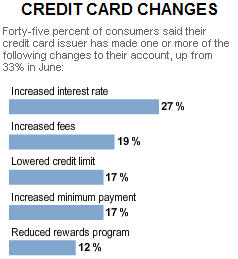
With regulation threatening their current business model, credit card companies are responding with new fees, Sandra Block reports for USA Today.
Starting next year, Bank of America will charge a small number of customers an annual fee, ranging from $29 to $99. The bank has characterized the fee as experimental. But card holders who have never carried a balance or paid late fees could be among those affected. Citigroup, meanwhile, has started charging annual fees to card holders who don’t put more than a specific amount on their cards, typically $2,400 a year. Other banks are charging inactivity fees if customers don’t use their credit cards during a specific period of time. You heard that right: You could be spanked for staying out of debt.
These fees are the credit card industry’s response to credit card legislation that will, among other things, restrict credit card issuers’ ability to raise interest rates on existing balances. Credit card issuers are looking for ways to raise income before the new rules take effect in February. During the first quarter, 27% of credit card offers included annual fees, up from 18% a year earlier, according to Synovate Mail Monitor, a credit card direct-mail tracking service.
Curtis Arnold, founder of CardRatings.com, says he expected credit card issuers to raise annual fees after the legislation was enacted. What he didn’t expect, he says, “was that good customers were going to be hit.”
This was entirely predictable. Credit cards aren’t a public service but rather a means of generating profits for businesses. If the government is going to close off revenue streams, card issuers are naturally going to look for others.
To be sure, I find some of the practices common in the industry to be unconscionable. Aside from the ability to retroactively change the APR on existing balances, the one that irritates me most is that, if a customer does not pay the balance in full by the due date, the “float” ends on subsequent purchases. That means customers are paying interest from the moment of purchase. It’s not widely understood and can come as quite a surprise.
But card issuers have to make money in a hyper-competitive environment. There’s a limit to how much they can charge merchants before they stop accepting cards (which is why, for example, many merchants won’t take American Express, which charges higher-than-standard rates). Only customers with very low IQs or very low credit scores pay annual fees. So, unless you’re carrying a revolving debt and paying the usurious interest rates, you’re not a particularly valuable customer.
Am I a “good customer”? I’ve used credit cards for more than two decades and have always been a convenience user. I’ve never intentionally carried a balance on any of my cards and tend to charge everything possible, even very small purchases, finding it faster and more convenient than paying with cash and accumulating lots of spare change. Further, I refuse to pay annual fees. So, the only way credit card companies make money off of me is from the fees they charge merchants. Indeed, since the two cards I use most generate points that translate into airline miles and hotel stays, they’re actually paying me to use the cards.
Because I charge a ridiculous amount each month, I likely generate enough in merchant fee payments to be worthwhile. But they’d almost certainly prefer someone who was carrying several thousand dollars in debt and making the minimum payment each month.









