AFP (“France counts cost of violent protests, 1,800 arrested“):
France was reeling on Sunday from widespread damage caused in violent protests the day before that saw 1,800 people arrested, a historic town hall torched and widespread looting.
The convulsion, which officials described as of extraordinary intensity, raised the stakes for President Emmanuel Macron, who is in his final months in power before elections to replace him in six months’ time. It followed weeks of student protests that had also turned violent at times.
Around “1,800 people have been arrested and now investigations are under way to identify the perpetrators of these acts so they can be brought to justice”, Interior Minister Laurent Nunez said on X on Sunday.
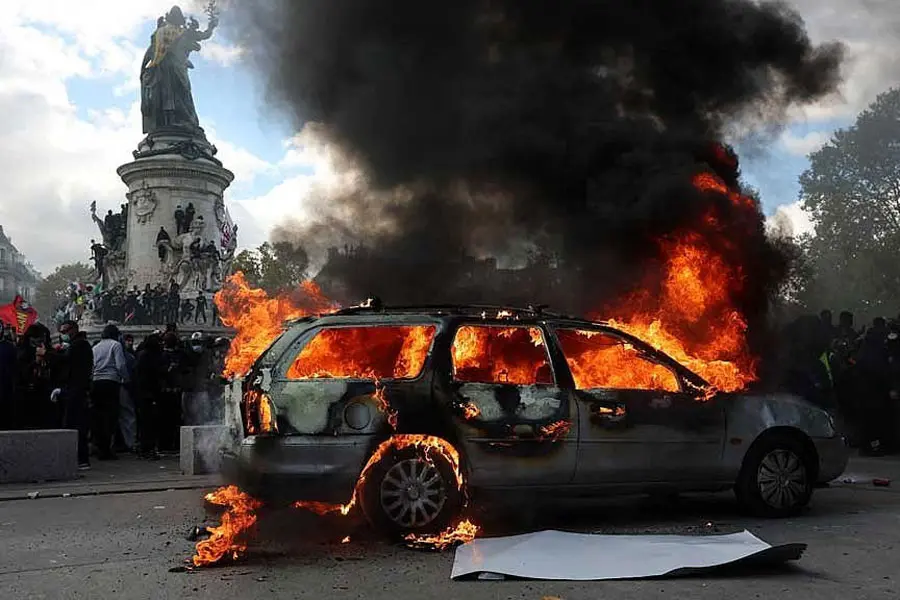
In Paris, where police said a “record” 855 people had been arrested, streets were littered with the burnt-out remains of barricades built by protesters using bikes and bins and other materials. Several streets had smashed shop windows and the remains of torched cars.
The capital experienced “a level of violence that we have never, I believe, seen before”, said Paris deputy mayor Lamia El Aaraje.
Paris and many other cities, including Marseille, Bordeaux, Nice and Strasbourg, had scores of shops pillaged by masked youths during the protests, which had been called against high inflation and the cost of living.
The city of Limoges lost its 19th-century town hall to a fire the local prefect, Maurice Barate, told LCI television had been deliberately set by “a wild horde”. The fire was only brought under control early Sunday.
Political recriminations flew over the scenes of destruction.
Macron’s centrist government and far-right presidential candidate Marine Le Pen both blamed “ultra-left” groups for the violence.
Far-left presidential candidate Jean-Luc Melenchon, who had prominently backed the demonstrations, late Saturday urged demonstrators to stay away from any looting, describing it as “contrary to our methods”.
Paris’s Socialist deputy mayor, Lamia El Aaraje, accused Le Pen’s party of fuelling tensions around the protests to further her ambition of becoming president next year.
The far-right National Rally party was “acting like a pyromaniac firefighter”, El Aaraje said.
US Vice President JD Vance also waded in, implying that the unrest stemmed from immigration.
“Western liberals imported the third world into France and other countries in the name of diversity and compassion. They ignored fundamental questions of assimilation and compatibility,” Vance said on X.
NYT (“France Reels After Largest Riots in Years“):
France was in a state of shock on Sunday, as citizens woke to streets littered with shattered glass and images of burned-out government buildings after the country’s largest demonstrations in years devolved into riots and looting.
The unrest on Saturday — which led to some 1,200 arrests — caused widespread damage to several symbols of the state, including a 19th-century city hall in Limoges, a town in central France renowned for its porcelain, that was largely destroyed in a nighttime arson attack.
Rioters attacked city halls from Lille in northern France to Marseille in the south, where masked infiltrators broke into the local government headquarters and tipped over a bust of Marianne, a symbol of the French Republic. Fires also destroyed a tourist office in Lyon.
On Sunday, that violence had given way to a political blame game. Government officials accused the far left of stirring up the unrest, and a left-wing leader blamed the government.
Prime Minister Sébastien Lecornu placed the blame for the chaos squarely on a far-left party, France Unbowed. The leader of that party, Jean-Luc Mélenchon, stands a chance of making the runoff in next year’s presidential election to succeed President Emmanuel Macron.
Mr. Lecornu accused the leaders of France Unbowed of sowing distrust in the police among student protesters all week. He also said that intelligence suggested that the earliest rioters — who started attacking riot police and government buildings before official protests were set to begin — were members of the “ultra-left.”
“Behind all this, there is obviously a political battle to wage,” Mr. Lecornu said, adding that the country was at “the point of no return.”
“It’s also time to choose sides,” he said. “Either you are in the camp of the Republic, and therefore of law enforcement — and of those who protect people and property and enforce the laws — or you are on the side of the rioters.”
In response, Mr. Mélenchon blamed the government. He said on social media that Mr. Lecornu was “responsible for the chaos” — due to “incompetence or a worst-case strategy to create a party of order that would make people forget his failure in public finances.”
Reuters (“France counts cost of worst unrest in years“):
France woke on Sunday to the wreckage of one of its most violent days of unrest in years after protests over high prices and public services left one demonstrator dead, hundreds of police injured and nearly 1,800 people arrested.
Nationwide demonstrations erupted into riots on Saturday, with a town hall torched, shops ransacked, and buildings covered in graffiti as violent groups clashed with police in cities across the country.
One protester died after suffering a cardiac arrest during demonstrations in Paris, where police made a record 855 arrests. Across France, more than 500 officers were injured, the interior minister said.
“It’s like a war zone here,” said Dutch entrepreneur Tije De Boer, who had come to Paris with his children to visit a friend and said the protests forced him to evacuate his hotel at Place de la Republique, which suffered major damage on Saturday.
More than half a million people joined marches in scores of cities, marking the convergence of a month-long student movement with broader social discontent against rising living costs and declining public services.
President Emmanuel Macron will address the nation at 2000 local time (1800 GMT) on Sunday, his office said.
The French love to riot, but this is incredible even by their standards.
As NYT Paris bureau chief Mark Landler explained a few days back,
The causes of the chaos may appear disparate. But they have a common root: France’s two-decade-long struggle to fund its state — a struggle now being exacerbated by high borrowing costs, surging fuel prices and political uncertainty.
France’s public finances, already fragile, are deteriorating, fanning fears in markets that France could be the next European country to tumble into a full-blown financial crisis.
The country’s debt stands at roughly $4 trillion, more than its entire economy. The annual cost of servicing that debt is projected to increase to roughly $100 billion in 2027. The street clashes have not helped traders’ jitters.
[…]
But France may be heading toward a reckoning: The country can no longer afford the generous welfare state that has always been so central to its identity.
“That is the deepest source of anger in France,” said Michel de Rosen, a French author and businessman. “We’re a country that can no longer do what it wants to do.”
Appearing on The Daily a little over a week ago, he added:
[T]hese protests are occurring against a backdrop of multiple other crises in France. So in addition to these protests over the state of France’s education system, you’ve got port workers who have barricaded ports over the rising price of oil. You have public sector workers who are striking over pay freezes. And you have an evolving financial and economic crisis in the country that all goes back to a very simple but very difficult reality for France, which is that this country can no longer afford its social welfare state.
[…]
rance, like a lot of European countries, offers very generous entitlements. They offer medical care. They offer free schooling. They offer allowances to families. They offer a lot of paid leave for mothers, for example.
But what really sets France apart is its pension system. France has one of the lowest retirement ages of any European country. It’s currently just over 62 years. And that allows French people to begin drawing on their pensions sooner than almost any of their European neighbors, and that saddles the French state with an enormous additional burden, one that even generous social welfare states like Germany, for example, don’t have.
[…]
France has been living beyond its means for something like 20 years now. And as it has continued to increase its spending on social welfare, it has racked up some genuinely gargantuan debts. Its total public debt is now larger than the gross domestic product of the country, and the government is running budget deficits that are greater than 5 percent of its GDP.
[…]
Elections are scheduled for April 18, and the leading contenders are extremists who want to wish the problem away, but differently.
Marine Le Pen is a populist. So she actually embraces economic policies that favor entitlements and that favor a large state role in the economy. In fact, one of Le Pen’s biggest promises going into this presidential election is to reduce France’s retirement age from 64 back to 62.
[…]
And of course, that’s extremely expensive. It adds billions and billions of euros to France’s pension burden. But what’s the great paradox here is that Marine Le Pen is running as a disrupter. And yet, in a funny way, she’s a bigger defender of the social welfare status quo in France than almost any other candidate for president. And that’s perhaps the great contradiction about the far right in France.
[…]
[T]he other rising candidate in France is on the far left, a politician named Jean-Luc Mélenchon, who, by the way, is actively embracing the students’ cause. He offers a prescription for fixing France’s debt problems that is every bit as unrealistic as Marine Le Pen’s, just in a different way. What Mélenchon wants to do is simply cancel a large chunk of France’s debt.
[…]
Well, you can’t, of course. You can threaten to cancel it, but the moment you do that, you sow chaos in the market. You cause a giant crisis at the heart of the European Union. So really, it’s not a credible remedy. But to a segment of France’s angry voters, it probably sounds like the kind of medicine they’d like to have. So this is where France finds itself, with a political establishment that is really not in any way facing up squarely to the problems that they need to deal with.
Politicians are loath to tell voters things they don’t want to hear. Telling them that they can have all sorts of wonderful things and someone else will pay for them is a surefire crowd-pleaser.
And that’s just when the penalty for telling them the truth is that they’ll vote for the demagogue. Add to that a political culture where they’ll riot in the streets for weeks on end, and you get, well, France.