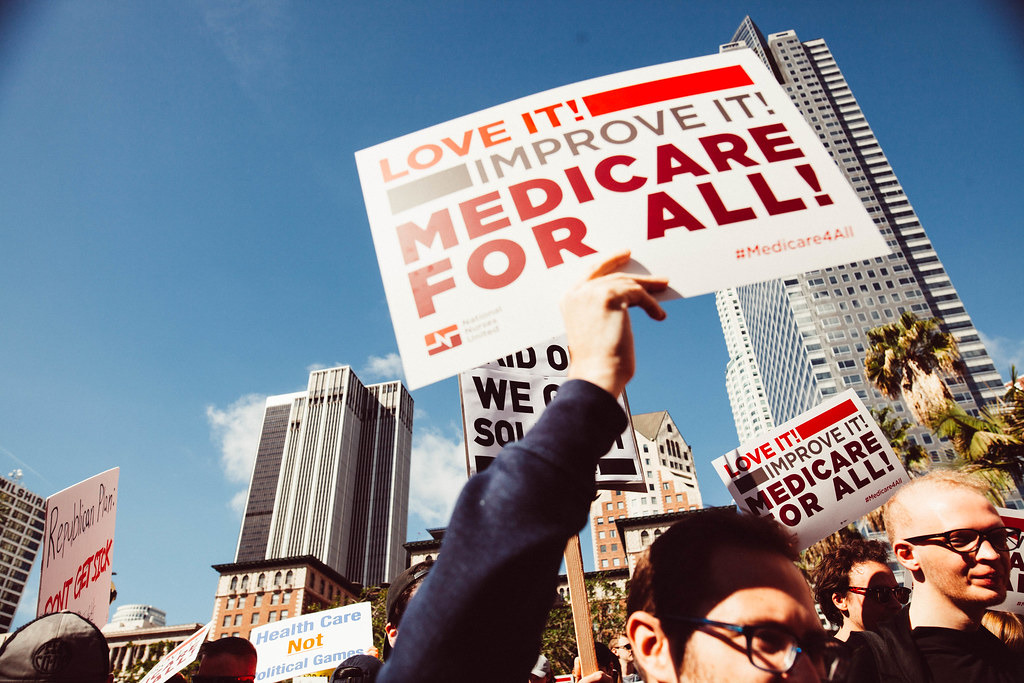
While hardly the midterm campaign’s centerpiece, the Democrats’ historic victory has brought an old topic back into the spotlight. Several reports have come to my attention in recent days.
AP, Nov. 18(“AP Exclusive: Bernie Sanders unveils how he’ll push for Medicare for All when Democrats take power“):
Sen. Bernie Sanders is preparing to use his return atop a powerful Senate committee to push for sweeping changes to the nation’s healthcare system, setting up an early test of how far Democrats are willing to go in embracing progressive priorities.
Sanders, a Vermont independent who caucuses with Democrats, is currently the ranking member on the Senate Health, Education, Labor and Pensions Committee and is expected to become its chairman when Democrats take control of the Senate in January. His agenda, first provided to The Associated Press, lays out the legislative implementation for proposals that he and progressive candidates championed on the campaign trail this cycle.
At the center is Sanders’ longstanding push for Medicare for All, a universal healthcare system that would be implemented over four years. The first year would lower the Medicare eligibility age from 65 to 55, expand coverage to include dental, vision and hearing care, and guarantee healthcare to children through age 18.
“This is no longer a utopian vision. This is where the American people are,” Sanders said in an interview with the AP.
[…]
Sanders has long championed a single-payer national health insurance program that would replace most private insurance with a federally administered system providing universal coverage.
His proposal for the new Congress lays out a four-year transition to that system, beginning with expanding Medicare eligibility and benefits. In the second year, the eligibility age would fall to 45, followed by 35 in the third year, before extending coverage to everyone in the fourth year.
“Transforming a system which is 18% of the GDP of America, you don’t do that overnight,” Sanders said of the transitional period.
But the costs of lowering Medicare eligibility are likely to lead to massive debate between the two major political parties as the national deficit stands at $2 trillion, or 6.2% of gross domestic product. And the Congressional Budget Office estimated in 2022 that lowering the age of Medicare eligibility to 60 would increase federal budget deficits by $155 billion over the 2026–2031 period.
[…]
Sanders also argued that Democrats could pass the first stage of the transition through budget reconciliation, a process that allows certain tax and spending legislation to advance through the 100-member Senate with a simple majority rather than the 60 votes typically required to overcome a filibuster. Democrats will have a 56-44 Senate majority when the new Congress begins in January, marking the party’s largest advantage in the chamber in 16 years.
WSJ, Nov. 24 (“Democrats Are Already Watering Down Their Medicare for All Plans“):
A Democratic push to enact Medicare for All is already narrowing in scope given the obstacles to reworking a private health insurance market that covers more than 200 million Americans.
[…]
The support of more than a dozen incoming congressional Democrats is unlikely to be enough to surmount the obstacles to enacting Medicare for All, chief among them President Trump’s veto pen. Far more candidates backed modest extensions of government-funded health benefits instead of a full Medicare expansion. Trump himself suggested meeting in the middle when he told the New York Post on Tuesday that he planned to meet with Michigan Democratic Sen.-elect Abdul El-Sayed on the issue.
“Healthcare is a $6 trillion industry,” said Dr. Ezekiel Emanuel, an oncologist who helped craft the Affordable Care Act. Moving all of that to the federal budget is “a major, major barrier.”
Roughly 20% of 64 winning battleground House and Senate Democratic candidates campaigned on Medicare for All, according to an analysis by the Progressive Change Institute, a liberal advocacy group based in Washington, D.C., while 60% campaigned on a Medicare Buy-In or public option that would expand access to government-sponsored coverage while preserving employer-sponsored and other private insurance.
The result is that the early plans taking shape in the House and Senate to expand healthcare are unlikely to provide the kind of comprehensive care voters heard about on the campaign trail.
[…]
House Democratic leader Hakeem Jeffries (D., N.Y.) recently endorsed universal health coverage for children, expanded dental, vision and hearing benefits under Medicare and lowering the program’s eligibility age, though he hasn’t specified how far he would lower it. Jeffries’s approach wouldn’t fundamentally replace the existing insurance system.
The proposals mark a notable shift for Jeffries, who earlier this year said he doesn’t support the Medicare for All proposal put forth by Sanders.
El-Sayed, who made Medicare for All a centerpiece of his campaign, said he favors guaranteeing public health coverage to all Americans while allowing private insurance, including employer-sponsored plans, to coexist. In an interview with The Wall Street Journal, he compared his approach to public education, where Americans can use the public system or pay for private alternatives. “It’s not about what you take away,” he said. “It’s about what you offer.”
[…]
Democrats themselves have yet to reach consensus on how far to expand government-backed coverage. Sen. Elissa Slotkin (D., Mich.) told reporters she supports adding dental, vision and hearing benefits to Medicare and was “willing to consider” changing the program’s eligibility age. Other moderates have questioned whether lowering the age would be worth the cost, and some have suggested that healthcare dollars could be better spent elsewhere.
Axios, Nov. 26 (“The pros and cons of Medicare for All“):
The boldest idea in health care comes down to one massive tradeoff: Guaranteed coverage for everyone in exchange for an eye-popping price tag and an ultra-messy transition.
Why it matters: Talk of Medicare for All is growing now that Democrats will control Congress next year with huge majorities in both chambers — so it’s time to take a clinical look at the pros and cons, based on what we’re hearing from policy experts who have studied it.
[…]
Democrats can certainly try to force votes on Medicare for All when they’re in power, although they’re likely to find that not everyone in the party is on board. Medicare for All backers are wagering that enough people are fed up with the existing health system that they’ll accept a bigger federal role providing coverage to more Americans, warts and all.
[…]
The pros: Medicare for All would replace the nation’s fragmented insurance system with universal coverage that’s subject to a single standard.
- That would, in theory, eliminate the gaps that left 28 million Americans uninsured last year, per most recent Centers for Disease Control figures.
- The coverage also would be “portable,” meaning you’d keep the same arrangement if you change jobs or move to a different state. For life.
- The basic benefits would also be more generous than in most existing forms of public and private insurance. And with no insurance co-pays and fewer out-of-pocket expenses, some households could come out ahead.
The cons: Sticker shock. The projected 10-year cost of implementing a plan is about $47 trillion, per the White House Council of Economic Advisers, which predicts higher taxes, more deficit spending and program cuts.
- There’s also the transition to a new system. Sanders’ 2017 Medicare for All bill called for current workplace coverage, Medicare Advantage, Medigap, Affordable Care Act plans and most existing Medicaid coverage to disappear in four years.
- How the government would take care of the continuity of people’s medical care during that time is a big unknown. (El-Sayed says he’s in favor of allowing “additional private insurance through unions or employers” so it’s not all wiped out.)
- Critics predict delays in getting medical tests and treatments — because once there’s no more cost sharing, doctors’ offices and clinics could get overwhelmed with new patients, possibly diverting care from patients with urgent needs.
Between the lines: Some Democrats are already convinced they’re not going to get Medicare for All, so they’re looking into narrower changes like lowering the eligibility age for Medicare — although even those ideas could cause headaches of their own.
Some form of universal healthcare coverage is a no-brainer. Our system is more expensive than that of any other OECD country and delivers poorer outcomes on many key measures. As of 2025, we spent $14,885 per capita on health, almost three times the OECD average of $5,967. Yet we have fewer hospital beds and doctors per capita and have a 2.7-year lower life expectancy and higher preventable mortality. While there are multiple ways to achieve universal coverage, it’s hard to imagine that anyone designing a healthcare system from scratch would come up with ours.
At the same time, most of us are reasonably happy with our current coverage. While the cost of my family’s Blue Cross insurance has gone up considerably, we’ve had little trouble getting claims paid and have faced no real obstacles to getting the services we need.
Quite naturally, people in that situation are hesitant to switch to a government-run system. Why, some federal bureaucrat would decide what treatment I could get! There would be death panels! That profit-seeking insurance companies are already making those decisions seems not to bother people nearly as much.
Beyond that, even those of us who are quite happy with our current insurance are only one layoff, career change, or employer decision away from having very different coverage. There is something rather peculiar about a system in which changing jobs can mean changing doctors.
And, yes, the cost to the Treasury of insuring 340 million Americans would be staggering. The notion that only billionaires would pay higher taxes is just silly. But, of course, we’re already spending enormous sums on government healthcare programs. Off the top of my head, there’s Medicare, Medicaid, CHIP, TRICARE, the VA healthcare system, and subsidized coverage for millions of federal civilian employees and retirees.
Further, any tax increases would have to be considered in the context of what we’re already spending on healthcare. I currently pay $840 for medical, $45 for dental, and $18 for vision insurance every month. Assuming comparable coverage, a $900 increase in my monthly tax bill would actually save me $3 while helping extend coverage to millions of Americans who are currently uninsured or underinsured.
I also find the argument that “doctors’ offices and clinics could get overwhelmed with new patients, possibly diverting care from patients with urgent needs” rather bizarre. To the extent that this happens, it would largely be because people who currently can’t afford the treatment they need would finally be able to get it. Certainly, there would be transitional challenges in meeting the increased demand for medical services. But surely the solution to an inadequate supply of healthcare is to increase the supply, not to ration access on the basis of people’s ability to pay. I struggle to imagine many people who would sit around a doctor’s office all day just for fun.
Regardless, while it’s unlikely that Democrats will be able to put together a veto-proof package—or even one Trump would sign—this cycle, putting forward a credible plan that gets us closer to universal coverage is a worthwhile endeavor.
The aspect of the Sanders vision that never made sense to me was the elimination of private insurance for services covered by the government plan. Most traditional Medicare beneficiaries already have some form of supplemental coverage to fill gaps in what the program provides. There’s no obvious reason why universal public coverage and a supplementary private insurance market couldn’t coexist.