

Did you know that the iPhone is made in China for a mere $6.50? It’s false but true:
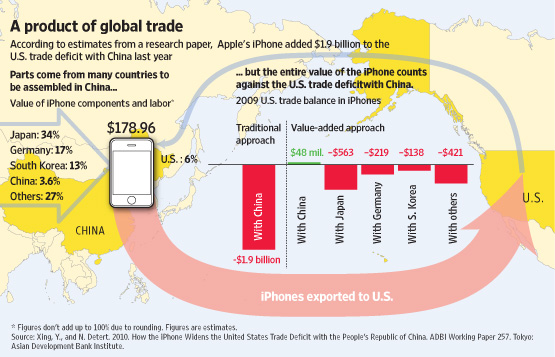
[T]wo academic researchers estimate that Apple Inc.’s iPhone—one of the best-selling U.S. technology products—actually added $1.9 billion to the U.S. trade deficit with China last year.
How is this possible? The researchers say traditional ways of measuring global trade produce the number but fail to reflect the complexities of global commerce where the design, manufacturing and assembly of products often involve several countries.
“A distorted picture” is the result, they say, one that exaggerates trade imbalances between nations.
Trade statistics in both countries consider the iPhone a Chinese export to the U.S., even though it is entirely designed and owned by a U.S. company, and is made largely of parts produced in several Asian and European countries. China’s contribution is the last step—assembling and shipping the phones. So the entire $178.96 estimated wholesale cost of the shipped phone is credited to China, even though the value of the work performed by the Chinese workers at Hon Hai Precision Industry Co. accounts for just 3.6%, or $6.50, of the total, the researchers calculated in a report published this month.
[…]
“What we call ‘Made in China’ is indeed assembled in China, but what makes up the commercial value of the product comes from the numerous countries,” Pascal Lamy, the director-general of the World Trade Organization, said in a speech in October. “The concept of country of origin for manufactured goods has gradually become obsolete.” Mr. Lamy said if trade statistics were adjusted to reflect the actual value contributed to a product by different countries, the size of the U.S. trade deficit with China—$226.88 billion, according to U.S. figures—would be cut in half.
Of course, this works both ways. Many “American” cars are made overseas and “assembled” here. Conversely, many “Japanese” and “German” cars and trucks are made right here in the US of A.
Stephen Green says, “We’re using 19th Century accounting to track 21st Century design, manufacturing and trade. Something’s gotta give.” Indeed.
Maybe that “something” is the very notion of trade deficits. Trying to determine what percentage of a given item is manufactured in one country or another is ultimately arbitrary and futile. But we get all hot and bothered by it, demanding that our politicians “do something” about it all. No matter, as George Will likes to point out, that he’s been running a trade deficit with his barber for years with neither of them dissatisfied in the least.
And what does it matter, really? What’s important isn’t whether the item is “Made in the USA” or “Made in China” but tangible things like collecting taxes, paying wages, and buying stuff.
Presumably, the US Government and its localities are collecting tax money on the sales of iPhones, whether in the form of tariffs on imports, levy on corporate profits, or at the point of sale. And American workers are being paid for their role in designing, marketing, shipping, and servicing the phones. And American consumers are improving their lives because, well, there’s an app for that.









