Iran War Now Targeting Oil and Water Production
Is no one thinking about the end state?
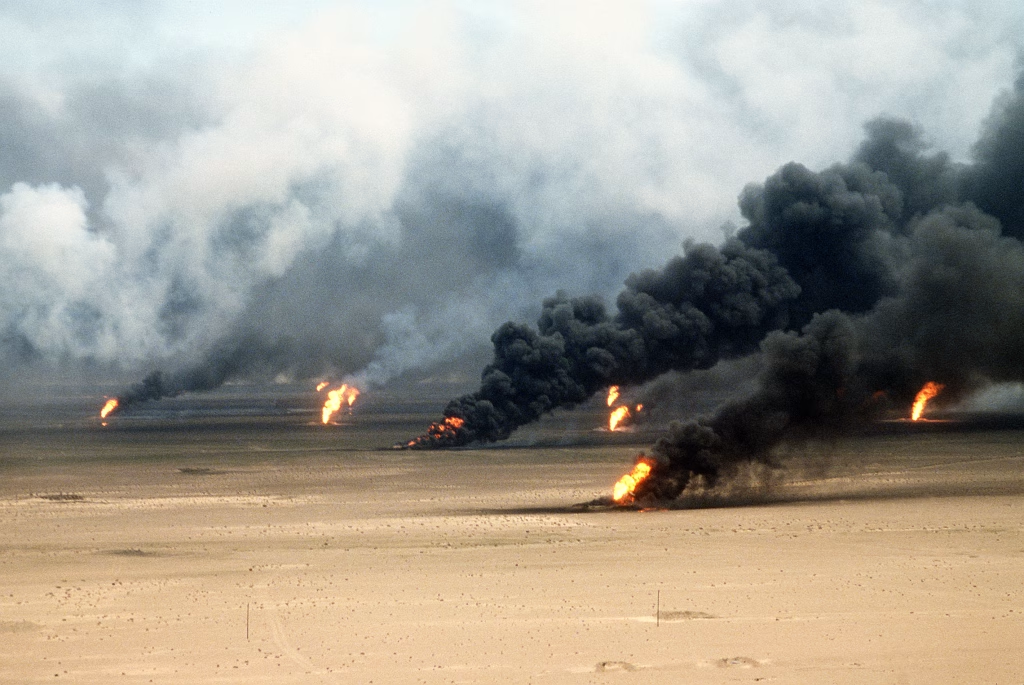
AP (“Iran accused of attacks in the UAE and Bahrain, while Tehran blanketed by smoke from Israeli strikes“):
Israel on Sunday struck southern Lebanon, Beirut and an oil storage facility in Tehran as the war in the Middle East keeps escalating, and Prime Minister Benjamin Netanyahu promised “many surprises” for the next phase of the conflict.
Iran also hit a desalination plant in Bahrain. Earlier Sunday, Iran’s Foreign Minister Abbas Araghchi said a U.S. airstrike damaged an Iranian desalination plant on Qeshm Island, warning that in doing so “the U.S. set this precedent, not Iran.” Such infrastructure is critical for drinking water supplies in the parched deserts of the Gulf.
An Israeli attack on an oil storage facility in Tehran sent up pillars of fire that could be seen in Associated Press video as a glow against the Saturday night sky. It appeared to be the first time a civil industrial facility has been targeted in the war.
The conflict has rattled global markets, disrupted air travel and left Iran’s leadership weakened by hundreds of Israeli and American airstrikes.
“Strikes on Iran oil facilities push the war into ‘dangerous phase,’ official says“
An Iranian official deplored the U.S.-Israeli strikes on oil facilities in Iran, saying they pushed the war into a “dangerous phase.”
“These attacks on fuel storage facilities amount to nothing less than intentional chemical warfare against the Iranian citizens,” Foreign Ministry spokesman Esmaeil Baqaei said in a social media post.
He said such attacks will have “devastating the environment, and endangering lives on a massive scale” because of hazardous materials and toxic substances they release into the air.
“The consequences of this environmental and humanitarian catastrophe will not be confined within Iran’s borders,” he said.
It’s one thing for energy and water production facilties to be collateral damage in a war and quite another for them to be intentionally targeted. Not only does it make rebuilding after the war geometrically more difficult, the latter may well be a war crime.
AP’s Annika Hammerschlag (“Oil built the Persian Gulf. Desalinated water keeps it alive. War could threaten both“) provides context:
As missiles and drones curtail energy production across the Persian Gulf, analysts warn that water, not oil, may be the resource most at risk in the energy-rich but arid region.
On Sunday, Bahrain accused Iran of damaging one of its desalination plants. Earlier, Iran said a U.S. airstrike had damaged an Iranian plant.
Hundreds of desalination plants sit along the Persian Gulf coast, putting individual systems that supply water to millions within range of Iranian missile or drone strikes. Without them, major cities could not sustain their current populations.
In Kuwait, about 90% of drinking water comes from desalination, along with roughly 86% in Oman and about 70% in Saudi Arabia. The technology removes salt from seawater — most commonly by pushing it through ultrafine membranes in a process known as reverse osmosis — to produce the freshwater that sustains cities, hotels, industry and some agriculture across one of the world’s driest regions.
For people living outside the Middle East, the main concern of the Iran war has been the impact on energy prices. The Gulf produces about a third of the world’s crude exports and energy revenues underpin national economies. Fighting has already halted tanker traffic through key shipping routes and disrupted port activity, forcing some producers to curb exports as storage tanks fill.
But the infrastructure that keeps Gulf cities supplied with drinking water may be equally vulnerable.
“Everyone thinks of Saudi Arabia and their neighbors as petrostates. But I call them saltwater kingdoms. They’re human-made fossil-fueled water superpowers,” said Michael Christopher Low, director of the Middle East Center at the University of Utah. “It’s both a monumental achievement of the 20th century and a certain kind of vulnerability.”
Much later in the piece, she notes:
During Iraq’s 1990-1991 invasion of Kuwait and the subsequent Gulf War, Iraqi forces sabotaged power stations and desalination facilities as they retreated, said the University of Utah’s Low. At the same time, millions of barrels of crude oil were deliberately released into the Persian Gulf, creating one of the largest oil spills in history.
The massive slick threatened to contaminate seawater intake pipes used by desalination plants across the region. Workers rushed to deploy protective booms around the intake valves of major facilities.
The destruction left Kuwait largely without fresh water and dependent on emergency water imports. Full recovery took years.
To say the least, we should not be emulating Saddam Hussein.

Who would be thinking about such things? Trump? Hegseth? The real estate developers Witkoff and Kushner? Trump and the real estate boys may well be thinking, ‘That’s some fine coastline for condo development,” but neither is capable of thinking beyond that. And Hegseth has never had a thought more complicated than, “Bro, beer me.”
The only other voice with any influence whatsoever is Marco Rubio. Rubio is blinded by the prospect of a free Cuba, in which scenario he, personally, would be a conquering hero raised high on the shoulders of Cuban ‘exiles’ in Florida. Exiles who, for the most part, have never stepped foot in Cuba. Of course little Marco is a fool to imagine that Trump will ever allow him to claim any credit for anything at all.
We will make a desolation and we won’t even be able to call it peace.
How long before Iran, or more likely an Iranian proxy, targets the US homeland?
I have little faith in Fatso’s ability to protect us.
This makes me think further about my assertions that this administration thinks like all this is a movie. In action movies and superhero films, the fights cause insane levels of damage (think what happened to Metropolis in the most recent Superman movie), but that is all ultimately inconsequential, and in the sequel, it was like a reset button was hit.
Worrying about consequences is for suckers, it would seem.
Plus, to my point in a comment in another thread this morning, apparently blowing shit up in the “good part” of war.
@Michael Reynolds:
Bibi Netanyahu has some influence and some unique ideas about end state.
Exactly.
“Sodium Perchlorate, etc.”
@Daryl: “How long before Iran, or more likely an Iranian proxy, targets the US homeland?
I have little faith in Fatso’s ability to protect us.”
Hey, just because Kash fired all the FBI agents dedicated to threats from Iran is no reason to think we’re not perfectly well protected.
Targeting oil and desalination facilities is a completely predictable response when the regime is afraid it won’t survive.
Serious people would have asked people who know something about the regime and the region about the likely scenarios, including this one.
Serious people would have wargamed out the operation. No doubt this would have appeared as an option for the red team.
But we don’t have serious people in power. The President can wage war on a whim, with no preparation. And here’s where we are, suffering entirely predictable outcomes to an aggressively stupid and heedless war. The little people will have to clean up the mess, as they always do.
Given the situation that Iran is in, destroying the oil production/transportation infrastructure, along with desalination makes perverse sense. The felon and Israel aren’t going to stop till we run out of weaponry, destroying ME oil/gas production ensures a level of pain will be felt by the world.
I’m confident the Israelis are thinking of the end state but it’s not the same one as us. We think the place should be re-made, “Make Iran Great Again!” said Trump. But the Israeli government has something else in mind.
@dazedandconfused:
Given the lack of such thinking in re: Gaza, I have my doubts.
@Steven L. Taylor:
I suspect they may have the same end-state for Iran in mind, actually. The current government would prefer to “mow the grass” with Round Up.
@dazedandconfused:
Beyond extensive acquisition of Palestinian land and ethnic cleansing in service of building a Greater Israel, the Netanyahu regime’s end game is lacking. Climate change is coming on hard. The region’s water resources are limited and dwindling. Portents for food insecurity are growing. The Israelis are still woefully out numbered. And the Gulf States’ resources, technology, and global geopolitical/economic influence is zooming.
And there’s Bibi and his supporters scrapping about land, when they should have been building regional community instead of regional enmity. Totally understandable that both Netanyahu and Trump flock together. They both run a “short game” but long on “I, me, my.”
Israel blows up fuel depos in Tehran. U.S responds with “WTF?” Is there any question of who is the tail wagging the dog here?