
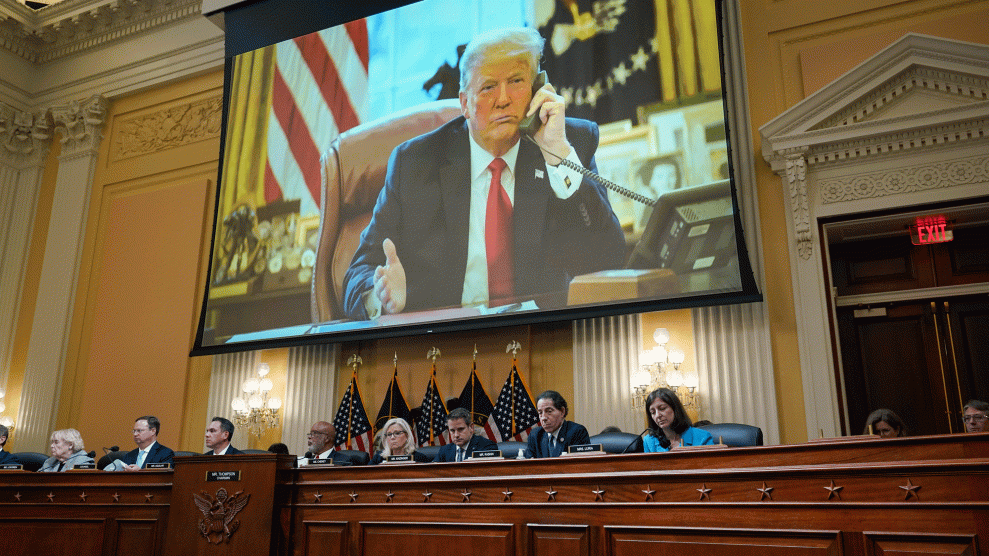

President Biden‘s name appears on today’s Washington Post op-ed titled “What Americans should remember about Jan. 6.” The nut ‘graphs:
[W]e should not forget. We must remember the wisdom of the adage that any nation that forgets its past is doomed to repeat it. We cannot accept a repeat of what occurred four years ago.
An unrelenting effort has been underway to rewrite — even erase — the history of that day. To tell us we didn’t see what we all saw with our own eyes. To dismiss concerns about it as some kind of partisan obsession. To explain it away as a protest that just got out of hand.
The rest is a recitation of what pretty much everyone here believes about that day. Alas, it is a message that Biden, Vice President Harris, most Democratic politicians, and even a few erstwhile Republican politicians have ben hammering for four years. And, of course, the fellow who tried to foment an insurrection to steal that election is about to have his actual victory in the subsequent election certified with Harris in the humiliating position of presiding over the count.
Frustrating and dispiriting though that may be, I would not go so far as John Ganz, who proclaims, “January 6th was Successful.”
Today is January 6th and I feel a certain tedium and impatience about marking the anniversary of the Capitol Hill attack four years later. There seems to be a growing consensus that it, along with all of Trump’s other menaces to constitutional rule, is not worth taking seriously. The line on January 6th is that even if it was a coup or insurrection attempt, it was a farce and a failure. But this is wrong. In retrospect, it was a great political success for Trump. Not only because he got away with it, but because of how he could fracture and polarize the response. Attention paid to it is now considered sour grapes: part of a discredited political strategy and a remnant of liberal sentimentalism that is fast going out of style. He came back from it and rallied even those who initially condemned it or were frightened by it to his side. And he made the defense of the constitutional order a partisan issue.
We are accustomed to repeating now that Trump’s coalition is fragile or that there are intrinsic weaknesses in his governing style. True so far as it goes, but how fragile is a coalition that reformed and expanded after he attempted to overthrow the U.S. government? And how weak is someone who managed to suffuse the atmosphere with a sense of total credulity about himself and total cynicism about his opponents? This is an attitude now shared even among those who do not consider themselves his supporters. There is now a process of retrospective legitimation, as if the vote somehow wipes the slate clean, and makes lies the truth. There is a kind of spiritual Gleichsaltung going on: Trump is now the man and to continue one’s criticism forcefully makes you a sad deadender. Resistance liberalism is turning into Vichy liberalism and the NeverTrumpers suddenly discover they were AlwaysTrumpers. Some of that can be blamed on the failure of the media or the opposition party, but some credit has to be given to Trump himself. The great insult comic has landed his jibes: he has embarrassed the opposition, he has humiliated them. They are forced to laugh along now or look like spoilsports. Looking back in the 1960s, the Italian socialist Pietro Nenni remarked, “Everyone in Italy agreed in not taking Fascism seriously.” Not being taken seriously is probably the thing that helps Trump the most, on the one hand, it drives him, it torments him and everything he does can be read as a demand to be taken seriously, but it is also his greatest political gift and strength, it allows him to glide.
On January 6th Trump successfully broke the system: there is no neutral, recognized arbiter of the law and the constitutional order, there is just raw politics. That does not mean he will necessarily prevail in every political contest, but he should never be seen as the underdog. His political skills should not be underestimated. His appetite for risk has been rewarded. Why would he not be emboldened to try other desperate stratagems since he’s faced no repercussions thus far?
I would argue that insurrection was not successful in either a literal or figurative sense. Most obviously, because the system held and Trump was in fact ousted from office at the appointed hour. And, to the extent roughly half the country doesn’t care enough about a failed attempt to steal the election to punish the man who did it, it’s not a victory for the riot but simply a sign of an apathetic polity. Binary choices have that impact and the malaise predates Trump by decades.
In some sense, Trump’s re-election does “wipe the slate clean.” That Senate Republicans failed in their duty to vote guilty in the second impeachment trial is shameful, if not the least bit surprising. That the wheels of justice in the various federal investigations of Trump ground too slowly is frustrating but the nature of the system. But, the voters, with four years to absorb the findings of the January 6 Committee and relentless speechifying and advertising about the threat to democracy posed by Trump nonetheless chose him over Harris. He is, therefore, entitled to exercise the powers of the presidency for another four years absent new transgressions.









