
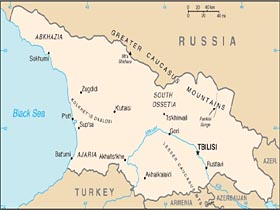
 Ari Rusila argues that the bloody crisis in South Ossetia is directly tracable to Western backing of Kosovo’s secession. While we considered Kosovo’s claim “unique,” he argues, “Moscow and [a] few other capitals considered the move a serious step toward the degradation of international law and the triumph of arbitrary approaches to the resolution of global problems.”
Rusila correctly notes that “The root of the problem is that the international community cannot agree on rules for the independence of small regions.” I disagree, however, that “the best exit strategy from Pandora box is to return Kosovo case from where all today’s development started.”
I say that even though I was deeply torn on the question of backing Kosovo independence at the time, calling it “a classic case of the logical dictates of Realpolitik clashing with our moral positioning and building soft power equity.” What’s done is done at this point: Kosovo is independent. Indeed, the very essence of Pandora’s box is that, once opened, it can’t be closed again.
But Russia warned us then that “it will set a dangerous precedent for secessionist movements across the former Soviet Union, including Chechnya and Georgia.”
Daniel Larison is sympathetic to their current position:
To understand the Russian response, imagine how Americans would respond if Serbia launched an attack into Kosovo while our KFOR troops were still there, and then imagine how much stronger the U.S. response would be if, in the course of the attack to retake the province, our troops took casualties because of that attack. These are the unfortunate, ruinous things that happen when state sovereignty is reduced to a meaningless phrase by past interventions and partitions, and the governments that attacked Yugoslavia over its internal affairs and partitioned Kosovo have no authority to find fault with what Russia is doing now.
As my colleague Dave Schuler noted in an update to that post, and several times elsewhere, the real question is: “What is the unit of measure for national sovereignty? The county? The village? The city block? The individual?” It’s an age-old question (going back to at least the Peace of Westphalia) and one that remains unsettled.
Writing back in November 2006, ISN Security Watch editor Jen Alic noted that the Western media treated the two cases as wildly different, championing the cause of Kosovar independence while totally dismissing South Ossetia’s claim, but argued that the cases should in fact be linked.
Legitimacy and Self-Sufficiency
Neither South Ossetia nor Kosovo has ever been an independent nation, as far back in history as is rationally warranted to look. Both have at times enjoyed various levels of autonomy. Both have minorities whose rights may not be ensured and whose safety is anything but guaranteed. South Ossetia is home to 14,000 ethnic Georgians, while Kosovo is home to an estimated 120,000 Serbs, who live in fear in UN-guarded enclaves. There is no indication that either minority will be offered adequate protection or adequate rights. And conflict could result from a decision either way.
[…]
Furthering the comparison, neither Kosovo nor South Ossetia are necessarily prepared for independence, though Kosovo can expect help from its kin in neighboring Albania and the international community, while South Ossetia can expect some, though likely limited, aid from neighboring Russia. In economic terms, it is unclear how either could support their populations, however small. Industry is for all intents and purposes absent in both locales, while the majority of income is rumored to be made on the black market, largely through arms and drug smuggling.
Geopolitics
Alic observes that, “South Ossetia is a buffer for Russia against the Western-leaning Georgia, while Georgia is a buffer for the US against Russia” and that, “While Russia has played coy with the South Ossetia issue, refraining from recognizing its last declaration of independence in the 1990s and officially supporting Georgia’s territorial integrity, it has clearly supported the separatists there.”
At the same time, however, oil is a major factor in South Ossetia and not in Kosovo.
The Caspian Basin is a place of intense competition, with the US, Russia and China all vying for a stronger foothold. In July, the US$4 billion Baku-Tbilisi-Ceyhan (BTC) pipeline was inaugurated. The BTC pumps Caspian Sea oil to the Turkish Mediterranean, bypassing Russia and Iran. It should supply 1 million barrels of oil per day by 2009. It passes through the Georgian capital, Tbilisi, and also runs rather close to South Ossetia.
BP, formerly British Petroleum, has a 30.1 percent stake in the pipeline. The pipeline was commissioned by a BP-led consortium that includes energy companies from the US, Norway, Turkey, Azerbaijan, Japan, France and Italy. The BTC is a key to Western energy security. Upsetting Georgia – a major player in this energy security – by allowing South Ossetia to declare independence and be internationally recognized would be risky.
She also offered this prediction:
Russia, for its part, would be more than happy to see Kosovo granted independence – this, despite its support for its Serb allies and Serbia’s territorial integrity – if only because it would set a precedent for similar moves in South Ossetia, Abkhazia (Georgia’s other breakaway republic), and Moldova’s breakaway republic of Transdneistr.
It’s safe to say Russia was far less than happy. But, yes, it certainly set a precedent.
____________
Background:









