Latest YouGov Polls
Trump is not popular.
Via YouGov.
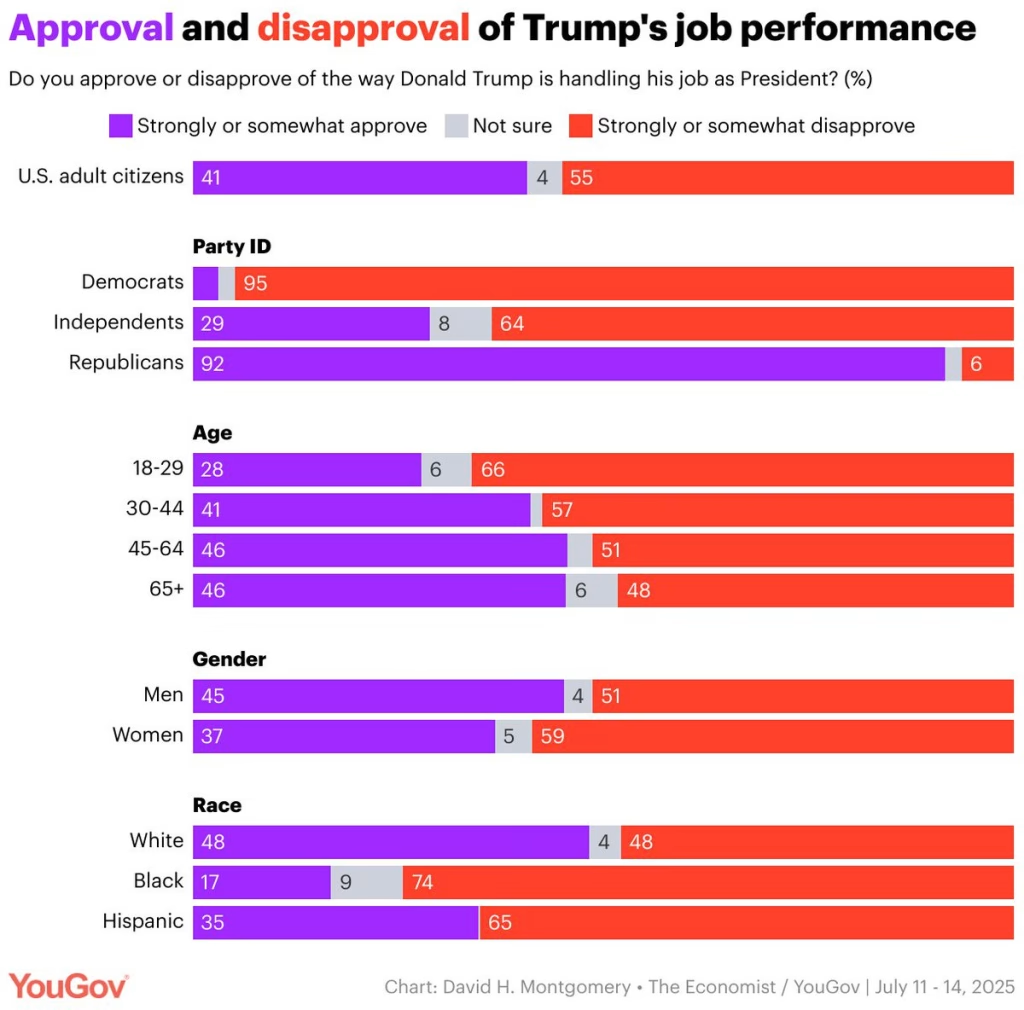
He wins Republicans (natch) and that’s it. He even loses men and is tied with whites and those 65+ (accounting for MOE)!
Side note: it is striking that Hispanics are the most decisive group–zero are “not sure” about their opinions of Trump!
Keeping in mind that these days it is expected that the baseline for popularity is around the 50/50 due to polarized partisanship, the reality is that Trump is an especially unpopular president. The fact that he is doing what he promised, and a lot of people don’t like it (note “independents” above in particular), adds credence to the notion that he won in 2024 as much because of general frustration with the incumbent administration as it was anything about Trump himself. This is not to say he and his policies don’t have ardent supporters (they do), but that those policies are less likely the reason he won than, again, a global anti-incumbency mood due to COVID and inflation.
In regards to Biden, note below that he was simply quite unpopular towards the end of his term. Presidential elections tend to be a referendum on the incumbent party.
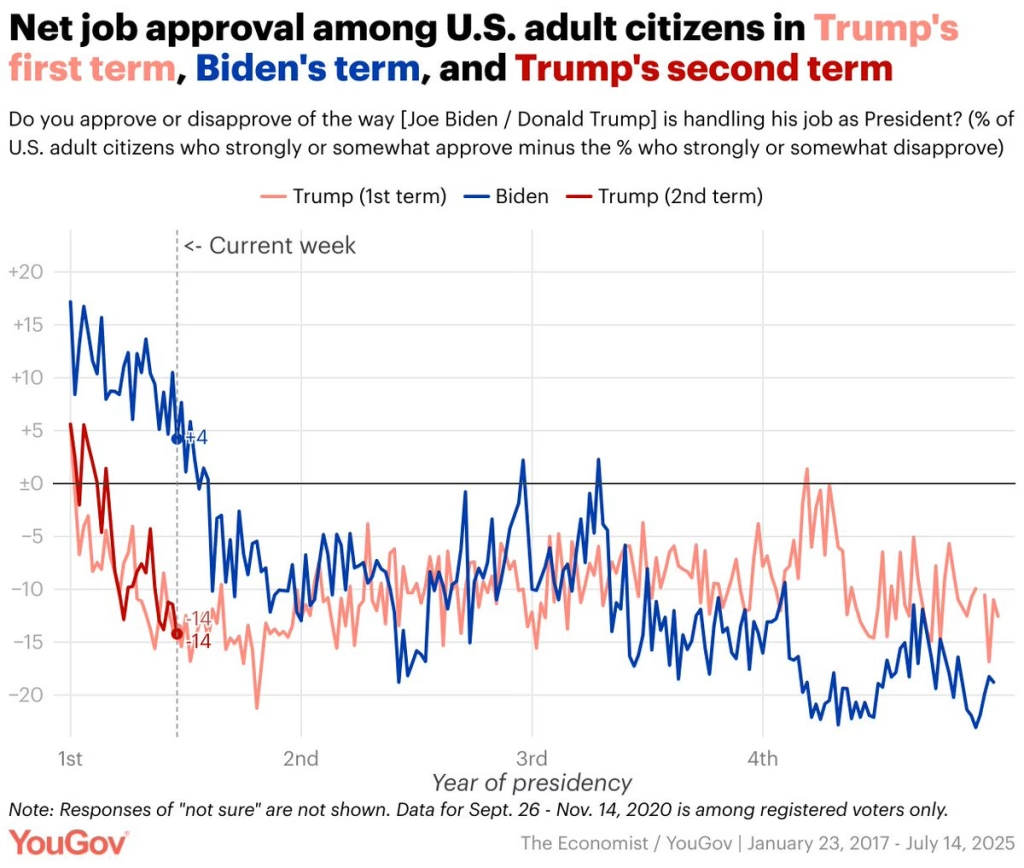
This is heartening only insofar as the threat Trump poses to American democracy and general governance would be even greater than it is if he were popular (and it is still a significant threat, don’t get me wrong).

Trump is not popular. When have I heard this before?
Leading up to last November’s election. We all know how that came out.
I will say it again as I have been saying for years. Alot of people say they don’t like Trump but support him.
@Bill Jempty: As per the post:
Note the blue line in the second graph.
@Bill Jempty:
Note, too, that he won in 2024 will less than half the vote. The numbers are the numbers. Indeed, I am not sure what your point is.
The self declared independents are interesting. I believe that we’re in agreement that most independents have a prefered party that they consistently vote for and that ticket splitting, vote the candidate indi’s is only 3-5% of independents. Yet in many polls the independents digress in large numbers from their chosen affiliation. This pattern existed during the Biden years and probably is evident throughout the history of polling.
@Bill Jempty:
Or vote for the Republican party. Or vote against the Democrats.
That’s the reality of a two-party system. As @Steven L. Taylor noted, that’s still not a majority of voters (or the voting population). In terms of the popular vote it was a difference of less than 2.5 million votes (or ~1.5%) of voters.
To be fair, the EV different was much more significant, but that has as much to do with geographic sorting and the shape of our system than anything else.
@Sleeping Dog:
Agreed about the independents. I also think we need to acknowledge that when push comes to shove almost all either come home to their preferred party OR stay home. Both those things can sway elections.
Polls are polls and they are the best empirical data we have. I don’t dispute that.
And, I observe that lying is second nature to MAGA, and wonder how many of them would not give a pollster the satisfaction, and say that they approve of Trump even though they are mad about, oh, Epstein or something.
The top stat, US Adult Citizens
(disapproval/approval 41/55).
Maybe these polls need to be also looking at emotional age along with chronological age. It would be interesting to see how much the two Stats converge or diverge.
@Sleeping Dog: Without any doubt, most “independents” are strong leaners, if not closet partisans.
Still, it is a useful barometer to see how the people who see themselves as independent react in these polls.
@Steven L. Taylor:
Polls have been underestimating Trump support for 8 years. That’s the point. Steven, you should know that was the point I was making. Like so many other forum members, you don’t like having the failure of the polls pointed out to you. Or me pointing out Biden’s mental shortcomings before the June 2024 debate.
@Bill Jempty:
2024 polling was pretty accurate. See for example: https://www.nbcnews.com/politics/2024-election/2024-polls-got-right-got-wrong-trump-harris-rcna181105
As for 2016 and 2020, because we’re at such a divided moment within national politics, little shifts in behavior can have big impacts. Pew provided a really good writeup of this situation here:
https://www.pewresearch.org/methods/2021/03/02/what-2020s-election-poll-errors-tell-us-about-the-accuracy-of-issue-polling/
From the Pew article:
The thing is that generally speaking, it’s more the interpretation of polls and a general misunderstanding of polling by people who don’t understand margin-of-error that’s the bigger issue. Or the over reliance on any single poll–especially one that fits someone’s priors rather than looking at polls as an aggregate tool.
Also the idea that an opinion poll translates to actual behavior at polling places.
I do agree that many of us completely misjudged the metal acuity issue prior to the debate. So happy to give you that win Bill.
@Matt Bernius:
All the swing states were up for grabs? How adid that turn out again?
Almanacs of American Politics, which I have read* as far back as 1983, said the polls were wrong in 2016 and 2020. 2024? The 2026 Almanac of American Politics isn’t out yet.
*- Sometimes not always.
@Bill Jempty: IIRC, the polling in 2024 was within the margin of error.
Again, I am not sure what your point is, save that you like to be really, really, really pedantic on this issue.
Within the margin of error, did it not?
@Bill Jempty:
Feel free to point out those errors. I am not saying polls are magic or perfect, but the general track record is quite good.
THIS is the crux it all. I acknowledge that you were critical of Biden’s mental acuity and that you thought Trump would win.
I dispute that you were alone in noting that Biden was old. And calling a basically 50-50 contest isn’t that hard. It is like bragging someone called tails, you called heads, and it was heads.
Your propensity to carry a chip on your shoulder is tiresome.
@Steven L. Taylor:
Trump won them.
From what you said last November–
The polls were off in 2016 and 20 and were being conservative in their modeling in 2024. As to not underestimate Trump’s support. How did that work out again if that’s what was happening.
The polls were wrong about Trump. You, JJ, and most of commenters here were wrong last November but you’re still saying margin of error. Denial is pretty strong around here.
I’m late for my afternoon nap. Have fun.
@Bill Jempty:
And last I checked, the majority of swing states fell within (or just outside) the margin of error. That means, in fact, they were “up for grabs.” It’s just they all went for Trump. https://red.msudenver.edu/2024/did-the-presidential-polls-really-get-it-wrong/
Again, that’s how polling works. MoE is a thing.
I don’t have a copy of the Almanacs of American Politics for 2024. And any of their poll analysis isn’t available online (at least not via a quick Google search). If you know where I can find one, please point me at it.
I have provided a few well-sourced counterarguments. We can go back and forth on interpretations but the facts are pretty clear. Most swing states, once all the votes were counted and certified, fell within the MoE. The fact they all fell in one direction was noteworthy and does suggest there was a broader trend to help with interpretation that was missed, but that doesn’t mean the polling itself was wrong or that Trump’s numbers were underestimated this time.
I don’t understand this statement. A margin of error is a permissible deviation from the exact value of something–of course they are still saying it, it’s statistical terminology. In the case of polling, being within the MOE is usually +/- 3 or 4 %, if the poll is done well. In PA, Trump won by 1.7%, which is within the MOE. Yes, he won. But it is, empirically, within the MOE.
@Bill Jempty:
Which is part of what margin of error means Bill. Seriously–polling is about predicting a range of outcomes. And if it falls within the Margin of Error that doesn’t mean the polling was wrong–especially when it was showing a tie.
What’s so hard about acknowledging that point?
THIS.
Trump won. Without a doubt that’s a fact.
And the results were in the MoE of aggregate polling. That’s without a doubt a fact as well.
Neither fact cancels the other out.
Three facts:
1) No one can really consistently and accurately predict the future.
2) Polls cannot consistently and accurately predict the future.
3) Even Seldon’s Psychohistory predictions can go wrong (at least in the books).
I’m so tired of announcements that Trump is crashing in the polls. (Not meaning here at OTB.) He has not crashed, but crucially, neither has he risen. And that’s before inflation, tariffs and rising costs of labor.
These are interesting numbers, but the number I tend to focus on is Trump’s so-far rock solid 40-45%. It’s encouraging that youth is still pretty strongly anti-Trump while the old farts are evenly split. In general I’d rather have supporters who are not likely to die soon.
The defection of Blacks has been overstated, and that 1/3 of Hispanics is going to shrink as the reality of a bullying, law-breaking, brown shirt ICE becomes clearer.
The Democrat to-do list as I see it:
– Present a more humane way to control illegal immigration and boil it down to a couple of bullet points.
– Make sure Black men see the open racism in things like the new shaving rule in the military.
– Make the case that Trump’s war on education is a war on youth.
– More broadly go after the billionaire class that backs Trump. Easy targets thanks in part to Musk.
– And there are small but meaningful opportunities in the BBB’s assault on rural life.
If Trump’s 40-45% floor cracks, even if it’s only a few consistent points, American democracy survives.
I think Jempty is far too modest about his assessment of Biden’s cognitive status.
Far too few reminders for me to have internalized it.
I’m sorry I keep forgetting, Bill.
@Bill Jempty:
And who is disputing that?
The 538 model in late October gave Trump a 51% chance to win. He won.
You want to be a bit more specific as to what it is you are obsessed with here? Links would be nice, so I would know what to explain or apologize for. I have left a pretty extensive written record.
@Steven L. Taylor:
I did get my 2024 election prediction wrong. I predicted Harris would eke out 270 EVs. I was wrong.
In terms of the popular vote, I was off by less than 3 points.
But man, in that same post, I got this prediction right:
I gave my best-case scenario for Trump at 302 EVs. He won 312.
Well, I sure am embarrassed.
(The site has an okay search function, and Google works pretty well also if the goal is trying to find out what I wrote.)
@Bill Jempty:
My morning-of predictions are published for all to see.
This is followed by a Harris 276, Trump 262 Electoral Vote map “giving Trump North Carolina, Georgia, and Arizona while giving Harris Nevada, Wisconsin, Michigan, and Pennsylvania.”
But I also acknowledged, “Alas, I can also see” a Trump 287, Harris 251 vote.
It’s also noteworthy that the polls were really, really close. I quote Nate Silver:
This was not 2016, where the polls had Trump losing pretty soundly (albeit, still giving him significant possibility of winning if there was a perfect storm.
Here are the ingredients of a very possible future:
1. Trump’s popularity continues to drop.
2. He continues to wield power successfully without checks and balances, or the ability of the courts to constrain him.
3. He continues to manufacture various emergencies and threats.
4. The midterms grow closer.
What would you speculate is likely to happen?
I can understand the feeling that the polls were off in the last election.
While the final vote was within the margin of error of the polls in all seven swing states, the fact that all seven states swung to Trump is why it seems the polls were inaccurate.
I’m not a statistician, so I’m likely wrong about thinking of margin of error like a coin flip; but given that preconception, winning seven out of seven coin flips seems really unlikely.
@restless:
I, too, was surprised by 7-for-7. But it’s often the case that the close-run states trend the same way. That happened in 2016 and, to a lesser extent, 2020.
I’m increasingly of the view, by the way, that 2020 was the outlier. It’s quite possible that, even with his mishandling of the COVID disaster, Trump would have won had it not been for the shift to nontraditional voting methods. Not only that that tend to disfavor his older, more rural base but he amplified the effects by railing on and on about how those methods were rigged against him.
@restless:
I don’t think MOE should be understood as a coin toss. It is just the range of possible deviation.
And given the degree to which US politics is national, it is not that surprising that 7 states with small margins all went the same direction.
@Kingdaddy: I take some solace in his popularity being low. I think that makes it harder, not easier, to actually affect the elections in a nefarious way.
I remember a lot of interactions like this after the 2016 results. Discussions in October that were along the lines of “I think Hillary will win but it’ll be close” and “It’ll be close but too many Americans are sheeple and Trump will clinch it” became “EVERYONE DOUBTED BE BUT I’VE NOW PROVEN TO BE THE MOST PRESCIENT POLITICAL PROGNOSTICATOR, PERIODT. YOU FOOLS DOUBTED ME, NOW WHO’S THE FOOL.”
My favorite–it may have been on here, maybe on social media–was a guy who said in late October that Trump would win the popular vote but wily Hillary would eke out an EC win. The exact opposite happened, the prediction was about as granularly wrong as someone could be, but since the person did predict a Trump win of some sort (popular vote) in their mind they were political geniuses.
It’s an odd craving, wanting people to bow down in acknowledgement of their superior intelligence. People consumed with politics predict a lot of things. Most of us make a mix of right and wrong predictions.
BTW, the polling in 2016 was not as bad as people remember (see here). The Wisconsin poll was a big miss, I will say (but again a “big miss” in US polling is still a single digit number).
The main problem was that several models were giving HRC a ~90% chance to win (although not 538, which gave Trump at 30%+ chance).
Expectations being failed, coupled with the EV/PV inversion, led a lot of people to blame “the polls” when they really weren’t that far off.
@Sleeping Dog:
Let’s assume that independents who can swing elections are only 3-5%. I think it’s a lot more complicated than that, but 3-5% is decisive when elections are very close, which they have been.
For the rest of the convo in this thread, I highly suggest reading the Catalyst analysis of the election. It’s not a simple story of everyone voting their partisan preferences.
It’s also the case that the parties are realigning. The party bases are not the same as they were two decades ago.
@Andy:
Thank you for the link.
Will take a bit to digest, I imagine.
Since we’re all revisiting our public 2024 takes here are mine:
https://outsidethebeltway.com/9-guy-fawkes-day-beyond-predictions/
I was more optimistic than James or Steven, but I stated as well that I expected it to be a close race too. You can read my brief day after reflections here: https://outsidethebeltway.com/whos-predictions-were-wrong/
At the time I wrote this:
I’m still thinking through this. As such, big thank you’s @Andy for that link. I gave it a quick read, and it feels like one of the best analyses I’ve read on the topic to date. It also gets to the idea that this wasn’t simply “one mistake” or even “one thing.” Instead, it’s a lot of moves at the margins that, in the face of a close election, can compound into becoming all the difference necessary to shift things.
@James Joyner:
I think you are right about some of the factors that led to 2020. And I also wonder the degree to which 2016, 2020, and 2024 all represent a “new” status quo where–due to the split nature of the electorate–everything depends on small shifts at the margins.
@Steven L. Taylor: Agreed that the results were within the margin of error. But Trump’s 2016 win was a genuine surprise in a way that 2024 wasn’t.
@James Joyner: Indeed.
@James Joyner: @Steven L. Taylor: At least in part because it was hard to process that a self-confessed pussy-grabbing reality TV star with no political experience could win.