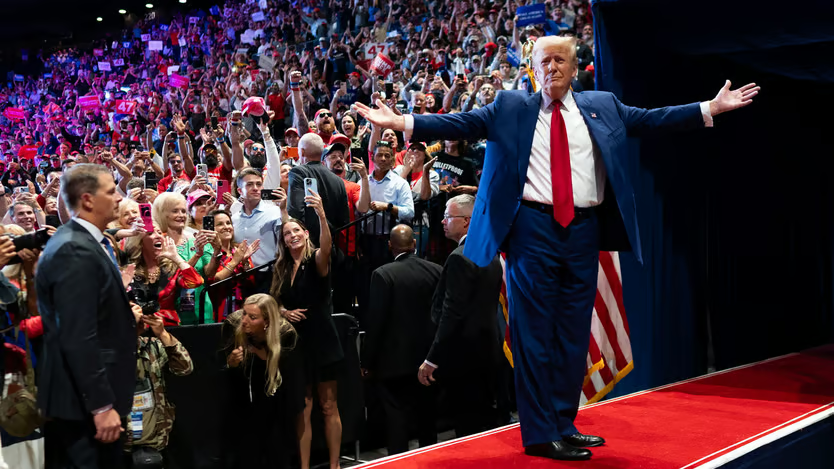
Despite urging from Ezra Klein and others to ignore the polls, it’s the nature of the political junkie to stay attuned. Oddly, while Donald Trump seems to be melting down before our very eyes and Kamala Harris seems to be running a perfectly smart campaign—and Democrats doing quote well in most of the swing state Senate races—the models suddenly have him ahead in the Electoral College race.
The Nate Silver-less FiveThirtyEight:

For the first time since 538 published our presidential election forecast for Vice President Kamala Harris and former President Donald Trump, Trump has taken the lead (if a very small one) over Harris. As of 3 p.m. Eastern on Oct. 18, our model gives Trump a 52-in-100 chance of winning the majority of Electoral College votes. The model gives Harris a 48-in-100 chance.
The change in candidate’s fortunes came after a slow drip-drip-drip of polls showed the race tightening across the northern and Sun Belt battlegrounds. In our forecast of the popular vote in Pennsylvania, the race has shifted from a 0.6-point lead for Harris on Oct. 1 to a 0.2-point lead for Trump; In Michigan, a 1.8-point Harris lead is now just 0.4 points; And in Wisconsin, a 1.6-point lead for Harris is now an exact tie between the two candidates. Meanwhile, Arizona and Georgia have flipped from toss-ups to “Lean Republican” states.
Still, a word of caution: You might be tempted to make a big deal about our forecast “flipping” to Trump, but it’s important to remember that a 52-in-100 chance for Trump is not all that different from a 58-in-100 chance for Harris — both are little better than a coin flip for the leading candidate. While Trump has undeniably gained some ground over the past couple weeks, a few good polls for Harris could easily put her back in the “lead” tomorrow. Our overall characterization of the race — that it’s a toss-up — remains unchanged.
The caveat is surely bigger than the swing: it’s still essentially a 50-50 race. But I’d certainly prefer that the trend be moving in the other direction.
I saw the headline about 538’s move a couple days back and didn’t bother to write about it. Mostly, I’ve been busy with work and some minor chaos on the home front. But it was, after all, just one prediction model.
Until now.
The Economist (“Why Donald Trump has moved ahead in our election forecast“):
For the first time since August, Donald Trump has overtaken Kamala Harris in The Economist’s statistical model of America’s presidential election. Our latest forecast shows that Mr Trump has a 54% chance of returning to the White House, up six percentage points during the past week. Although the race still remains more or less a coin toss, it is now weighted slightly in Mr Trump’s direction.
The shift in our model reflects a steady narrowing of Ms Harris’s lead in national polls during the past month. Shortly after she became the Democrats’ presumptive nominee in July, a chunk of respondents who had previously said that they were undecided or backing third-party candidates started supporting her, increasing her national vote share from 46% to 49%. Many of these voters were probably disillusioned Democrats.
Now, Mr Trump appears to be benefiting from similar partisan consolidation, as Republican-leaning undecided voters “come home” to their party’s nominee. Whereas Ms Harris’s support has been flat for two months, Mr Trump’s has ticked up from a low of 45% in August to 47% now. This has cut his deficit in the national vote from a high of 3.7 percentage points to just 1.6.
Our forecast still gives the vice-president a 74% chance of winning the popular vote. However, the reason that Mr Trump has pulled ahead is his advantage in the electoral college. State-specific polls published in the past week confirm that Mr Trump’s position has strengthened slightly in the plausibly decisive states, just as it has nationwide (see chart). The data do not support the claim by some Democratic partisans that Republican-aligned firms are “flooding” polling averages with Trump-friendly results: the former president has also gained ground in surveys by pollsters that tend to publish good numbers for Democrats.
Just as in 2016 and 2020, the Democratic nominee is faring worse in swing-state polls than in national surveys. The candidates are roughly tied in Michigan, Nevada, North Carolina, Pennsylvania and Wisconsin, and Mr Trump is up by almost two percentage points in Arizona and Georgia. As a result, our model now estimates that Ms Harris needs to win the national popular vote by at least 2.5 percentage points to be favoured in the electoral college, up from 1.8 points in August.
Again: the movement here is small:

But, also again, the trendline is in the wrong direction.
The Economist‘s proferred rationale is plausible: these aren’t really “undecided” voters being persuaded that Trump is the better candidate but regular Republican voters who ostensibly gave Harris a chance to win them over and were unpersuaded. Presumably, these are also the subset of those telling pollsters they plan to vote for Trump who are least likely to actually show up to the polls and do so.
The aforementioned Nate Silver also shows a modest Trumpward trend. The analysis is behind a paywall, but Newsweek reports,
According to Silver’s model, last updated on Sunday, Kamala Harris still leads nationally and in three key swing states of Michigan, Wisconsin, and Nevada, the candidates are tied in Pennsylvania, and Trump leads in Arizona, Georgia, and North Carolina.
But compared to the same model’s aggregate polling from one month ago, almost every state tracked has shifted slightly toward Trump, including nationally and in all seven battleground states.
The biggest swing in a battleground state, was in Michigan, where Trump narrowed Harris’s lead to an average of 0.5 points, a swing of 1.9 points toward Trump in the last month.
Sure enough:

The national race, though, has been remarkably steady since the model’s launch in late September.

But, of course, we don’t elect Presidents by a national vote.
For what it’s worth (and I honestly don’t know, not having paid attention to them in a long time), the Daily Mail/J.L. Partners model has also moved Trumpward. I won’t bother to dissect it.
I continue to be befuddled that the race is even close. Trump was an awful President who tried to steal the 2020 election after he was defeated. He’s a convicted felon. He’s melting down before our eyes. And yet he’s doing better in the pre-election polls than he ever did in 2016 or 2020.
I don’t expect Republicans to abandon him in droves for Harris. But you’d think any on-the-fence voter would have done so long ago. But nope.
Indeed, on my social media feeds, I’ve seen a tiny handful of really bright people that I’ve followed for years, at least one of whom is a professional Democrat (a Latina woman) who is suddenly supporting him. As best I can tell, Harris and Walz flaws—which I acknowledge—are being cited while Trump’s rather obviously much more serious flaws are being shrugged off.
While I hold out hope for a Harris landslide—basically, a sweep of the swing states—and a thorough, hopefully final repudiation of Trump and Trumpism, I suspect it’ll be the race we’ve expected for months, with it all coming down to Pennsylvania.