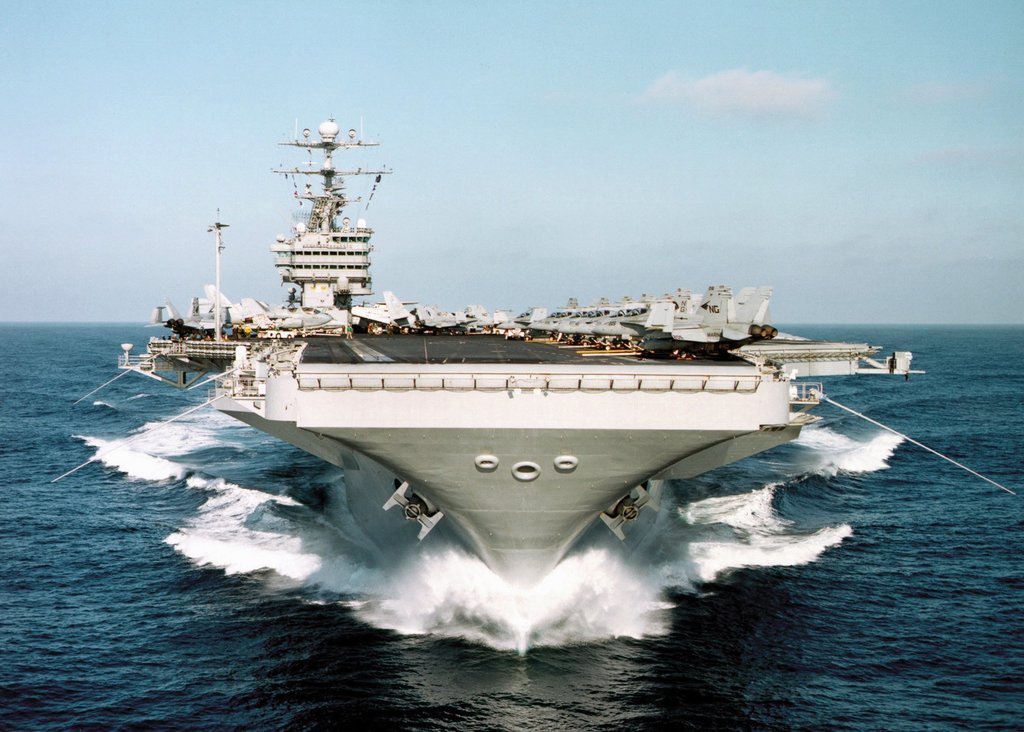
Navy Has Been Escorting Ships Throught the Strait
But at nowhere close to the prewar level.

NYT (“U.S. Military Is Quietly Guiding Ships Through the Strait of Hormuz“):
American forces in recent weeks have helped coordinate the passage of dozens of commercial vessels through the Strait of Hormuz, according to U.S. officials, even as travel through the waterway remains risky amid stalled negotiations to end the war with Iran.
U.S. Central Command has guided around 70 commercial ships through the strait, traveling into and out of the Persian Gulf, in the last three weeks, one of the officials said, speaking on condition of anonymity to discuss operational matters. The U.S. officials added that most of the vessels had turned off their transponders to avoid detection when going through the narrow waterway.
The officials declined to say what type of vessels were going through and what route they took, but one official indicated that at least one route was not close to the Iranian coastline. Ships passing near Iran without obtaining Iranian approval face the threat of an almost-certain attack by Iranian drones or missiles, U.S. officials said. Shipping analysts say the U.S.-guided crossings appear to follow routes that are closer to Oman.
So, this is surprising news. I’ve received multiple classified briefs on the operation and had no idea more than a handful of ships had gotten through.
Alas, some perspective is in order:
Before the U.S.-Israeli attacks on Iran in late February, well over 100 commercial ships a day passed through the strait. So the U.S.-coordinated passages — an average of three a day over the three-week period — do not represent a big comeback for shipping. And because U.S.-guided crossings take place with transponders turned off, known as “dark” passages, shipping analysts say they cannot independently verify how many may have taken place.
But it does at least mildly address the most obvious impediment to re-opening the Strait without Iranian backing:
Still, a steady passage of ships under U.S. guidance would suggest that some shipowners are willing to take the risk to get in and out of the Persian Gulf, where many vessels have been stranded for weeks, losing money and leaving their crews in trying conditions.
Getting civilians to trust that their ships and crews will survive the passage is a big ask, indeed.
Cutting off 97% of all traffic sounds like a pretty successful blockade to me.
And while getting this limited number of ships in or out may – depending on circumstances – constitute a significant tactical success, strategically it’s close to meaningless.
Good job, Donnie.
It seems to me that shipping analysts – who have time series geolocation data for ships – can indeed figure this out. With this advanced mathematical concept known as subtraction.
Ok, maybe it’s a bit harder. You would have to compare tracks between days, and assume that after the passage ships will turn their transponders back on. On day X ship with tag Y is in the Persian Gulf, on day X+1 ship with tag Y is in the Gulf of Oman. I guess it teleported?
Sooo, this makes me more than a little suspicious.
And Lloyds of London et al.
I assume escort duty falls to destroyers or maybe to cruisers, with lots of anti-air missiles and a Phalanx or two, but that the carriers are staying well away. I wonder how many such vessels it takes to provide coverage for a lumbering 2-million barrel tanker?
@Michael Cain:
The U.S. military has been coordinating with and helping to guide some commercial vessels through the strait, but not actually escorting them. From the NYT article,
There’s an excellent YouTube cast by Sal Mercogliano, What’s going on with Shipping, with several episodes per week. In yesterday’s episode, he said that U.S ships have not been escorting, but U.S. aircraft have been providing surveillance for commercial ships.
Wonder if any escorting ships have actually had to take action, and what would that look like? Would an escort cruiser be able to get between a tanker and a drone to interdict? And what weapon would they be using to interdict a drone?
@drj: “Cutting off 97% of all traffic sounds like a pretty successful blockade to me. ”
Seconding. James, this ‘success’ is a massive flashing strobe light of failure.
@Eusebio: I suspect what they are trying to dance around there is the Iranian’s are probably quite sparing in the use of their radars, as every time a radar fires up it gives away its position. The US Navy may simply be letting the captains know when the Iranian radars are quiet, perhaps promising to try to help if an attack does come, so they are saying they are not “escorting” them.
My instinct is to shout “Bad James, Bad!” and swat your nose with a rolled up paper. I don’t know the exact rules on handling classified information, but I would have expected remarking upon it and summarizing it on a blog would be against the spirit if not the letter, even if the information itself was outdated.
A transponder can be thought of as having three states:
– on, inside the gulf
– off
– on, outside the gulf
I would expect that one could make a pretty good independent estimate of ships exiting by comparing the first and third states over time. Unless they are changing transponders upon leaving.
I wonder who these “shipping analysts” are, and why they aren’t cross referencing data and analyzing.
@dazedandconfused:
Sounds to me more like a few shipowners are making arrangements with Iran and the administration is claiming some credit for allowing them to pass.
The statement @Eusebio: quoted is consistent with my interpretation,
@gVOR10:
My summary may have been lacking, so here’s a portion of the auto-generated transcript from Sal Mercogliano’s show:
He also showed a group of ships located on in the mountains of the UAE… but not really, because their locations were being spoofed to appear in that area. And he pointed to a couple of ships in the strait that were squawking, but appeared to be misrepresented, including…
He didn’t make the connection to 404 meaning “not found”, nor did I see any comments to that effect.
A couple of questions: I assume the escort is just one way. This is facilitating escape. Not trade.
Two, how much is this costing the US? Ships, fuel, salaries, food, etc. What is the cost/benefit? And how is it that the US bears this cost?
Better than none; still nowhere enough.
And how many ships are going INTO the Gulf?
Because I doubt many shipping firms are going to be doing that.
And I’ll say this again: at some point the GCC countries are going to be having serious problems about food supply, 70% of which has previously come in via the Straits.
Replacing that by overland routes from the Read Sea is going to be logistically non-trivial.
To put it mildly.






