On “Realism” and Trump’s Attacks on Iran
An IR theory that is often misapplied in my view (especially by certain kinds of practitioners).

So, I listened to last week’s episode of The Ezra Klein Show, I Asked a Former Trump Official to Justify This War, which was an interview with Nadia Schadlow. Schadlow is currently a Fellow at the Hudson Institute and was a Deputy National Security Advisor for Strategy in the first Trump administration. She holds a Ph.D. from the Paul H. Nitze School of Advanced International Studies (SAIS) at Johns Hopkins.
I will stress that she is not a member of the current administration, so she is not privy to updated inside information, nor is she personally responsible for current policy. Still, she made the choice to be at least a quasi-defender of the ongoing operations in Iran, so I think critiquing her in this general arena is fair game. Mostly, I have thought about her theoretical approach as much as anything.
I was struck by the following. Indeed, I was struck by quite a lot, but I will focus here.
Klein: In 2018, you described Donald Trump as a “conservative realist.” What did you mean by that?
Schadlow: “Realism” essentially means that you look at the world the way it is, not as you wish it to be. And Donald Trump is someone who sees the world in a particular way.
It’s a world that’s competitive. It’s a world in which power matters. It’s a world in which nation-states matter, interests matter. That’s what I meant by the realism part.
The conservative part: Today, in the current National Security Strategy of 2025, which I’m sure we’ll get into, they actually use the term “flexible realism.” So I might actually say that might be more accurate today.
You don’t want to do everything everywhere. You will take risks, but essentially, you want to make sure that American power is preserved and not expended unnecessarily.
So, let me acknowledge that Schadlow’s expertise is IR, both as an academic and a practitioner, while my main area is comparative politics. Still, I have formal training in political theory, and I taught a master’s level seminar on IR theory for many years. In that context, I always find the claim that realists “essentially means that you look at the world the way it is, not as you wish it to be” to be hugely problematic.
Before I go on, please note that this post is not intended to be a comprehensive discussion of realism, and further, I am not trying to denigrate the entire theoretical school. While I do think that the approach has serious flaws, the point here is to address what I often see as a very surface-level approach to the concepts in question. It truly is something that I repeatedly saw from students (both undergrad and grad) and that I have heard from commenters and political operatives alike, my entire life. People like Stephen Miller, who likes to claim that the only tool of politics is raw power is perhaps the best example of the worst application of these notions.
Here’s Miller:
“We live in a world in which you can talk all you want about international niceties and everything else,” deputy chief of staff Stephen Miller told CNN’s Jake Tapper. “But we live in a world, in the real world … that is governed by strength, that is governed by force, that is governed by power,” Miller said.
“These are the iron laws of the world.”
Any US allies still in denial after the first wild year of Trump’s second term should listen to something else Miller said. “We’re a superpower. And under President Trump, we are going to conduct ourselves as a superpower.”
Emphases mine.
People like Miller think they are boldly proclaiming some hard truth when they talk like that, as if only people like themselves have the courage to speak about unpleasant realities. But, in truth, that is the attitude of the bully.
Don’t get me wrong: I agree that the world is governed by power, but power is not just guns, bombs, and warfighting. Sometimes power is subtle and soft. Sometimes power is deep economic ties and, dare I say it, friendship. Yes, a host of military power considerations are relevant to the existence of the EU, yet it is not maintained by a bullying imposition of order via raw power.
Who is more powerful? The burly bully who can break some skulls, who starts a barfight, or a more normal fellow who has a number of friend who has his back in that same barfight? Raw power isn’t everything.
I would note that the US is vastly more powerful than Iran. And yet that doesn’t mean we are going to get exactly what we want. Indeed, we may spend a lot of money and kill a lot of people, all while causing a global economic crisis, demonstrating our power, while all the while not getting what we want (if, in fact, we know what that is).
Plus, being powerful does not protect a person (or even a superpower) from consequences.
I could go down this rabbit hole further, but instead, we resume our regularly scheduled post, and so, back to Schadlow.
First, I would note that it is a major conceit of some “realists” that they are the ones who look at the world as it is, it’s in the name, don’t you see?
Indeed, before I continue, let me be as clear as possible on what we are talking about. “Realism” is a specific theory (really, a group of theories) that attempts, as all theories do, to explain the way in which states interact with one another in the international system. In simple terms, international relations is the study of why states sometimes go to war and why they sometimes remain at peace with one another.
Realism, as a theory, makes a number of claims about states as actors and about the international system as a whole. More on that below.
But I would hasten to add that there is a more colloquial usage of the term, such as someone saying, “I am a realist about [fill in the blank].” Such as: “I am a realist about my chances of getting a better job,” or “I am a realist about my romantic prospects,” or whatever. It simply means I am not dreaming or hoping for some unrealistic outcome. I know, to stay with the examples given, that, based on my resume and life experiences, I am not going to be hired as the CEO and make 8 figures. The basic notion is being a grounded person who accepts that life has real parameters based in reality, versus wishing for unicorns and rainbows, because wouldn’t that be nice?
What I have long found to be the case is that both lay people and often many students, here of the IR theory of realism, conflate it with just being practical, and glom onto it as the best theory.
It is also true that realism often focuses on power, and if one thinks of international relations mostly in terms of wars (as most people seem to do, especially undergraduates), then a theory that seems to focus on power is typically very appealing.
I am leaving an awful lot out, but before going on to the second point, I would underscore that being a “realist” sounds more pragmatic and obvious than being a liberal, a neoliberal institutionalist, a constructivist, or any number of other labels that other theoretical positions use.
Second, let’s get back to this claim by Schadlow, “Realism essentially means that you look at the world the way it is, not as you wish it to be.” That sounds so compelling, especially given the colloquial usage of “realism” or being “realistic.” But here’s the problem with this assertion: all theorists claim that they are seeing the world “as it is”-that’s the whole point of theories. If one is a neoliberal, a constructivist, or even a Marxist IR scholar (to name but three options), one thinks that one’s theory is based on how the world works. Theories, by definition, are meant to explain how the world works and why. So, the issue is not whether only one theory makes such claims, but the need to assess which theories do a better job of explaining reality.
Indeed, back to her more expansive definition (“It’s a world that’s competitive. It’s a world in which power matters. It’s a world in which nation-states matter, interests matter. That’s what I meant by the realism part”) I have to note that all theories that I can think of think that nation-states, competition, and interests matter. None of that is exclusive to “realism.”
Really, the contrast here is not between one approach that is clear-eyed about how the world works and a bunch of pie-in-the-sky dreamers. The contrast between different theories is based on their assumptions of how the world works.
Let me demonstrate how this might work.
A central question about the international system is how states (i.e., countries) deal with the fact that they exist in a state of anarchy. Contrary to popular usage, anarchy does not mean chaos, but rather it means the lack of an authoritative ordering principle in a given system. In other words, there is no global government that can impose order on the states that exist in the international system. In simple terms, inside the boundaries of a state, there is some amount of hierarchy, because the central government can impose order via law-making and enforcement. In the international system, there are no actors that can impose order, and therefore, that system is anarchic.*
Realists often interpret anarchy along the lines of Thomas Hobbes: that in a state of anarchy, states are basically in a constant war of all against all, and that at any moment attack is possible. This means that every state needs to arm itself and constantly prepare for possible conflict. Survival is the goal, and it can only be maintained by arming oneself against the possibility of attack. It assumes a world of “kill or be killed.”**
However, such an approach does not explain how, for example, increased globalized trade leads to more peaceful relationships between states.*** Nor does it explain how some states actually behave like friends rather than perpetual enemies (e.g., the US and Canada or the “special relationship” that the US and the UK have long maintained).****
Having perhaps confused everyone more than providing clarity, let’s circle back to the Trump administration and whether or not it is being “realistic” in either the colloquial or IR theory or senses of the term.
I would note that whether one is a realist in the sense of the IR theory discussed above, or if one is just a realist in the colloquial sense, one has to be realistic about what power can do. Despite the simplistic nonsense that comes out of Pete Hegseth’s mouth on a daily basis about warriors, war-fighting, and lethality, military operations large and small are not about just blowing up the bad guys. As Clausewitz aptly noted, “War is the continuation of politics by other means.” You fight to achieve certain outcomes, and only a fool thinks that violence alone achieves those outcomes (but, as it pertains to Hegseth and company, I repeat myself).
Anyone who knows anything about history knows that when the fighting stops, there is additional work to do. A lot of work, in fact.
But, of course, we are witnessing a war fought by fools who don’t know anything about history, so, in terms of just a basic, colloquial “realism,” I’m not seeing it.
Indeed, Schadlow herself strikes me as living in a fantasy land despite calling the Trump administration “realists.”
For example, here’s her quasi-defense of the Maduro kidnapping:
Schadlow: [Trump]’s willing to take risk, and he’s basically elevating a willingness to take risk over process. If in two years the situation in Venezuela is much better, and the millions of Venezuelans who have left their homeland go back, will people say that’s a mistake? Probably not.
I mean, sure, if things work out great, then it was all worth it. But that’s not realism of any sort. That is hand-waving hopery.
If my plan to feed my family is just to throw a bunch of seeds in the backyard, well, if in two years I have plenty of food as a result, then will people say that’s a mistake? Probably not. But anyone who knows anything about gardening would tell you that such an outcome is not likely.
She engaged in some similar talk about the Iran operation.
Schadlow: So it’s unfortunate. No one wants to see prolonged chaos. But it’s also not guaranteed. There could be opportunities for a better outcome, more stability, maybe more involvement by the Gulf states in helping that stability emerge. They should be thinking about this and planning, too, and thinking about what a better outcome would look like.
To me, “could,” “should,” and “maybe” are not the hallmarks of her own definition of realism, which again was, “you look at the world the way it is, not as you wish it to be.”
Let me circle back to a key theoretical claim made by IR realists (although not exclusively): the most important motivator for a state is its survival. As such, if the war planners in the current White House had at least a C+ understanding of undergraduate IR theory, especially of the realist flavor, they would have seen the very likely possibility of things like Iran’s indiscriminant attacks on its Gulf neighbors, and most especially the closing of the Strait of Hormuz. The Iranian state wants to survive, and therefore, they are going to use whatever means they have to do so.
It also seems that the administration has failed to understand that making maximalist claims about the regime’s survival means that negotiations are moot. People tend to have no reason to negotiate when the other party has proclaimed their goal to be your demise.
To be honest, if this administration should be considered to be “realists” (whether “conservative” or “flexible”), then, at best, they are barely at the D+ level. Hegseth reminds me too much of a student I once had who thought that he was very, very special because he was on the baseball team, and that I was being unreasonable, expecting him to be in class and like, you know, learn stuff.
To be honest, it seems to me that this administration should not be seen as having much in the way of a theoretical understanding of the world beyond that of a simpleton who is a gambling bully who personally has little to lose because he is old and rich and basically immune from any legal consequences.
I will conclude by noting that a realist by any definition ought to have a plan beyond blowing things up and hoping for the best.
*BTW, it seems worth noting that the usage of various international institutions like NATO and the EU, as well as things like GATT, have lead to more order in the international system. This suggests that the pure self-help notions of certain realist approaches, including things that Schadlow talks about in the interview that I have not included, are flawed. In other words, the chance of war can be diminished in ways other than simply being powerful enough to deter an attack or being powerful enough to preemptively strike an enemy.
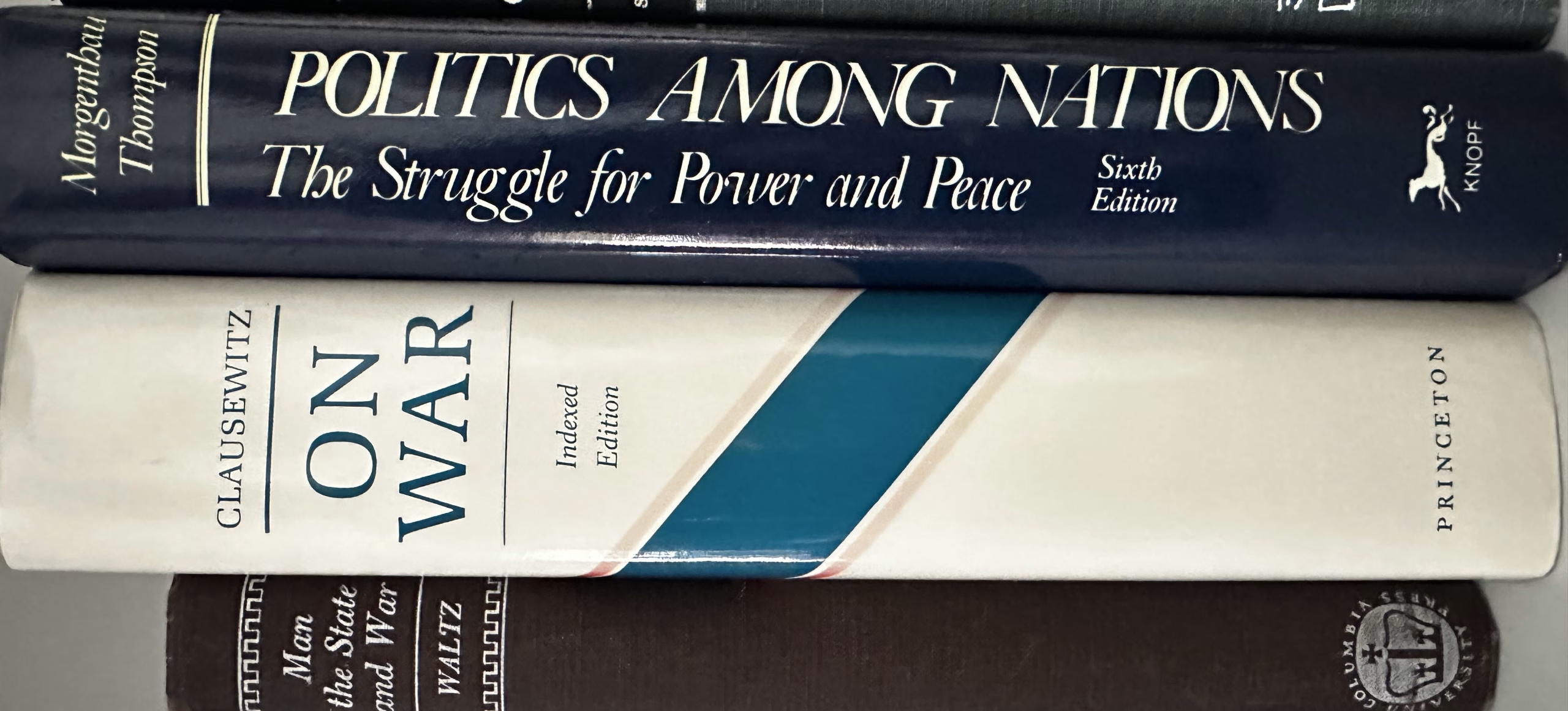
**I am speaking here mostly of what is called “classical realism” as derived by Hans Morgenthau. There is also a major strain of realism known as “structural realism,” which finds its source in Kenneth Waltz. For anyone who wants to read up on this topic, I recommend Donnelly, Jack. 2000. Realism and International Relations. Cambridge University Press. Donnelly is not a realist, and the book itself is ultimately a critique, but it also takes its subject very seriously and is one of the best texts that I have ever encountered in providing a succinct overview of the core principles of realism alongside its multiple variations.
One of the key failures of the Trump administration’s approach to foreign and defense policy is its failure to understand why there hasn’t been a global war since the 1940s and why, in particular, there was no major war in Europe until Russia invaded Ukraine. Indeed, I am of the view that realist theory does a great job of explaining European wars of the 19th and early 20th centuries, but does a very poor job of explaining the European peace for the latter half of the 20th century and the first quarter of the 21st.
For some additional definitions, see here: An Introduction to Realism in International Relations, which includes Morgenthau’s six principles of political realism.
***See, for example, work by Robert Keohane and Joseph Nye, especially their work on complex interdependence, such as their book, Power and Interdependence.
****To get into the possibility that anarchy does not, as the realists claim, create a static context for state interaction, see Wendt, Alexander. 1999. Social Theory of International Relations. New York: Cambridge University Press.
I think that in the end she’s not only not a realist, but doesn’t even know what that is. I’m getting quicker to discard alleged ‘intellectuals’ who can’t comprehend Trump.
A possible demonstration about how dishonest Schadlow can be.
And you did not even a mention of the quote that got some attention on social media, “ Congress does not have a constitutional role in the declaration of war.” She clarified [or, backtracked] after Klein quoted the Constitution.
Granted, she may have simply misspoke. But it is difficult for me to give her the benefit of the doubt. She has a Ph.D. from a prestigious IR institution, and her explanations of realism suggest that she is comfortable stretching the truth, if not, engaging in outright falsehood. It seems reasonable to conclude she is leveraging the colloquial use of “realism” rather than doing the hard work of justifying her view.
That leads me to think that her patently false claim about Congress’s role in declarations of war was less about describing practical reality and more about justifying Trump’s actions. It is also possible that most of her media hits are with moderators/interviewers who allow the other guests/panelists space to correct errors or are with bobbleheads.
I have more thoughts for later.
At risk of sounding anti-intellectual, the minute you formulate a theory you become protective of that theory and start to distort reality to fit the theory. My own theory (and I am perfectly willing to distort reality to fit) is that in anything involving human behavior theory will come up short. Mathematical theories? Sure. Pies really are squared. Scientific theories? Sure. Turns out it was bacteria and viruses and not the vicious humours at all. But theories to explain let alone predict human behavior, whether writ small or large? Nope.
Numbers do not have free will, humans do. A single decision in a single human mind can alter the course of history. One German can decide that physics is ‘too Jewy’ so Einstein moves to New Jersey and the Americans get the bomb. One Texan can decide, ‘they tried to kill my daddy,’ so the US invades Iraq. And now we learn that it was one fuckwit who, despite being told otherwise, decided that we don’t need to worry about the Strait of Hormuz. Theories are rational, humans are fucking crazy.
@Kurtz:
Hacks gotta hack. Schadlow made a choice to defend the administration and dishonesty looks better on a political intellectual than utter incoherence.
From Schadlow herself (per the transcript):
Sanewashing Trump’s pathologies into a doctrine is a fool’s errand, best left to fools. As Steven himself observes in his post, we are governed by a simpleton controlled by power mongers skilled in manipulating said simpleton. It really is that straightforward.
Some of the thoughts I had were about this:
One, he sometimes expresses a similar, even identical, view wrt domestic issues. The irony is that if his worldview were true within a society, he would have been bludgeoned long ago for running his mouth.
Two, I have mentioned that individuals seem to take freedom of speech as more than an unfettered license. Some speak as if they take it as not only a prescription to say anything that can be uttered, but that the freedom itself plays a role in determining the veracity of a given statement.
Simply, if a statement is perceived to be forbidden, then it must be true. ‘Defiance’ itself as a value.
The stereotypical moody 13-year-old as political identity.
It sounds like her version of realism is just “I’m right, and my wishes will all come true.” Yup, checks out.
I’m way down the list for political theory comprehension (my depth is like a 100-level overview course from 25+ years ago), but just reading the “Six Principles”, it sounds like she’s discarding half of them?
– The entire Iran adventure is a moral aspiration with Christian Dominionist ideas behind it. Or maybe it isn’t idk nobody can tell what the hell this whole campaign is trying to be about, but the Trump-Is-Christ crowd sure seems to be mostly in charge and clapping along that way.
– The attack is clearly not in our state’s interest by any measure. In Israel’s interest? Maybe. But even then, it’s not entirely clear, and you still have the tall hurdle of whether Israel’s current interests are even close to aligning with ours. We know there’s a massive future military cost. We’re seeing massive current economic costs. It’s also a self-inflicted waterbed effect for our perceived dominance.
– This isn’t rooted in objective laws regarding human nature. Even a surface understanding of human nature tells you that bullied people will fight back (so you need to have at least some sort of counter to that when you start throwing fists), and people whose children are murdered will become even more hardened. No mystery here! Except to a moronic regime that’s dumping bombs on Iran with no scruples, zero plan for the future, and a shocked face emoji about them clamping down the Strait. Oh, and a Wish-Upon-A-Star attitude about getting help from our myriad partners after we took a dump in their front yards.
I guess the general question is, what’s the point of proclaiming yourself in a particular school of thought if you so readily funge yourself into agreeing (even mildly) with actions that obviously run counter to it?
@Michael Reynolds:
Not anti-intellectual at all.
My take:
We are in an era in which we have access to more data and better tools to evaluate said data. Moreover, a loud, potentially large, portion of the cohort that designs those tools misapprehend the notion of objectivity.
Them: 75% of people think x is true.
x is objectively true.
Reality: the objective part would be the first statement. The second statement is non-sequitur.
And, of course, it gets damn messy when we start using those analytical tools to predict behavior, because the ‘objective truth’ becomes a standard to evaluate worth.
I commented on Klein’s column that he had done a really nice polite job of exposing Schadlow’s vacuity. Seems to me that Trump/Miller America First “realism” (which I call the Big Dog theory) and what ever we call the Obama/Biden approach both place U.S. interests first. But America First favors the oligarchs with a short timeframe while the Obama/Biden approach favors broader interests over a longer timeframe. And a deal less personal corruption.
I couldn’t get through the interview, it was so bad. I’m a fan of Schadlow’s work, especially War and the Art of Governance , which actually considerably modified my understanding of an area I had considered myself something of an expert in. Her 2017 National Security Strategy was surprisingly good, considering the constraints she was working under.
But I found much of what she said in the early portion of the interview absurd, if not dishonest. No serious IR scholar would define Realism as “Seeing the world as it is, not as we want it to be.” That’s hackish propaganda, not IR Theory.
This was a frustrating listen. It’s tempting to do a thorough fisking, but not worth the effort. A few stray thoughts:
This notion of “realism” reminds me of people (eg, politicians, university faculty) who talk about being pragmatists. “I’m not a partisan, I just want to focus on solutions that work.” Pray tell, work on what problems and according to what definitions of success?
People who talk of seeing the world as it really is are often using this as cover for some very unsavory inclinations and behaviors. It also provides cover for the wholesale rejection of decency and moral consideration. “Only a fool orients toward virtue in the ‘real’ world, and only a fool would attempt [insert good intentions/behavior].”
Your point about the realists’ conceit made me think of Heisenberg’s quotes “What we observe is not nature itself, but nature exposed to our method of questioning.” and “The reality we can put into words is never reality itself.”
Finally, I detest this invocation of risk as a noble courage:
Who’s blood and treasure are being risked here?
@Michael Reynolds: “the minute you formulate a theory you become protective of that theory and start to distort reality to fit the theory.”
The only theory that matters:
https://www.youtube.com/watch?v=cAYDiPizDIs
The Taco so-called administration wouldn’t be deemed realistic if it existed inside the movie Last Action Hero.
@Michael Reynolds:
That’s hardly a theory; it’s practically an axiom. Complaining that behavioral theories come up short is like being shocked that weather forecasts don’t predict individual raindrops. Theories provide the climate, humans provide the storm.
“free will” — now that’s a theory… and a remarkably protective one at that! 😉
Kind of ludicrous to accuse a 2nd-rate reality TV host of being a realist, dontchya think???
@Barry_D: They remind me of a scene in
Asimov’s ‘Foundation’ series where there is a recording from Hari Selden which doesn’t mention the growing crisis with The Mule (a freak mutation).
Except that this is more like LLM’s denying that there is ‘The Mule’.
@Michael Reynolds:
Wow. No social scientist I know of has ever noted such a thing! (/s)
But also: all theories, including those about the natural world, come up short. Theories, by definition, cannot capture all of reality on a given subject. We have theories to help us understand reality; none of them actually tells us all there is to know or understand about a given subject of study.
Loosely interpreting DeLong in Slouching Toward Utopia, there was a “long 20th century” from roughly 1870 to 2010 during which economic progress accelerated, leading to a long post-WWII period in which much of the world saw good economic growth under social democratic mixed capitalism. Then, for no very compelling reason, we changed to neoliberal theories, the failure of which has left everybody looking for what’s next. Apparently we can’t simply go back to what worked.
Your footnote ii leaves me feeling the same way about international relations. The consensus was working, why did we change? Why can’t we go back? (My answers would revolve around stupidity and plutocrats.)
@Mimai:
I add that I cannot think of an example of someone who employs that line of reasoning who is not doing it on behalf of a particular system/ideology that relies on a particular moral framework.
When faced with results that do not match the implied or expressed moral virtues of the system, one presents the pragmatic argument in defense. When faced with a competitive alternative to their preferred system, one relies on the morality defense as if the failures were never discussed.
@gVOR10:
I may be off, but American patriotism seems peculiar to me. Its expression, vapid. Its attitude, smug.
Empty hubris comes closest to describing my perception of it.
I think that plays a role in your answers, because lacking any foundation, pride can be directed toward any end, even those that contradict the stated premises of American exceptionalism, via manipulation.
@Steven L. Taylor:
“All models are wrong; some models are useful”.
Unfortunately, that also means:
The wrongness of any given model can be useful if one’s goal is to manipulate others.
@James Joyner:
The funny thing is that her own description of the book (which I have not read) suggests that she should be a major critic of the Iran operation.
@Mimai:
100%
@wr: Perfection.
@Kurtz: Indeed.
@James Joyner:
BTW: agreed, although on that quote, Morgenthau does come pretty close to saying it!
Still, as I note in the post, this is kind of stuff I expect mediocre undergrads.
@Mimai:
I don’t like seafood. So if someone opens a can of sardines in the kitchen with the door shut, I can still smell it in the backyard. I will still smell it as I vacate the area.
You have opened a can of sardines. Now I must leave the area.
@Steven L. Taylor:
To help us understand, or to help us mis-understand. Theories that are plausible but false and unfalsifiable obstruct the search for truth. Sometimes those mistaken theories end up killing quite a few people. The theory that cats were responsible for the Black Death was unhelpful. As was the theory that it wasn’t the cats, but the Jews.
When theories can be tested and falsified they are necessary. That’s science. When theories cannot be falsified – as is the case with most theories outside of the hard sciences – they aren’t so much theories as they are guesses, or worse yet, ideology or dogma or rent-seeking. And once formulated such theories develop advocates who care little about the truth and a lot about the theory. See: Q. See: Marxism. See: Creationism. See: trickle-down economics.
For academics there’s an economic and reputational incentive to formulate a theory. They may, as you snarkily suggest, understand that theories are imperfect, but once some department head formulates a theory, how much of his energy is devoted to testing that theory, and how much to defending it against any challenge? In your experience in academia, how many of the profs you know would be happy to see their pet theory exploded, which is what should be the reaction since debunking a theory is a step toward truth?
So, We have theories to help us understand reality, should perhaps read, We have theories to help us understand reality, or to actively impede understanding, or to gain personal advantage, or to hurt people we don’t like, or, as with the Flying Spaghetti Monster, to get a laugh.
Anyway, that’s my theory – the theory that outside of hard science, theories are not really advanced in pursuit of truth. My theory is not falsifiable. I need to develop a syllabus.
@Michael Reynolds: All science is, whether experimental or not, an attempt to better understand the world around us.
Yes, that can be manipulated to bad ends (this includes experimental sciences).
It is not a massive insight to note that many human beings behave badly and are not honest about their pursuits (and applications) of knowledge.
Yet, somehow, we have managed to learn a great deal over time, and not just about “hard” sciences.
I don’t understand your need to denigrate that.
@Mimai:
Is any human capable of acting in a way that denies free will? No. So does that prove free will, or prove that we have no free will since we cannot but act as though we had fee will? Later I’ll spark up a doobie and give this paradox the thought it deserves.
@Michael Reynolds: It’s not my field, but I will note that there are neuroscientists who would argue with you.
And yes, if free will becomes nothing but a tautology, then it does raise the question about the usefulness of the concept, does it not?
@Steven L. Taylor: Ceding the name “realism” sounds like a failure of the profession against a grandiose claim. I mean, if you’re going to name your theory “realism”, you tell yourself it’s because all the other ones just wish they were right and this is The One True Path. And then anyone who hears it will think, Certainly this must be a theory based in Reality, not in the fantasy world of those other theories. And man, that OG namer needed to be checked hard, not given the green light by strapping adjectives on to make new forms of “realism.”
@Steven L. Taylor:
I don’t think I’m denigrating so much as taking the piss, as @JohnSF might say, and also avoiding what I should be doing which is writing a scene I don’t want to write.
Sounds like IR is the political theory equivalent of Originalism. Both are exercises in self deception and an attempt to claim that one’s own personal biases aren’t impacting your view (“only libruls interpret the Constitution”; or the forever be damned “calling balls and strikes” as if we don’t argue about that virtually every game and accumulate millions of pieces of evidence that the umpires, in fact, get it wrong sometimes!).
Very often a flaw of IR theories about “reralism” is that they are rather formalised and formulaic concepts, ito which messy actual history is jammed.
Frequently it seems to evisage a world structured arounf a small hierrachy of Great Powers, with the Superpowers at the top. And lesser countries obliged to orbit around them and conform to their desires almost without agency.
I reality, history indicates that “lower-tier” states are often quite capable of pursuing their own ends, either in negotiated cooperation to a Great Power, or sometimes in despite of one.
The problem with assuming a Hobbesian “State of Nature” is that that “the war of all against all” has very often not been the basis of international relations at all.
If a particualr state assumes that is the basis upon which it can, and should, operate, it’s liable to find that there are limits to how much pure power can achieve. And that quite often s self-limiting approach that is open to negotiated is probabably more likely to achieve reasoanbale outcomes at lower costs than pure imperial hegemonism
There is for eaxmple a very good case for arguing that the Soviet Union determination to impose direct control on eastern/central Europe after 1945 was what doomed it to collapse via military overstretch.
There’s a sense in which these “realists” sound like trauma survivors. You know, kind of like how Scarlett O’Hara vowed to never go hungry again, they are determined to knock down any threat they perceive, no matter how remote or implausible.
Maybe what “realist” means is “telling the truth doesn’t matter, only power matters. And you can’t stop me from lying.”
The tool that explains what’s wrong with this attitude is the Ultimatum Game. I’m convinced it is the big thing that MAGA doesn’t get. Like at all.
If you don’t know this, let me describe it. There are two players, Alice and Bob, and the researcher. The researcher places $100 dollars on the table and describes the game: Alice gets to propose a division of the money, and Bob gets to say “Yes” or “No”. If he says, yes, both parties get the money as Alice proposed. If he says, “No”, nobody gets any money and the game is over.
The “rational” thing to do (perhaps the “realist” thing?) is for Bob to accept any split, including one that gives him one lonely buck.
But that’s not what people do in Bob’s shoes. They will reject a deal that seems too unfair to them.
We are in that game with Trump. Obeying in advance is taking the dollar. They think it’s rational for people to cave to them. Probably because that’s what they did when they were bullied enough.
@Michael Reynolds: Let’s just say that it always comes across as denigration.
Do with that what you will.
Trying to force Trump’s approach to IR into a coherent theoretical frame is a fool’s errand. His approach to other nations focuses almost exclusively on the personalities of their leader/s, not their goals or interests or history. For example, he obviously can’t stand Zelenskyy but he likes and admires Putin. The whole history of his approach to the Ukraine War has been tension between his urge to make Zelenskyy submit and pressure from other Republicans to stand up to Russia. There are other countless examples: he hated Trudeau, likes Kim Jong-Un, loathed Maduro but likes the nice lady who’s replaced him, thinks the world of Netanyahu and Erdogan and MbS while disliking Merkel and Macron and Ramaphosa.
Other countries’ leaders obviously understand this. They go out of their way to make Trump like them if they can, indulging in fawning and gift-giving that any normal president would find offensive, but Trump laps it up. Merz has not repeated Merkel’s mistake of arguing with Trump in public; even Zelenskyy tried (unsuccessfully) to build a personal rapport.
Trump himself would be the first to eschew the idea he’s governed by a theory of international relations. He admits he “listens to his gut”, is guided by “common sense”, starts a war because he “had a feeling” Iran was about to attack, will stop the war when he “feels it in his bones”. As I’ve observed many times, trying to explain Trump’s impulsive actions by reference to any rational framework is doomed to failure. There’s a very good reason his book of “memoirs” that followed his first presidency was a coffee table volume full of photographs of Trump with other people, together with his observations of their personality, character, intelligence and so on. To Trump, that’s how to understand the world.






