
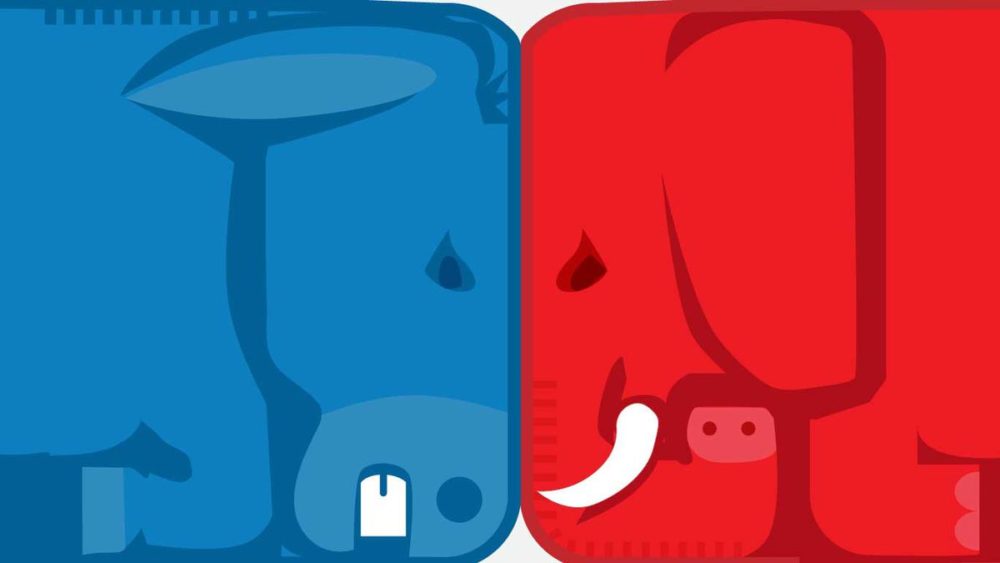

There are three conversations at OTB of late that need to be brought together so that we (the reader here, but Americans writ large as well) need to come to terms with how they interact.
The first is James Joyner’s post (and the subsequent, lengthy comment thread that I mostly drove), Should NeverTrumpers Become Democrats? It raises the question of the real options that face those who have traditionally voted Republican, but who oppose Trump and hie effects on the GOP.
The second is another post from James on Justim Amash’s declaration of independence from the Republican party, as his “a pox on both parties” critique of American politics: Justin Amash Leaves GOP with BothSides Op-ed.
A third is a post of mind from March, On “Independent” Voters (and a follow-up, On “Independents” Again). Those posts dealt a Pew Research Center study about the voting behavior of self-identified independents.
These posts have a theme in common: the intersection between the practical politics of the rules and incentives our of electoral and governing system and the issue of partisan identity.
They also have another theme in common: the disjuncture between what we might like to be true about possible political outcomes and the cold hard truth of the probable outcomes.
Now, let me lay down a huge caveat, which should not be a surprise to anyone who reads this site regularly: I am fully in favor of an electoral system that would unleash the ability of libertarians like Justin Amash, self-declared independents, and various other ideological groups. I very much support electoral reform that would actually result in a representative set of parties to reflect American political preferences. I would further like to see a host of institutional reforms to make the US government more representative in general.
But to paraphrase Donald Rumsfeld: you go to the ballot box with the electoral and party system you have, not the one you wish you had.
So, here’s the hard truth:
Rules. The rules of election, specifically the use of single seat districts with plurality winners, coupled with the usage of primaries to nominate candidates, creates a dynamic in which the only viable winners are Republicans and Democrats (especially as it pertains to the presidency and control of congress).
It would takes thousands of words to explain why this is the case (and I have written about this topic before, and there is a planned post in my series on Democracy and Institutional Design to specifically deal with that subject, but alas, it does not exist yet). But the proof is before your eyes in terms of the clear rigidity of our two party system. There is zero doubt that a politician’s chances of winning office are far higher as a Democrat or a Republican than it is the case for them to win via any other route.
Yes, the two party duopoly has been ruptured before: way back in the mid-19th Century when the Republican Party became the second party to the Democrats, replacing the Whigs. So, the logic goes, it could happen again!
Incentives. Well, sure, it could. But I would vigorously argue that a) it is unlikely and b) there are no signs is it going to happen soon. Moreover, as I have argued before, primaries means that there is no incentive to try and create a viable third party to challenge the duopoly. It is far easier to just win a primary and then have all the advantages of the established party.
Think libertarians Ron and Rand Paul. Did they go to Congress as Libertarians? No. They won GOP primaries and served as Republicans. Think self-identified democratic socialist, AOC. Did she win office as a Democratic Socialist? No. She won the Democratic primary and serves as a Democrat.
Think, too, the Tea Party, which was never a party, but instead a faction of the GOP.
And look, can you find examples of third party winners? Sure. The best example is Bernie Sanders, an independent in the Senate. But even Bernie makes my point: he has twice now sought the Democratic nomination for president. He understands that if he ran as an independent for president, he would have zero shot, but running as Democrat means a real chance at office (and that would be running with the exact same platform. This just shows, yet again, that the electoral rules matter!!).
But, first, Bernie is almost singular in his national-level success winning as an independent for Congress (there are a handful of others–but note the word “handful”). The most prominent example of a third party presidential candidate in recent memory was Ross Perot (who lost badly) and the most prominent example of a national figure who won office as a third party candidate was Jesse Ventura winning the Minnesota governor’s race in 1999.
So, as long as the levers of power are in the hands of the two part duopoly, that is where change has to take place. The only way to even attempt to calibrate the parties is via primaries.
Yes, having only two viable parties stinks from a democratic and representative point of view. But reality is reality.
Identity. Of course, the problem is, people’s identities get wrapped up in their partisan preferences. This is quite normal and understandable. A major purpose of a party, and clear label to identify that party, is so that like-minded people can work together to create desired political outcomes. The “R” or “D” by the name on the ballot is supposed to give you usable information to help you make a choice.
But, identity is a strong force. It can lead people who espouse family values and who cite Christian morality as their bedrock to support a twice divorced candidate who had affairs with a porn star a a Playboy model (among others). This is both a snarky, but also very real, illustration of the power of partisan identity. Plus, people rank-order preferences. Granny may abhor Donald’s porn-star-cavorting, but she sure does like those possibly anti-Roe Supreme Court appointees.
Politics is always inherently about compromise and determining which preferences are at the top of your personal hierarchy.
And this is where we can explicitly bring in the posts I linked at the start. First, one party has the lion’s share of the blame at the moment: the Republicans nominated and elected Trump, and the Republicans in congress are enabling Trump (so Amash’s bothsiderism is off the mark).
Second, part of what gave Trump the White House in the first place was the fact that once he was nominated, partisan identity took over for a lot of people. Not everyone who voted for Trump voted affirmatively for Trump. A lot of them voted for the Republican. This may seem like no difference, but in terms of human behavior, it is a true observation. Likewise, a lot of people who did not identify as Democratic. but who were #NeverTrump could not bring themselves to vote for HRC. Identity matters and it motivates behavior.
Let’s face facts, it is hard for people to give up their identities and vote in a way that that they feel is betrayal of that identity. This manifests as life-long Republicans having to come to terms with the GOP not being what they want it to be, as well as Libertarians and other third party voters trying to decide what their best options are given the presences of Trump on the ballot.
So, Justin Amash decided he is going to quite the GOP, but he can’t quite bring himself to just criticize the GOP. Instead, he engages in some serious bothsiderism.
Now, does the Democratic Party deserve criticism? Of course it does. All parties do. But, at this present moment, and this is key, there is not going to be a third party movement that will deal with Trump nor with the Trumpian behavior of the GOP. The only operative route of serious opposition in the Democratic Party. The only way to guarantee the removal of Trump starting in 2021 is for the Democratic nominee to win. This is incontrovertibly true unless one is engaged in highly wishful thinking.
And this also gets to identity. To semi pick on James Joyner (whom I have known well enough and long enough to know he can take it, and moreover, know he will largely agree with what I am about to say:
As I wrote recently, while I’m functionally a Democrat these days, having voted for Democrats in general elections in 2016, 2017, 2018, and 2019 and almost certain to vote for the party’s candidate in 2020 to defeat Donald Trump, I don’t consider myself a member of the party. While I’ve certainly moved left on some issues over the years, I’m still much more temperamentally conservative than the Democratic leadership. I’m enthusiastic about restoring sanity and a respect for process and the rule of law to the White House, but not necessarily large parts of the Democratic platform.
Source: Justin Amash Leaves GOP with BothSides Op-ed
The part I want to pick on, and it is relevant to both James’ post about NeverTrumpers and the Democratic Party as well as my posts on independents (all linked above) is that the “membership” framing is, in my opinion, all wrong.
Look, the closest we come in the United States to “joining” a political party in any formal way is that in closed primary states you have to register a partisan preference. These exist in a minority of states (Ballotopedia identifies only 14 states with closed primaries for congressional and state-level offices). Most states have open primaries, or semi-closed ones wherein non-affiliated voters can treat the primaries as open. It should be noted, too, that several states with closed primaries have same-day registration, meaning that voters can register to vote on election, which obviates partisan registration since you can change at will.
And sure: you can give money to the RNC or DNC and they might send you a “membership card”–at least their junk mail used to include such, but all that is a token linked to contribution.
As I have repeatedly argued (see the two posts on independent voters), all that really matters in terms of “partisan ID” or “party membership” in a given election is how you cast your ballot.
When we added up all the votes for HRC in 2016 we did not have a tally for “real Democrats” and “temporary Democrats” and “#NeverTrumpers who voted for HRC” or anything like that. We just had a list of votes for the Democrat, which we then called, in complex analytical terms, “Democratic votes.”
It doesn’t matter what is in your heart when you vote. It matter what is on the ballot.
To me, in terms of electoral analysis. the relevant metric is always how votes were cast in the election. Analytically it does not matter, in terms of electoral outcome, how votes view themselves or the motives for their votes. This is whole point I keep making in post after post about the number of “independents” in the US. We know, from actual voting, that most self-identified independents are actually reliable Ds or Rs in the voting both (but it is invariably the case that those posts get very passionate comments from self-identified independents who want to argue about identity rather than measured behavior).
Indeed, Amash goes that route in his op/ed:
Most Americans are not rigidly partisan and do not feel well represented by either of the two major parties. In fact, the parties have become more partisan in part because they are catering to fewer people, as Americans are rejecting party affiliation in record numbers.
These same independent-minded Americans, however, tend to be less politically engaged than Red Team and Blue Team activists. Many avoid politics to focus on their own lives, while others don’t want to get into the muck with the radical partisans.
Source: WaPo, “Justin Amash: Our politics is in a partisan death spiral. That’s why I’m leaving the GOP.“
This is an argument about identity, not behavior. Yes, a lot of Americans identify as “independent” but they, in mass, vote reliably D and R.
And this outcome is not going to change until the structure of the system changes.
So, the argument at the moment is not “should you join the Democratic Party?”–the question is, whether one is Justin Amash, Jame Joyner, Steven Taylor, Doug Mataconis, or some random person reading this post (God bless you for sticking in this long), the question is: what is the most efficacious way to cast one’s ballot to generate the desired outcome of your various rank-ordered preferences?
Put another way: given the structure of the game, how can one score?
No choice, by the way, will perfectly match a given voter’s preferences. The only way to a leader who perfectly fits your personal bill of preferences is for you to become Absolute Dictator (and those jobs are really hard to get).
And look: I understand that personal identity can trump strategic voting. But it still strikes me as worthwhile to think this all through, especially to keep in mind the reality of the possible outcomes, and those outcomes are Rs and Ds.
And I agree with James’ conclusion of his Amash post:
But here’s the thing: pretending that the Democrats and Republicans are indistinguishably bad at the moment is dangerous. Amash himself has come out in support of impeaching President Trump. Our erstwhile party is backing him to the hilt, not only making removing him from office impossible but actively working to ensure he remains in office through January 20, 2024 [sic, actually, gulp, 2025].
Yes, our polarized system is bad for America. Yes, we should seek more moderate alternatives and restore a spirit of seeing those who disagree with us politically as fellow citizens and not enemies. But, no, the blame isn’t evenly spread. One of the parties is geometrically worse right now and it must be defeated at the ballot box.
We have got to understand that the rules and incentives of our system do not provide a third party salvation. And, therefore, we have to recognize that our most pressing problems are being generated far more by one major party, not both.* This, then provided only one pathway for electoral influence over what come next.
BTW: under more normal circumstances I have a different view of third party voting. Signalling has its place. And third party defections can influence the mainline parties, if those defections are large enough. But that is for another set of circumstances.
*And yes, I recognize that not everyone agrees with this sentiment. This post is aimed, therefore, mostly at those who agree that Trump is the most pressing political problem we have at the moment.
As I noted in the comment thread of the post on NeverTrumpers and the Democratic Party:
-Trump is damaging our democracy,
-Trump is doing potentially long-term damage to our economy. (See: tariffs, e.g., )
-Trump is doing potentially long-term damage to the global order (economically and politically).
-Trump has made open racism more acceptable in the United States.
-Trump’s policies on the border have directly created a massive humanitarian crisis.








