
Much of the commentary that has surrounded the departure of David Petraeus from the Central Intelligence Agency due to a sex scandal has included at least some mention of how the retired General has tarnished what was otherwise an impeccable legacy due to a personal foible. It’s certainly true that Petraeus’s reputation as a General was amazingly high. Indeed, he may have been the most popular military commander in recent memory during the time that he was in the field, on a par in popularity with Colin Powell and Norman Schwarzkopf and arguably more skilled than both of them. As the story goes, he’s the man who successfully led the 101st Airborne Division during the invasion phase of the Iraq War, saved that war with the surge in 2007, and then did the same thing in Afghanistan three years later. He was mentioned several times as a possible candidate for President or, more recently, as Mitt Romney’s running mate on the 2012 Republican ticket. There were very few people in American government who were regarded as highly as David Petraeus.
In the wake of the scandal, and the news that Petraeus was allowing unusually close access not only to Broadwell but also to other members of the press and, most interesting, a host of Washington-based conservative think tanks that would embed with his command staff and even be granted the use of military aircraft, some people are reconsidering the Peteraeus legend and finding it wanting. Spencer Ackermann, for example, wrote yesterday about how he had found himself drawn into what he refers to as the David Petraeus cult:
The first time I met Petraeus, he was in what I thought of as a backwater: the Combined Armed Center at Fort Leavenworth. It’s one of the Army’s in-house academic institutions, and it’s in Kansas, far from the battlefields of Iraq and Afghanistan. In 2005, Petraeus ran the place, and accepted an interview request about his tenure training the Iraqi military, which didn’t go well. Petraeus didn’t speak for the record in that interview, but over the course of an hour, he impressed me greatly with his intelligence and his willingness to entertain a lot of questions that boiled down to isn’t Iraq an irredeemable shitshow. Back then, most generals would dismiss that line of inquiry out of hand, and that would be the end of the interview.
One of Petraeus’ aides underscored a line that several other members of the Petraeus brain trust would reiterate for years: “He’s an academic at heart,” as Pete Mansoor, a retired Army colonel who served as Petraeus’ executive officer during the Iraq surge, puts it. There was a purpose to that line: It implied Petraeus wasn’t particularly ambitious, suggesting he was content at Fort Leavenworth and wasn’t angling for a bigger job. I bought into it, especially after I found Petraeus to be the rare general who didn’t mind responding to the occasional follow-up request.
So when Petraeus got command of the Iraq war in 2007, I blogged that it was all a tragic shame that President Bush would use Petraeus, “the wisest general in the U.S. Army,” as a “human shield” for the irredeemability of the war. And whatever anyone thought about the war, they should “believe the hype” about Petraeus.
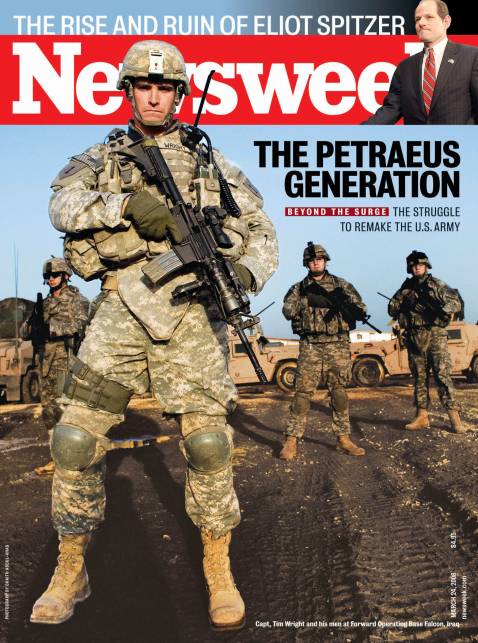
I wasn’t alone in this. Petraeus recognized that the spirited back-and-forth that journalists like could be a powerful weapon in his arsenal. “His ability to talk to a reporter for 45 minutes, to flow on the record, to background or off-the-record and back, and to say meaningful things and not get outside the lane too much — it was the best I’ve ever seen,” Mansoor reflects. It paid dividends. On the strength of a single tour running the 101st Airborne in Mosul, Newsweek put the relatively unknown general on its cover in 2004 under the headline “Can This Man Save Iraq?” (It’s the first of three cover stories the magazine wrote about him.) Petraeus’ embrIn ace of counterinsurgency, with its self-congratulatory stylings as an enlightened form of warfare that de-emphasized killing, earned him plaudits as an “intellectual,” unlike those “old-fashioned, gung-ho, blood-and-guts sort of commander[s],” as Time‘s Joe Klein wrote in 2007. This media narrative took hold despite the bloody, close-encounter street fights that characterized Baghdad during the surge.
Ackermann goes on to note Petraeus’s overwhelmingly positive press coverage during the time he was in command and the role that Petraeus’s staff, which stayed in close contact with the reporters that covered him, playing in shaping the media narrative:
There was another element at work: Counterinsurgency seemed to be working to reduce the tensions of Iraq’s civil war, as violence came down dramatically that summer. So when I got the occasional push-back e-mail from Petraeus’ staff that my reporting was too negative or too ideological, I feared they had a point. And I got exclusive documents from them that — surprise, surprise — not only vindicated Petraeus but made the general seem driven by data and not ideology.
To be clear, none of this was the old quid-pro-quo of access for positive coverage. It worked more subtly than that: The more I interacted with his staff, the more persuasive their points seemed. Nor did I write anything I didn’t believe or couldn’t back up — but in retrospect, I was insufficiently critical. And his staff never cut off access when they disagreed with something I’d written. I didn’t realize I was thinking in their terminology, even when I wrote pieces criticizing Petraeus. A 2008 series I wrote on counterinsurgencywas filled with florid descriptions like “Petraeus is no stranger to either difficulty or realism.“
In other words, without anyone actually realizing it, Petraeus, or at least his staff, was running a very sophisticated public relations campaign that helped to perpetuate the media myth that had developed around the General and created an environment where the reporters covering him came to believe the myth rather than question it. Whether this was consciously Petraeus’s work or not is unclear. After all, it’s not uncommon for a Commanding Officer’s staff to protect their leader and take steps to burnish his legacy. At the same time, though, the extent of the Petraeus myth making over the course of the years, and the numerous times that he himself developed closed relationships with journalists and academics, most notably of course with Paula Broadwell, suggests that Petraeus was well aware of the myth-making that had developed around him and was an active participant in it. That, perhaps, is why so many people believed, despite his protestations, that he had a political career in mind for his future.
Bernard Finel touches on that point in his comments about the entire Petraeus-Broadwell relationship, which he points out is about a lot more than just sex:
It wasn’t a private affair. Broadwell wasn’t some random family friend. She was his de factoofficial biographer. He’d used his position, first in the military and then at CIA, to enhance her visibility and reputation precisely because she was able and willing to burnish his public image. Petraeus’ conduct with Broadwell was abhorent even before he had sex with her. He used government resources to promote himself personally and to leverage that popularity in order to back elected officials into a corner in order to get what he wanted both in terms of policy and in terms of personal advancement. This is a public affair and it speaks directly to Petraeus’ abuse of power and position throughout the last decade.
I’ll also note that many of his defenders, particularly those trotting out the “private affair” line of argumentation are similarly compromised. Ricks, Boot, Andrew Exum, Mike O’Hanlon, and many others were all part of the same dirty little quid-pro-quo, where they got career boosts and access in return for building up the Petraeus cult.
Again, this is not a private affair. Broadwell was part of a general pattern of abuse of power and violation of civil-military norms by David Petraeus. Focusing on the sex is just a nice way to deflect from the deeper corruption here.
The fact that virtually nothing was said about this while it was going on is, if nothing else, a testament to how firmly the Petraeus myth had taken hold of many of the journalists who covered the military for a living. Rather than asking the questions they should have, these people found themselves caught up in the same kind of hero worship that drew Broadwell to Afghanistan and, eventually, into a relationship with Petraeus.
Beyond the hagiography, though, there are other reasons to be concerned about Petraeus’s legacy. For example, as Robert Wright points out, there’s the militarization of the Central Intelligence Agency:
When, in the fall of 2011, David Petraeus moved from commanding the Afghanistan war effort to commanding the CIA, it was a disturbingly natural transition. I say “natural” because the CIA conducts drone strikes in the Afghanistan-Pakistan region and is involved in other military operations there, so Petraeus, in his new role, was continuing to fight the Afghanistan war. I say “disturbingly” because this overlap of Pentagon and CIA missions is the result of a creeping militarization of the CIA that may be undermining America’s national security.
This trend was clear during the Bush administration, but it accelerated under President Obama, who greatly expanded drone strikes, and it reached a kind of symbolic culmination when Obama nominated this four-star general to run things at Langley. That would have been the perfect time to reflect on the wisdom of the convergence of the CIA’s and Pentagon’s jobs. But, instead, the network of journalists, think tankers, public officials and others who constitute the foreign policy establishment preserved their nearly unblemished record of not focusing on the biggest questions.
(…)
I think history is going to judge American foreign policy in the Bush-Obama years harshly. And I think a big reason is that we’re missing a fleeting opportunity to help build a world civilization based on widely respected laws and norms. Shortly after 9/11, with the US holding the attention and sympathy of the world, it had the opportunity to start doing this. President Bush failed–by, to pick just one of many examples, attacking Iraq without having international law on his side.
I wish I could say that President Obama has done a whole lot better than Bush. And, in Obama’s defense, he did get UN Security Council authorization before intervening in Libya (leaving aside the question of whether the intervention ultimately exceeded the UN mandate). But in many ways this president is no improvement over the last one, and Exhibit A is the acceleration of a far-flung drone-strike program that is shrouded in the secrecy of the CIA. The vision implicit in this program is of an America whose great calling is to lead the world into a future of chaos and lawlessness.
This prospect was vividly highlighted when, a bit more than a year ago, Obama had David Petraeus turn in his stars so he could move to the CIA and keep fighting wars. There have been other military men who headed the CIA, but never has there been one whose move to Langley brought so much continuity with what he was doing before he went there.
None of this is to say that Petraeus was a bad General. The evidence to the contrary on that point is far too voluminous to ignore. However, it should have been clear even when he was in the field that the man did not measure up to the myth, they never do after all, and that our media was doing us a disservice by buying into it.