
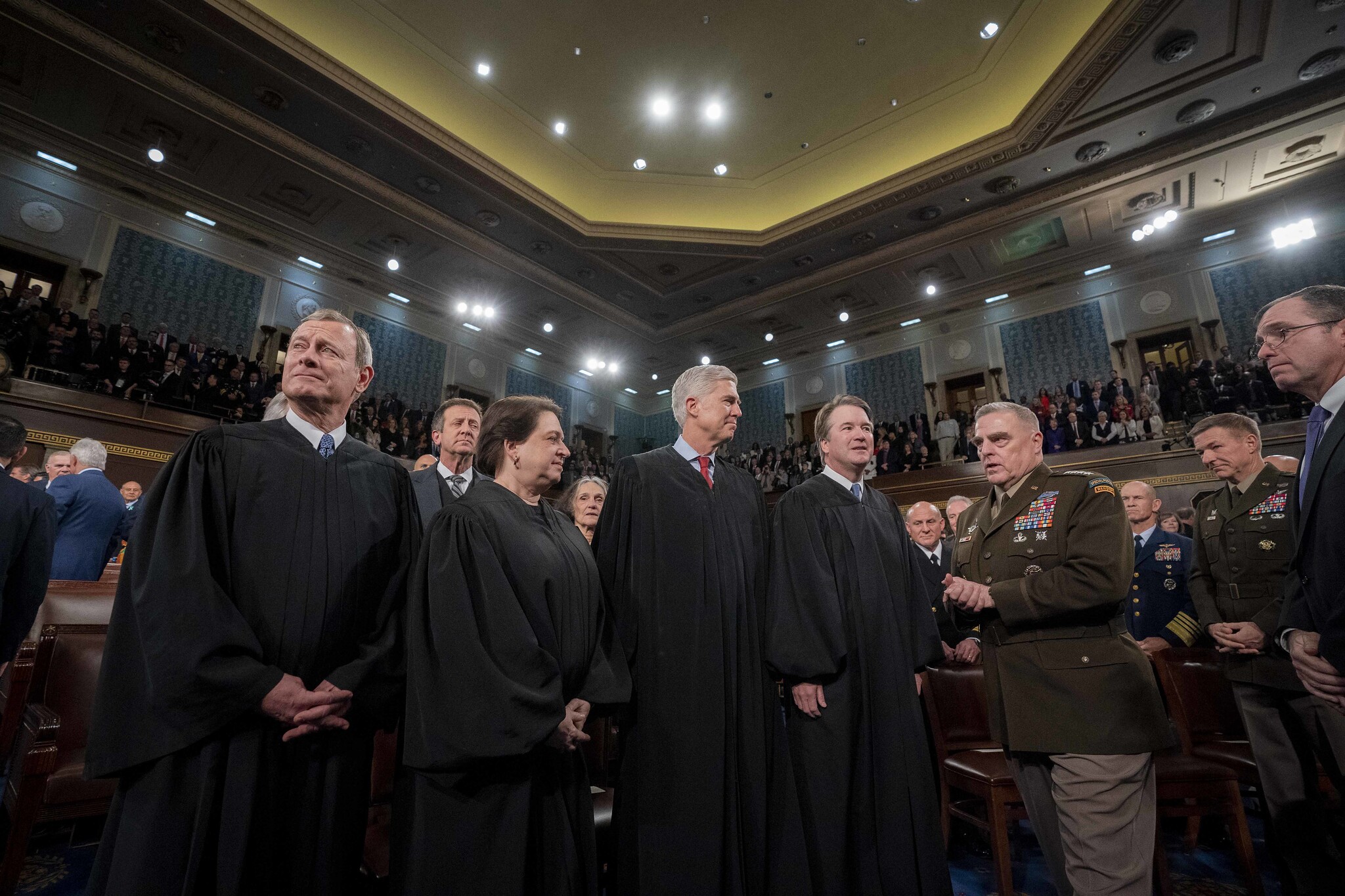

“You don’t want the political branches telling you what the law is. And you don’t want public opinion to be the guide of what the appropriate decision is,” said Roberts, who added, to laughter, “Yes, all of our opinions are open to criticism. In fact, our members do a great job of criticizing some opinions from time to time. But simply because people disagree with an opinion is not a basis for criticizing the legitimacy of the court.”
While I understand what he means from a judicial/lawyerly point of view, I would point out that the “political branches” actually make the law. Indeed, I think that law schools (and the general discourse on this matter) incorrectly propagate the notion that legal interpretation is a technical matter somehow unsullied by politics. I also think that, yes, in a democratic republic that public opinion is quite relevant to judicial decision-making (although the best way for that to happen is for democratic processes to produce the judicial branch instead of allowing minority rule to produce the courts).
As was noted in the comment section of another post recently, often people use the term “political” to mean “partisan” but even then, it is hard (indeed, impossible) to ignore the partisan nature of appointments to the court and to the behavior of the Justices once appointed.
For the Court to see itself as not “political” is ultimately absurd and deep down I think Roberts knows it.
And let’s speak plainly about the abortion issue. Regardless of one’s position on the matter, it is quite clear that we did not end up with Dobbs simply as a result of some technical legal process. Rather, it came about because of politics, electoral and otherwise. (But not because the majority of the population wanted this policy outcome).
Indeed, Roberts may have talked about calling “balls and strikes” on the bench during his confirmation hearing, which sounds oh so very technical and neutral. But the reality is that the strike zone he uses is politically defined (as are those of all the other Justices). It is the result of specific philosophical and ideological presuppositions and beliefs. It is political to its core. If being on the court was simply a matter of learning the law and a clear set of rules for the application thereof, then we could just have judges be trained bureaucrats like in code law systems and avoid the political system as a general matter.
And I would heavily underscore that while it is true that while “people disagree[ing] with an opinion is not a basis for criticizing the legitimacy of the court” the way the court has been constituted prior to making controversial decisions is very much a good reason to raise the legitimacy question.
We cannot pretend that it is inconsequential (let alone not political) that three of the Justices were appointed by a president who won office via a popular vote/electoral vote inversion.
Nor can we ignore that that fact is all exacerbated by the way McConnell denied Obama a vote on a nominee when Scalia died and then the way he rushed confirmation of Coney Barrett when RBG died.
Not only did McConnell himself orchestrate the outcome over the Scalia vacancy (and made arguments about proximity to elections that he then ignored when RBG died, in a supreme act of utter, naked, and totally political hypocrisy) there was no way the GOP was going to give Obama the ability to fill that seat. They had the votes and that was that. Still, I will note that the behavior in question was norm-breaking, as past presidents had been afforded the ability to fill vacancies without such obstructionism. But when Roberts cries crocodile tears over the court’s legitimacy being questioned, he needs to take a hard look at how the court over which he presides was constituted. I realize he has no control over that process, but he knows full well how it works.
I would further note that even setting aside the popular vote inversion issue, our flawed system allowed a single president, in one term, to utterly reshape the Supreme Court potentially for decades. Whether people fully understand the mechanics of that or not, it certainly creates perceptions of unfairness that lead to the questioning of the legitimacy of the process, especially when SCOTUS is willing to overturn established rights.
Let me spell it out for Roberts: a minority of the country supported the 45th president. The 45th president was then able to appoint three Justices to that Supreme Court who were all confirmed by a Senate that represented a minority of the population. That court then went on to overturn abortion rights that had been enshrined in constitutional law for almost fifty years. And, in doing so, at least one Justice noted that overturning rights to contraception and same-sex marriage were potentially fair game. Oh, and there is a real possibility that this court could threaten the integrity of democracy in the United States.
Gee, I wonder why some people might be a tad upset with the court?
Let’s talk about “legitimacy” for a moment. It is a somewhat tricky concept. We can think about it in technical-legal ways and also in a broader abstract/normative sense.
For example, legally, SCOTUS was legitimately appointed. One can gripe all day long about the Electoral College and the representativeness issues of the Senate and the like, but the reality is that Trump was elected to the presidency under the rules of our constitutional order and likewise the Senate. Further, there can be no arguments that constitutional processes and procedures were followed in the nominations and confirmations of Justices Gorsuch, Kavanaugh, and Coney Barrett.*
So, in the technical/legal/constitutional sense, there is no argument about SCOTUS’ legitimacy. This matters for a variety of reasons, not the least of which being that if one is truly upset about the makeup of SCOTUS and its rulings, the issue is fundamentally structural. (In more colloquial terms, don’t hate the players, hate the game).
We can also talk about legitimacy in the broader abstract sense, which has to do with the degree to which the population actually accepts the court and its rulings as just and proper.** One might even ask if the court has democratic legitimacy in the sense that a government that is supposed to derive its power from the people needs the acquiescence of the people to survive and govern, regardless of the legal processes noted in the previous paragraph.
It is worth noting that when large numbers of people start to question the democratic legitimacy of institutions, this can lead to civil unrest. It certainly can contribute to general public frustration with government in general, beyond just the object of concern. Such frustration can lead simply to political action (i.e., voting). So, for example, we are seeing the Dobbs decision be a likely motivator in November. If such basic political action leads to increased representation of majority views on this subject and to subsequent policy actions on this and related topics, then the frustration will subside. But, if it turns out that voting does not result in some level of alleviation of concerns, further frustration will build and more questioning of the democratic legitimacy of the system will grow. That way leads to contentious politics.
Growing frustration seems the likely direction, especially since SCOTUS will not be directly affected by the November elections. Indeed, the morbid truth is that change on SCOTUS will only occur via the expiration of members of the court (as resignations are unlikely–as is court expansion). And it would take multiple deaths coupled with specific political alignments in the presidency and the Senate to change the ideological makeup of the court any time soon. It is truly a bizarre system if one thinks that it should have some level of democratic legitimacy and the design of the constitution does connect the appointment and confirmation of Justices back to branches that can trace their fundamental power to democratic processes (even if they are indirect and not fully democratic–i.e., the Electoral College and the Senate).
I would note that even with the obvious democratic deficiencies of the EC and the Senate, the design of the model did not foresee the combination of a popular vote inversion and three vacancies on the court in one term (and it didn’t take into account the huge disparity in population size of the states–let the addition of 37 states).***
I could drill down into this subject quite a bit further, but this post is already quite long. The bottom line is that while I understand that Chief Justice Roberts likes the fiction (and make no mistake, it is a fiction) that SCOTUS is apolitical and just engaged in dispassionate legal refereeing, this is simply not the case. The court is inherently political, if not partisan. It makes binding decisions of great significance and the public has to right to have opinions about those decisions. Moreover, the legitimacy of the court is, dare I say, on trial, because of the way in which it is constituted and the fact that is it largely unaccountable to the broad population, despite the fact that we are supposed to have government of, by, and for the people.
I will conclude by noting that these contentious issues ought to be more firmly in the overtly political space, i.e., in the legislature. However, our national legislature is not set up to actually represent the public effectively. The House is too small and is elected predominantly in uncompetitive districts that do a very poor job of representing the varied interests of the population. Moreover, all legislation must make it through the Senate, which over-represents low-population areas of the country and is hamstrung by internal rules that empower a minority of the chamber.
Our core problem remains a dearth of actual representativeness at the national level. This is exacerbated by the empowerment of the numerical minority in the Senate, the EC, and SCOTUS and is why Chief Justice Roberts is facing a legitimacy crisis in the institution he oversees.
*Well, I am sure there can be arguments. Some will likely argue that McConnell acted unconstitutionally, but I do not think that position is defensible. There is no constitutional requirement for the Senate to act, not to mention, again, the Democrats did not have the votes regardless of what McConnell did or did not do.
**We have discussed abstract legitimacy before as it pertains to SCOTUS here at OTB before. For example, James Joyner’s post Against Packing the Supreme Court and my post Back to SCOTUS Reform and “Legitimacy” (wherein I make similar arguments to this current post).
***Really, design or intent-based arguments are ultimately problematic. The original design was for 13 states and did not presage adding geographically huge states, among a host of other issues. The system we have is quite plainly not what the Framers were dealing with in their debates in Philadelphia. To pretend otherwise is simply erroneous thinking (although it is widespread, I will agree).









