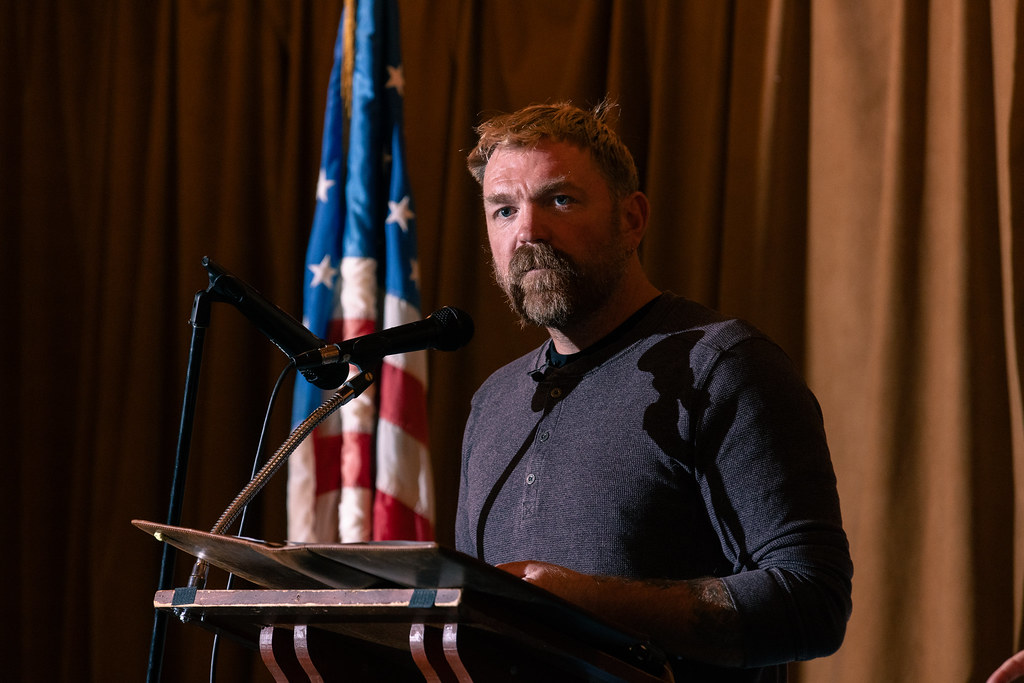
It appears that accused rapist Graham Platner will bow to the pressure to resign the Democratic nomination to be Maine’s next US Senator. Retired Army Special Forces officer Mike Nelson takes a victory lap in his Atlantic essay “Perhaps the Nazi Tattoo Was a Clue.”
Nearly everyone who previously supported Platner seems to have since reversed course. Credible allegations of sexual assault do, indeed, go too far.
But the question remains: Why was this horrific allegation the threshold when Platner had so obviously transgressed so many times before? Perhaps Platner’s Nazi tattoo should have been a sufficient indicator that he lacked the character to be a senator. Perhaps maintaining that SS logo for two decades, covering it up only when it became politically inconvenient, demonstrated that he lacked the judgment for national office. Perhaps a multiyear history of not just having abhorrent views about women and minorities, but feeling the need to post them for the world to see, could have told us that he is not the person to be Maine’s voice in Washington. Maybe a well-documented history of contemptible behavior in his personal life should have been enough, when taken with everything else, for Democrats to conclude that Platner was exactly the person he appeared to be.
When Platner emerged last year as the Democrats’ shiny new object—DSA sensibilities with a gruff voice and working-class clothes—many who favored his brand of leftist populism rallied to help him defeat Democratic centrism. He managed to do so when his primary opponent, Governor Janet Mills, suspended her campaign before votes were cast. Platner’s backers hoped that he could do the same against Susan Collins this fall. But when a clear pattern of Platner’s bad behavior and bad judgment emerged, these Democrats held firm, using their positions of prominence to assure voters that what we all could see was somehow not as it seemed. This latest allegation was not a black-swan event—a shocking and unexpected revelation from an otherwise strong candidate. Rather, it was the most recent in a steady drumbeat of disqualifying revelations.
It’s good that those who have changed their mind about Platner are now telling the woman who spoke with Politico, Jenny Racicot, that they will not stand with her alleged victimizer. But why were the Jews who were targeted by the organization whose logo he bore not worthy of the same support? And was Lyndsey Fifield, a conservative woman who alleged that Platner had engaged in emotional and physical abuse (also denied by Platner), less worthy because of her politics? What does it say about Platner’s defenders that his other horrible behavior was within their range of acceptability?
[…]
When the Platner campaign comes to its ignominious end, as it almost certainly will whether he withdraws or not, the value of conducting a postmortem will not be about Platner himself, a deeply flawed person worthy of neither the office he sought nor the support he received. It will be about those who gave him that support. Not only did they stand by Platner; they expressed outrage toward those of us who said he was unfit. And contemptibly, they attacked one of Platner’s accusers, Fifield. “Believe women,” it seems, does not extend to victims who commit the unforgivable sin of having voted for Republicans.
Perhaps next time these officeholders, influencers, advocates, and organizations will think twice before throwing their full-throated support behind someone they do not actually know or, at a minimum, withhold support from those who are clearly unacceptable.
[…]
The voters themselves should not be let off the hook; a republic’s survival requires the engagement of an educated electorate. Even though most of Platner’s behavior had been widely reported prior to the June 9 primary, an overwhelming majority of Democratic voters in Maine selected Platner. They either made no effort to inform themselves about the man for whom they cast their vote, did not believe the well-corroborated claims against him, or felt that Nazi iconography, alleged partner abuse, admitted substance abuse, and offensive Reddit posts were of less importance than defeating Mills. None of those justifications was ever sufficient.
Nelson definitely told us so, with two previous Atlantic essays on the subject. Back in May, he observed that “Condemning a Nazi Tattoo Shouldn’t Be This Hard.” He followed up in June with “The ‘Broken Veteran’ Excuse,” which was subtitled, “Graham Platner’s defenders are playing into a dangerous stereotype about Americans who have fought in war.”
The obvious rejoinder, of course, is whataboutism. Especially, “What about Trump?”
I’ve only recently become familiar with Nelson’s work and don’t know his voting history, but would bet it’s similar to mine, albeit shorter. His Atlantic resume dates back exactly a year and includes only two essays besides the Platner trilogy: “What Pete Hegseth Doesn’t Understand About Soldiers” and “The Enemy That Hegseth and Trump Insist on Honoring” (regarding the Confederacy). He has also been prolific at the #NeverTrump conservative site The Dispatch. A quick scan of the headlines of his essays there also tracks: he is not a Trump supporter.
Regardless, he’s right. We should demand that those who serve in leadership posts be decent human beings. There are plenty of people who meet that minimal threshold to represent your ideological preferences.