
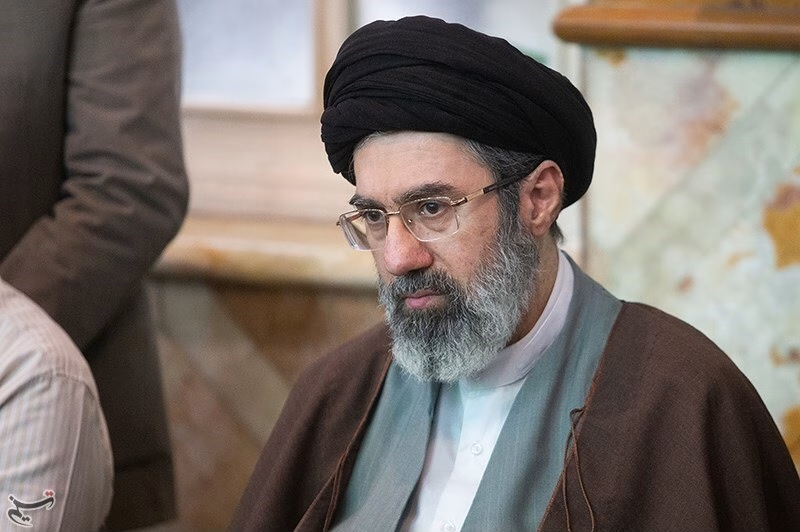
A disturbing report from a somewhat sensationalist source, the New York Post (“Iran’s leaders turn on each other as hardliners push for wider conflict“):
Iran’s leaders are fighting each other almost as much as they’re battling the West, with some senior politicians scrambling to save US talks while the powerful Islamic Revolutionary Guard Corps leans into the renewed war, regional sources told The Post.
With Supreme Leader Mojtaba Khamenei out of public view, there’s no one left to force the rival factions back into line — meaning the future of the conflict may now be decided by a power struggle in Tehran, not by Washington.
The growing divide has exposed what the sources describe as two competing centers of power inside Tehran: civilian leaders trying to preserve a fragile diplomatic track and military hardliners determined to keep up pressure through confrontation.
Iranian President Masoud Pezeshkian, Foreign Minister Abbas Araghchi and Parliament Speaker Mohammad Bagher Ghalibaf want to keep dialogue with the US alive and prevent the fighting from spiraling into another full-scale regional war, the sources said.
But their authority has steadily eroded, one regional source familiar with Iran’s internal dynamics told The Post.
“They can sign [agreements], but they can’t stop the IRGC from acting or parliament from legislating around them,” the person said.
Instead of winning internal political battles, the IRGC has increasingly created “facts on the ground” through military action, the source said, while hardline lawmakers move afterward to enshrine those actions into law.
“The hardliners don’t need to win internal arguments,” the source said. “They create facts on the ground … and get parliament to legalize them after the fact.”
“The shift is real — now it’s becoming law, which is much harder to reverse.”
That distinction — between the politicians publicly speaking about diplomacy and the security establishment making decisions on the battlefield — is key, according to Behnam Ben Taleblu, senior director of the Foundation for Defense of Democracies’ Iran Program.
“Yes, there are politicians who occasionally come out, including even Iran’s foreign minister, who talk about dialogue,” Taleblu told The Post. “But those driving the train, those with their finger on the trigger, those making some of the most important decisions continue to talk and act like escalation is what will secure their survival, not engagement.”
While Tehran has historically balanced diplomacy and military pressure simultaneously, Taleblu said recent events suggest the regime is increasingly betting on confrontation.
“There is obviously a divide in Iran,” he said. “But we have to make sure that when we look at the divide, we pay attention to who matters and what matters — and who and what matter seem to be doubling down on escalation.”
The widening split has become increasingly visible in recent weeks, the source said.
During the funeral ceremonies for Ayatollah Ali Khamenei, the front rows were filled with IRGC members rather than civilian officials, underscoring the military’s growing influence, according to the source.
What’s more, several televised speeches by Iran’s political leadership have been partially edited before broadcast instead of running live — raising further questions about who controls the country’s public messaging, the person added.
As noted at the outset, the Post is not my go-to source. It’s a sensationalist tabloid, with a longstanding ideological bent. But the report largely tracks what I’ve gathered from more mainstream sources in recent months.
First and foremost, the ostensible Supreme Leader, Mojtaba Khamenei, has not been seen or heard in public since the attack that killed his parents and in which he was reportedly grievously wounded. He has ostensibly issued several public statements that were read by others. But there’s no assurance that they’re actually his. For all we know, he’s not even alive.
Even presuming the statements are his, there’s no pretense that he’s in charge in the way that his father was.
An Al Jazeera report from 19 July (“‘Sacred unity’: Iran’s supreme leader calls for calm amid political divides“) gives the impression of disunity, if not disarray:
A message attributed to Iran’s Supreme Leader Mojtaba Khamenei has promised “unforgettable lessons” to Washington during their escalating conflict. But it also homed in on another theme that tempered some of the fire of his warnings against the US, amid eight nights of renewed fighting between the two countries.
Khamenei, who has not been seen or heard from since being made supreme leader in March, said Iranians must uphold “sacred unity” as a fundamental imperative, particularly against the United States.
His message also stated that it was a duty for the Iranian population and officials to refrain from “division, political disputes, and increases in social differences”. Iran’s enemies, he said, likely referring to the US and Israel, “must not detect any sign of weakness from us”.
The call for national unity comes against the backdrop of events in June, when another Khamenei statement stirred debate and controversy among some of the most hardline supporters of the Islamic Republic regarding the recently signed memorandum of understanding (MoU) with the US.
Khamenei said that although he “held a different view” about the agreement to pause four months of fighting, he approved it after President Masoud Pezeshkian, as chairman of the Supreme National Security Council, accepted responsibility for the deal.
[…]
Critics believe Khamenei was being forced into accepting a bad deal, and hardline clerical lawmaker Mahmoud Nabavian even resorted to reading from classified material on live television in an apparent attempt to derail the arrangement. He was removed from the parliament’s National Security and Foreign Policy Committee earlier this month.
Others went as far as accusing officials of treason, and the president and other officials linked to the deal were heckled during the funeral ceremonies for assassinated Supreme Leader Ayatollah Ali Khamenei earlier this month.
A July 10 NYT report (“Iran’s Supreme Leader Remains Absent, a Void at the Top of the Regime“) gives a similar impression:
Iran is grappling with a devastated economy, a restive population and the ever-present threat of a return to all-out war. And yet, there is a looming absence at the top of the government, with Iranians still waiting to see or hear directly from their supreme leader.
Ayatollah Mojtaba Khamenei was appointed to the role in March, days after U.S.-Israeli strikes at the outset of the war killed his father and predecessor, Ayatollah Ali Khamenei, but he hasn’t been seen in public since. That has led some to wonder not only about the health of Mojtaba Khamenei, who was injured in the attack, but also whether he is really running Iran at this pivotal moment for the country.
He has offered no clear public guidance on a clash between the hard-liners who oppose any diplomacy with the United States, and the pragmatists, including Iran’s president and foreign minister, who agreed to a preliminary cease-fire deal with the United States last month.
[…]
The supreme leader is entrusted with commanding Iran’s military; deciding the head of the judiciary and various key positions; declaring war and peace; and other critical leadership functions. In Iran’s blended system of theocratic and republican elements, it is the office that holds ultimate primacy.
There was some expectation that Iran and the world would get their first glimpse of the new Ayatollah Khamenei this week, during his father’s funeral. But, on Thursday, the ceremonies concluded without an appearance.
Without a strong central authority like the elder Ayatollah Khamenei, it has become even more unpredictable which faction will eventually gain the upper hand — and how the country will navigate its many crises.
[…]
“There’s no central authority in effect to reconcile the various factions that are fighting for control,” said Ali Ansari, a historian of Iran at the University of St. Andrews in Scotland.
It’s a drastic change from what Iranians became accustomed to over the past 37 years. Ayatollah Ali Khamenei was a constant presence in Iranian political life, giving frequent public remarks that signaled his views and served as implicit direction for the thousands of officials, security forces and politicians that run the government day-to-day.
Virtually the only hint that Iranians have had of Mojtaba Khamenei’s personality, approach or views has been in around a dozen written statements, issued under his name since mid-March, marking official holidays and in some cases, weighing in on policy. Because the public cannot see him or hear his voice, Mr. Ansari said, they cannot know what he actually thinks.
[…]
Under Ali Khamenei or his predecessor, Ayatollah Ruhollah Khomeini, the supreme leader would have represented an ultimate, recognized source of authority that could settle disputes and indicate a way forward. But now, Iran’s ideological military, the Islamic Revolutionary Guards Corps, appears to be asserting even more power than it did in the past, and there are some indications of a more collective decision-making process.
Writing for TIME back on May 9, Iran scholar Hamidreza Azizi (“The New Leaders Calling the Shots in Iran“) began similarly:
[W]ho, exactly, is running Iran?
After all, American and Israeli strikes have killed not just the former Supreme Leader Ayatollah Ali Khamenei, but also Ali Larijani, the chief of Iran’s highest national security body, as well as many senior commanders of the Islamic Revolutionary Guards Corps (IRGC) and the Iranian army. The result, according to U.S. President Donald Trump, is that the Iranians are “all messed up.” “They have no idea who their leader is,” he remarked during a recent call with MS NOW.
But then shifted to a more nuanced take:
[T]he war may have removed multiple Iranian leaders from the stage, but it has not paralysed the Iranian state. Despite the conflict, Iranian command structures have been reconstituted, decisions continue to be made, and Iran has adapted to sustained pressure.
All of which reveals the answer to the question posed above: in the post-Ali Khamenei reality, power in Tehran has not reorganized around a single, dominant leader. Yes, Mojtaba Khamenei, the new Supreme Leader, formally holds the position at the apex of authority. But he is not his father; power previously concentrated in the Supreme Leader’s office is now distributed among a narrow circle of military, security, and political figures whose portfolios and responsibilities increasingly overlap.
[…]
With the Supreme Leader no longer the sole authority, the man acting as a bridge between the military and political spheres of this revamped architecture of decision-making in Iran is Mohammad Bagher Ghalibaf, who has repeatedly adapted his public identity to the needs of the moment. He has served in almost every major institution in the Islamic Republic: an IRGC commander during the Iran-Iraq war, chief of the Iranian police, Mayor of Tehran for 12 years, a presidential candidate, and the speaker of the Parliament since 2020.
[…]
Another critical voice in that establishment as Iran navigates this war is Brigadier General Ahmad Vahidi, the acting commander-in-chief of the IRGC. A hardliner, Vahidi has held senior intelligence and operational posts within the military branch. He was the founding commander of the Quds Force, the powerful, elite branch of the IRGC responsible for covert operations across the Middle East. He also served as Iran’s minister of defense and interior.
[…]
But Vahidi’s influence has its limits. He carries serious weight among the more hardline factions of the IRGC and the broader security establishment, yet he is not a figure who can easily command the full loyalty of the establishment as a whole, let alone Artesh, the regular army, or the civilian bureaucracy. He must, therefore, work alongside Ghalibaf. Vahidi supplies the command structure with military resolve; Ghalibaf offers it political integration. Their roles are not interchangeable, but under wartime conditions, each makes the other more useful.
Beyond the individual personalities, the most important institution coordinating Iran’s security and foreign policy priorities amid the war is the Supreme National Security Council. The council used to be led by Ali Larijani, the formidable political operator and confidant of Ali Khamenei, who was killed in an Israeli strike in March. His replacement, Mohammad Bagher Zolghadr, personifies another shift in the Iranian system’s center of gravity, away from political management and toward security-bureaucratic coordination.
[…]
What emerges from this arrangement is a structure in which no single figure needs to do everything. Each commander operates within a defined set of roles that are distinct but complementary, allowing the system to function without relying on a single center of authority. Differences exist among them, and those differences may become more visible once the war ends. For now, however, they operate inside a shared framework held together by the imperative for survival, institutional cohesion, and the preservation of the Islamic Republic’s military core.
[…]
The result is a more thoroughly militarized system, but not a military junta in any conventional sense. Civilian institutions still matter. The parliament, the presidency, the judiciary, and the national security council remain part of the architecture. But the logic that now organizes all of these institutions is increasingly shaped by security commanders and battlefield veterans whose formative experiences are defined not by negotiation but by confrontation. The state has not abandoned its formal structures. It has bent them, without announcement, toward the requirements of prolonged conflict.
This is why internal differences within the system do not amount to paralysis. But under wartime conditions, these distinctions are contained by a fundamental consensus: the system must survive, the IRGC must remain cohesive, and the war must not end in a way that invites another round of attacks. Disagreements may sharpen after the war, especially over the distribution of political and economic power among different factions. For now, however, they operate within a shared framework rather than against it.
Almost three months have passed, and the system is surely more pressurized. But it’s one that’s immune to decapitation. It’s also one that would be really hard to negotiate with, given the varying factional interests.









