
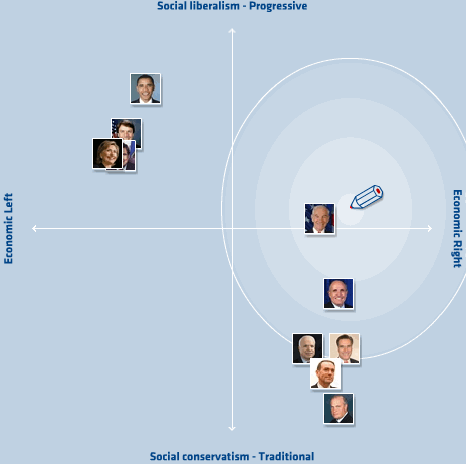
 The latest quiz meme going around the blogosphere is the Electoral Compass USA, which asks 36 rather poorly worded survey questions on a wide variety of issues and then matches you up with the candidates. Amusingly, Ron Paul is far and away the closest to me.
Dan Drezner had the same outcome, much to his chagrin. He rationalizes the finding away thusly:
This, by the way, is why things like personality and leadership style are relevant to voting decisions (and are tough to capture in surveys). A candidate’s policy positions are not the only thing that matter. The way in which the candidate will try to implement these policies matters too. I would’nt vote for a candidate who shared my precise policy positions but decided to implement them by constitutionally questionable methods, for example. Process matters just as much as substance.
Steve Bainbridge, whose results paired him with Mitt Romney — his least favorite candidate — concurs.
Mostly, though, I think this just shows that these political compass surveys don’t work very well. For one thing, as Drezner notes, they don’t measure intensity — they simply treat all issues equally, regardless of how important they are to a particular voter.
More importantly, though, the questions don’t allow for nuanced answers. In this particular case, the survey is filled with double barreled questions that presume premises with which I disagree.
“People should have a background check and obtain a license before they can buy a gun,” I answered Yes to this because it makes sense to take prudent measures to keep guns away from felons and nutcases. But I’d only support relatively painless “instant” background checks.
At the same time, I agree that “Stricter gun control will not reduce crime.” This question, though, points to another problem with the survey: Negative questions. They should all be in the form of “Stricter gun control will reduce crime.” Introducing a negative and then asking people to agree/disagree is confusing.
“An additional carbon tax on fuel will effectively reduce pollution” presumes a rather specific degree on knowledge which most people simply lack. Whether they understand the science behind it is irrelevant in measuring ideology, I suppose, but I’d wager few people even understand what a carbon tax is.
“The US should never sign international treaties on climate change that limit economic growth” merges two issues in a dubious way.
“The US had every right to invade Iraq” is a legal question rather than an ideological one. But it’s pretty complicated, regardless. One who says, “Yes, because Iraq violated the terms of the Gulf War cease fire treaty and several UN Security Council resolutions” is displaying very different ideological beliefs than someone who says, “We’re the United States of America and can invade whomever we goddamn well please!”
“The US is safer because of the invasion of Iraq.” I’d say we’re not in the short term but might be in the longer term. Regardless, we need to keep trying to buy time for an effective government to stabilize. Where does that fit on the quadrant/candidate map?
“The best way to reduce the federal deficit is to raise taxes.” The best way is stunning economic growth, followed by spending restraint. But tax cuts are good, too. So, while I disagree fundamentally with Dennis Kucinich on this question, we’d give the same answer.
“The government has no responsibility to provide retirement funds.” There’s so such inherent responsibility. We’ve created one, however, by seven decades of forced contributions to Social Security. So, do I agree with Ron Paul? Hillary Clinton?
“The federal government should reduce income inequality.” I’m a right-libertarian but would say Yes if No is my only alternative. At a minimum, we need to provide a safety net for those who truly can’t work owing to illness or handicap.
“Iran is not an imminent threat to world peace” is a ridiculously complicated question. It’s certainly a dangerous country led by a rogue regime. But it’s largely a regional threat and I’m not sure it’s “imminent.”
“The US should decrease its spending on defense” is something I’ve argued for years. It doesn’t make sense right this minute, though, given that we’re deployed to two major wars.
There are probably a dozen or more such examples but I shan’t belabor the point any longer.









