
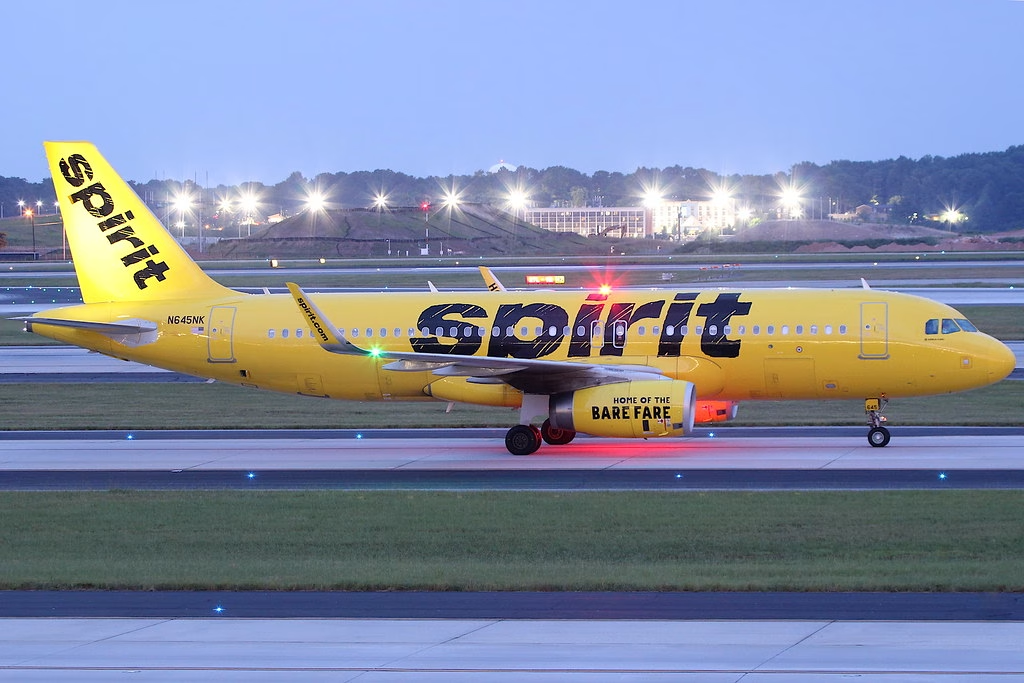
This morning’s episode of The Daily, “What the End of Spirit Airlines Means for the Future of Flying,” is a maudlin look at a failed business model. The guest is Niraj Chokshi, who reported the airline’s abrupt closure over the weekend.
Spirit Airlines reshaped aviation in the United States by stripping down flying to its essentials and selling what were often the cheapest tickets around. But the airline shut down for good on Saturday, a victim of the rising costs it once excelled at controlling.
[…]
The budget airline had lost billions of dollars in recent years as it struggled with intense competition at its most important airports — Las Vegas, Florida and New York among them — along with rising labor costs and aircraft maintenance needs.
As a result, Spirit filed for bankruptcy in 2024 and again in 2025. It had aimed to emerge from the second bankruptcy this summer as a smaller company, but those plans fell apart as jet fuel prices rose dramatically in recent weeks, a consequence of the U.S. and Israeli war with Iran.
[…]
The shutdown leaves 17,000 full- and part-time Spirit employees without work and tens of thousands of customers without flights. Spirit said it would automatically issue refunds for tickets purchased on credit or debit cards and was working to get more than 1,300 flight crew members home.
Many other airlines said they would offer affected travelers discounted prices on flights to and from the airports that Spirit served. Some said that they would help stranded Spirit employees get home and United Airlines also invited them to apply for jobs.
[…]
Spirit has been widely credited with democratizing air travel in the United States by keeping costs and ticket prices very low. The approach served Spirit well for years, generating huge profits. But competition from larger airlines and rising costs, particularly for pilots and other professionals, hobbled the company after the pandemic. It also suffered disproportionately from industrywide engine problems.
“Spirit Airlines played an important role in expanding access to affordable travel and bringing more low fares to more people,” Bobby Schroeter, the chief commercial officer of a rival, Frontier Airlines, said in a statement announcing discounted fares for affected travelers.
In an interview this past week, Scott Kirby, the chief executive of United Airlines, said Spirit’s problems predated the current rise in fuel prices. “They were in trouble well before this, and well-run airlines are able to be profitable even in this environment,” he said. He also criticized Spirit’s business model, saying it was fundamentally flawed because it was based on treating customers poorly.
I’m old enough to remember the years immediately following the Airline Deregulation Act of 1978 and to have flown on the short-lived People Express in the mid-1980s. Spirit in no way pioneered the concept of no-frills passenger service. Nor was it alone in that space even at its demise; Frontier, JetBlue, and Southwest all compete mostly on the basis of price.
Chokshi and host Rachel Abrams lament the “Spirit Effect,” in which the presence of the carrier at an airport drove down competitors’ prices. Which isn’t surprising, as most non-business flyers choose their flights solely based on price. Airlines that try to compete on the basis of better customer service, more comfortable seats, and the like lose out when customers use Expedia, Kayak, or Travelocity because most people view flights as a commodity.
The late Ben Baldanza, who was CEO of the airline from 2005 through 2016 and is widely credited (and blamed!) for its business model, was unapologetic about treating customers poorly in favor of cheaper fares. Customer service, reclining seats, legroom, refreshments, and baggage all cost money to provide and, if customers want it, they could pay an upcharge or take their business elsewhere. Uninitiated fliers were irate about not getting the minimum amenities they expected. But most people will still buy a $99 seat over a $250 seat.
Alas, the big boys caught on. They, too, started making service worse and nickel-and-diming customers for the ability to choose a decent seat, check a bag, and the like. Plus, they have business customers willing to pay (or have their company pay) considerably more to be treated like actual human beings.
It turns out that, if you’re operating on really thin margins, it’s really hard to absorb shocks. Maintenance on older planes got more expensive. Pilots started commanding more money. They survived two bankruptcies, but the Iran War-related spike in fuel costs was the last straw. Creditors essentially demanded that they shut down and pay their debts.
It’s obviously terrible for their workforce, who apparently failed to see the writing on the wall. And there’s a segment of the Spirit customer base that will be, at least for the short term, be priced out flying.









