
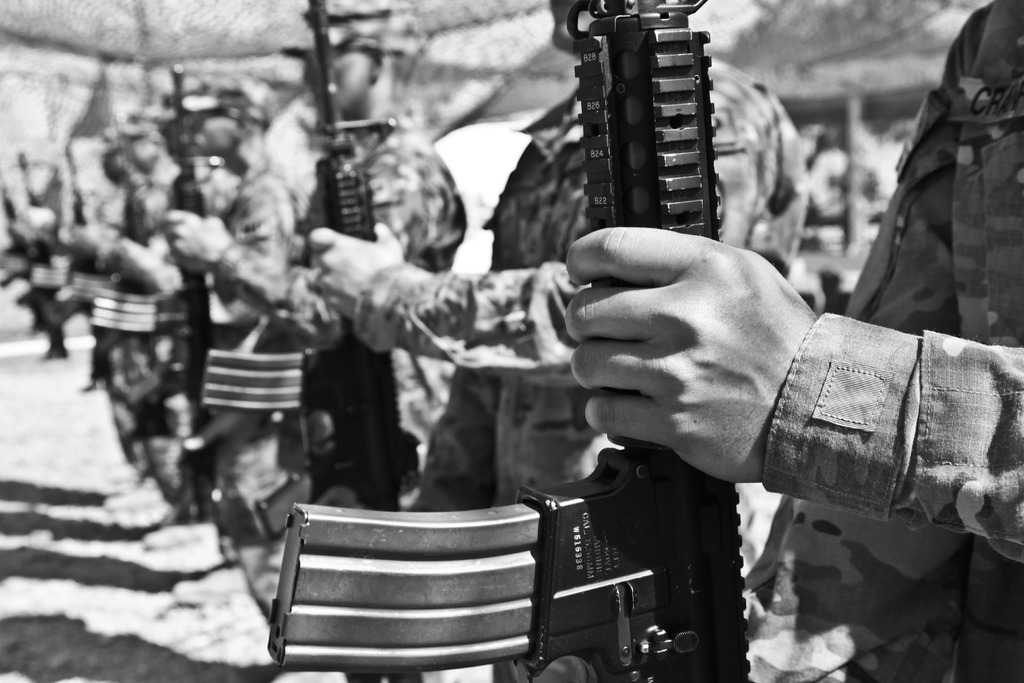
The debate over our policy in Afghanistan continues in the nation’s opinion pages.
Robert Kaplan in The Atlantic makes the case for counter-insurgency:
Obama needs to get behind his chosen general as soon as possible and put this spectacle of indecisiveness behind him. Gen. McChrystal must become the face of a policy that is supported at every level of the Administration, just as Army Gen. David Petraeus was the face of the surge in Iraq during Bush’s last two years of his presidency. Obama must capture the toughness and competence that Bush displayed as a war leader at the end of his term. Otherwise, in the coming months, the Democrats may be seen as having lost a war.
while Michael Scheuer in Foreign Policy argues that we should “go big or go home”:
Team Obama faces quite a dilemma. McChrystal’s plan to stave off defeat by asking for substantial immediate reinforcements — a request that is still far short of what is needed to “win” in Afghanistan — is a sure sign that long-term intense fighting and high casualties lie ahead. The United States’ latest Nobel Prize winner now has a choice: He must act quickly on the advice of McChrystal and the U.S. intelligence community to save a marooned U.S. Army, or dither behind the harebrained split-al-Qaeda-from-the-Taliban strategizing and let more overmatched U.S. soldiers and Marines die amid the ego-building praise of effete Americans, pacifist NGOs, and the Nobelistas.
[…]
This issue merits debate, but that must wait until McChrystal gets the troops needed to delay defeat. Afterward, only the all-out use of large, conventional U.S. military forces can be expected to have a shot at winning in Afghanistan. Since 1996, the United States has definitively proven that clandestine operations, covert action, Special Forces actions, and aerial drone attacks cannot defeat al Qaeda. It has likewise proven beyond doubt that nation-building in Afghanistan is a fool’s errand.
His conclusion is bleak:
Overall, then, we are well along the road to self-imposed defeat in Afghanistan, and about the best we can do is give McChrystal the troops he needs to slow defeat. After doing that, we can figure out how to get out of Afghanistan in an orderly manner, while preparing to absorb more al Qaeda attacks in North America.
A. J. Rossmiller in The New Republic comes closer to my own view:
After eight years of fighting, two things seem clear: First, the insurgency does not have the capability to defeat U.S. forces or depose Afghanistan’s central government; and, second, U.S. forces do not have the ability to vanquish the insurgency. It’s true that the Taliban has gained ground in recent months, but, absent a full and immediate withdrawal of U.S. troops, it cannot retake sovereign control. This is not to say that Afghanistan isn’t unstable; it clearly is. That has been the case for eight years, however, and, in the absence of some shocking, unforeseen development, it could be true for another eight or 18 or 80 years. An increase of tens of thousands of troops will not change that fact, nor will subtle tactical changes. Rather than teetering on the edge of some imagined precipice, the situation in Afghanistan is at a virtual stalemate. Only by appropriately characterizing the current situation in Afghanistan can we begin to determine the best way to achieve our stated goals there.
That last sentence bears consideration. I think we need to identify our actual objectives in Afghanistan very clearly, distinguishing between the “needs” and the “wants”. We need to keep Al Qaeda from re-establishing itself in Afghanistan. We want to be able to leave in the foreseeable future with a legitimate Afghan government in place that’s capable of holding its own against the Taliban and its Al Qaeda allies.
We might be able to achieve both our needs and our wants by following Gen. McChrystal’s plan and increasing our forces in Afghanistan substantially, protecting the Afghan people, and playing a long game there, hoping for an Afghan government capable of being a partner emerges. We can achieve our need and part of our wants by increasing our forces in Afghansitan substantially and carrying the battle into Pakistan, where the Afghan Taliban and their Al Qaeda allies continue to find refuge. This approach bears the risk of turning the Pakistanis against us.
Or we can abandon our wants and focus on our needs.









