As noted here last December, U.S. District Judge Reed O’Connor ruled the Affordable Care Act unconstitutional using some rather bizarre legal logic. To wit, because Congress had recently removed the penalty for failure to carry health insurance in the original ObamaCare statute, the justification by which the Supreme Court had found the mandate Constitutional was moot. Furthermore, O’Connor deemed the mandate an essential part of the plan and thus not severable. As Doug Mataconis argued in some detail, since the law in question had specifically stated that each provision was severable, the ruling was nonsense.
Both of us expected this ruling to be overturned in short order by the 5th Circuit Court of Appeals. But an interesting development overnight makes that much less likely.
CNN (“Trump administration now says entire Affordable Care Act should be struck down“):
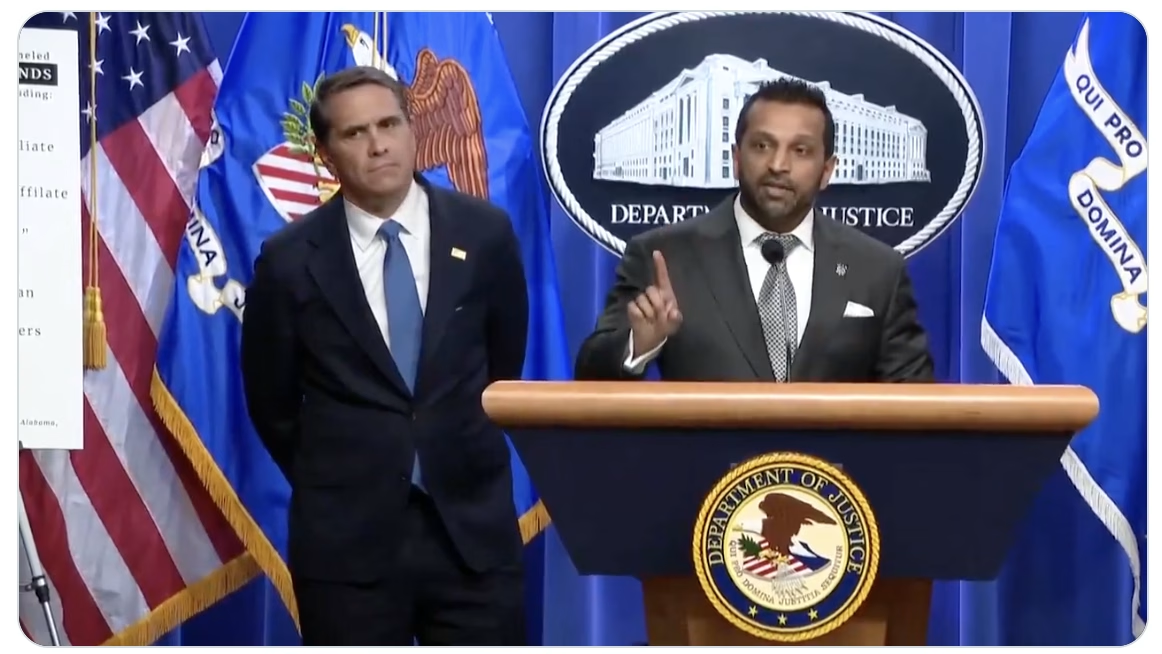
The Trump administration on Monday said the entire Affordable Care Act should be struck down, in a dramatic reversal.
In a filing with a federal appeals court, the Justice Department said it agreed with the ruling of a federal judge in Texas that invalidated the Obama-era health care law.
In a letter Monday night, the administration said “it is not urging that any portion of the district court’s judgment be reversed.”
“The Department of Justice has determined that the district court’s comprehensive opinion came to the correct conclusion and will support it on appeal,” said Kerri Kupec, spokesperson for the Justice Department.
It’s a major shift for the Justice Department from when Jeff Sessions was attorney general. At the time, the administration argued that the community rating rule and the guaranteed issue requirement — protections for people with pre-existing conditions — could not be defended but the rest of the law could stand.
After the Justice Department took that position, federal District Judge Reed O’Connor struck down the entire law and the case is currently before a federal appeals court.
Trump and the administration repeatedly promised — particularly leading up to the midterm election — to protect people with less-than-perfect medical histories.
But this shift in the Justice Department’s stance doubles down on stripping away all the protections that were a hallmark of the landmark heath reform law.
The administration’s move didn’t only startle supporters of the law. One former official who worked under Sessions told CNN Monday night that he, too, was surprised by the new position.
Because the case is before one of the most conservative appellate courts in the country, it almost guarantees that the issue will return to the newly solidified conservative Supreme Court at some point. President Barack Obama’s former solicitor general, Donald Verrilli — who once defended the law before the Supreme Court — is now defending the law on behalf of the Democratic-led House.
Most of the coverage and reaction at this point are about the public policy consequences of the ruling being upheld. They’re significant and horrific. But, to the extent O’Connor’s legal analysis is correct, besides the point. Congress doesn’t have the power to do good things that violate the Constitution.
The problem here is twofold.
First, as already noted, the ruling is baffling. While I agree that changes in the tax law indeed obviate the Supreme Court’s controversial ruling in Sebelius, it’s just absurd that it has anything to do with the remainder of the ACA.
Second, the Trump Justice Department, quite rightly, had indicated that it would advocate for enforcing the law with narrow exception. Now, without justification, they have radically changed course. That’s not only weirdly inconsistent but it actually works against their own stated policy aims. Their proposals for negotiating lower prescription drug prices, for example, are rooted in the ObamaCare system they are now working to eliminate.
One hesitates to guess what the new look Supreme Court will do here. Chief Justice Roberts bent over backward to justify the mandate in Sebelius, to the consternation of many conservatives, myself included. Is he going to continue to practice extreme judicial restraint, operating from the premise that the Court should seek ways to rule duly-enacted statutes Constitutional? Or will the replacement of Justice Anthony Kennedy with Brett Kavanaugh pave the way for a more conservative interpretation of the law? We just don’t know at this juncture.