Trump’s Nuclear Folly

Plus: Pete visits the Hill.

Source: Official White House Photo

The Secretary of Belligerence, Pete Hegseth (aka the Bro of War), testified to Congress this week. While he excels at such skills as smirking, dodging questions, and getting more than a bit shouty, he did not provide much in the way of helpful explanation concerning the ongoing excursion in Iran. Indeed, he provided a great new twist to the War Powers Act: cease-fire days don’t count. I think that’s kind of like cheat days when you have a donut (but just one!) when you are on a low-carb diet.

Shh! Nobody tell him that a naval blockade is an act of war!

One thing Hegseth did do this week was emphasize concerns over Iran’s nuclear potential.

For example:

That clip kind of makes my brain hurt, given the fact that, as a lifelong reader and writer, I am aware that words are supposed to mean things. Knowing something about international relations and politics, as well as basic cost-benefit analysis, adds to the pain of it all.

For example, this administration’s usage of “obliterated” has essentially become like what we all did as kids, saying a certain word over and over and over until it loses meaning (the internet informs me that this is called “semantic satiation“-so if you learn nothing else today, maybe you learned that like I did).

Anyhoo, for those keeping score at home, to “obliterate” means to “destroy utterly.” It does not mean, as Hegseth suggests, burying something. Perhaps Pete means “entomb”? Inter? Cover with rocks and garbage?

But, of course, the Möbius strip that is the explanation about the war is that we “obliterated” Iran’s nuclear capability by burying their enriched uranium and not destroying it, but we still had to go to war because they still have nuclear “ambitions” and because they are building a “conventional shield” (you know, the one that was utterly ineffective against our conventional attacks).

Indeed, in other testimony, he kept making it sound as if any cost is worth paying to prevent Iran from getting a nuclear weapon (despite all the aforementioned obliteration). For example:

I wonder how much the Iranian’s would have charged to sell us their enriched uranium? If no price is too high, I guess we should have paid it as per Hegseth’s, shall we say, logic?

Or, I wonder, if the cost of having to adhere to an agreement negotiated by Barack Hussein Obama was worth it?

Well, apparently, that cost was too high.

Setting aside a discussion of what the exact threat to the US or its interests would be of a nuclear-armed Iran, the sad reality is that we are where we are because Donald “Art of the Deal” Trump withdrew the US from the Joint Comprehensive Plan of Action (JCPOA) and promised to provide us with a much better deal.

You know, the same way he promised lifelong marriage to Ivana Marie Zelníčková and Marla Maples (but I digress) and that Trump University would provide some kind of actual education (which it did by proving the adage that a fool and his money are soon parted).

The NYT has an excellent analysis of the situation: How Iran Accumulated 11 Tons of Enriched Uranium.

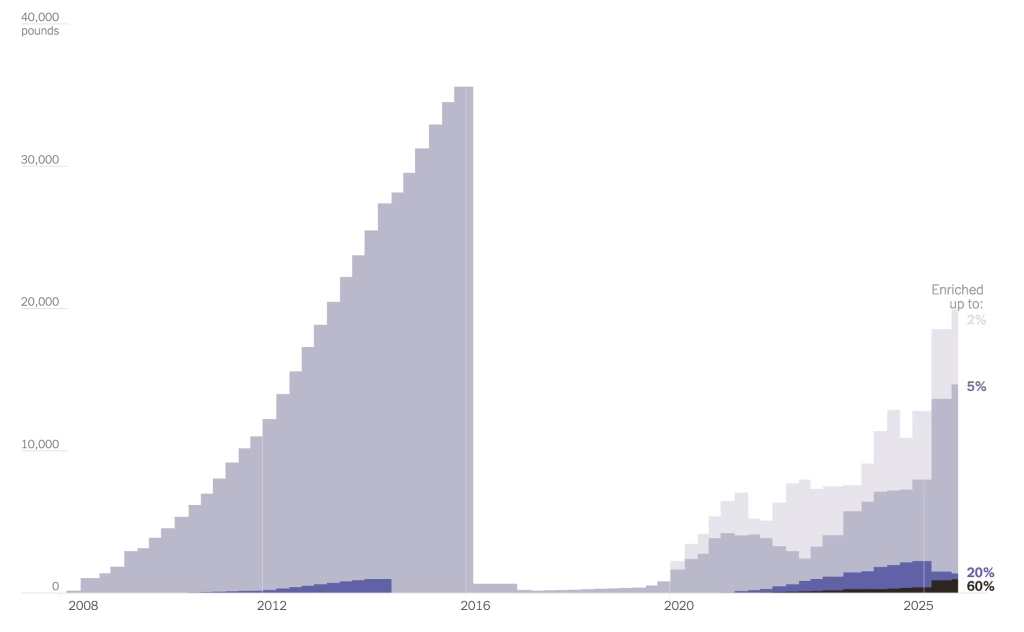
Since eight years ago when President Trump pulled out of a nuclear deal with Tehran, Iran has accumulated 22,000 pounds, or 11 tons, of enriched uranium. But the fate of Iran’s stockpile remains a mystery, two months after the United States began a war meant to prevent Iran from ever building an atomic bomb.

[…]

Iran lacked a single bomb’s worth of uranium in 2018, when Mr. Trump withdrew the United States from the pact and reimposed a series of tough economic sanctions.

Then Iran began to enrich above the deal’s limit, first at low enrichment levels to pressure the West and then up to 20 percent in early 2021, just before Mr. Trump left office.

The Biden administration tried, unsuccessfully, to restore aspects of the abandoned deal. Throughout the negotiations, Iran enriched uranium to an unprecedented level of up to 60 percent — a hairsbreadth away from the preferred grade for atom bombs.

With Mr. Trump again in office in 2025, Iran’s stockpile of enriched uranium grew at the fastest rate since the International Atomic Energy Agency started reporting.

Check out this graph. It may be difficult to spot, but if you squint, you can see where the JCPOA took effect and the consequences of the US withdrawal from said deal. Try not to strain your eyes
Heckuva job, Trumpie.

The reality remains, to conclude, that this war has emboldened the Iranians to use the Strait of Hormuz as a weapon, it has likely shifted regime leadership into a more hardline space, and it has taught them that they need a nuclear weapon as a deterrent.

So, to sum up: if the administration’s main goal is an Iran that has no nuclear ambitions, they appear to be doing everything in their power to ensure the opposite.

Maybe threatening to destroy all their bridges and power plants will help? Perhaps a threat to end their civlization will compel them to eschew any desire for the one weapon that has been shown to deter attacks of the kind they have recently experienced?

I know! Let’s send in a real estate developer and an investor with conflicts of interest to negotiate a peace deal.

That’ll solve the problem.

tl:dr, Trump essentially created the problem he is now trying to solve by spending massive amounts of money, killing people, and doing massive damage to the global economy (with collateral damage to our alliances in Europe and the Persian Gulf), all to create a situation that increases the chance that Iran will pursue a nuclear weapon. As a bonus, all of this will likely increase, not decrease, the chances of nuclear proliferation globally (not only because of regional concerns, but lots of countries that were willing to rely on the US will be less confident in that stance going forward).

FILED UNDER: Dumbest Timeline, Middle East, National Security, US Politics, World Politics, , , , , , , , , ,
Steven L. Taylor
About Steven L. Taylor
Steven L. Taylor is a Professor Emeritus of Political Science and former College of Arts and Sciences Dean. His main areas of expertise include parties, elections, and the institutional design of democracies. His most recent book is the co-authored A Different Democracy: American Government in a 31-Country Perspective. He earned his Ph.D. from the University of Texas and his BA from the University of California, Irvine. He has been blogging since 2003 (originally at the now defunct Poliblog). Follow Steven on Twitter and/or BlueSky.

Comments

  1. Sleeping Dog says:

    In the mid 70’s there was a jazz bar near Boston City Hall. A friend and I were in attendance one evening and on leaving followed behind a few women friends on a girl’s night out. A guy wearing a trench coat approached, a classic flasher, who proceeded to do his thing with the expectation that the women would be horrified. They laughed hysterically and the defeated, crestfallen look on the guys face was wonderful.

    Trump and his minions are that guy and the Iranians are the women. Too bad the stakes and costs are so high.

    4
  2. Daryl says:

    So you’re saying these guys are incompetent?

  3. @Daryl: It’s a real possibility.

    2
  4. Michael Reynolds says:

    It’s rather like what Putin did in Ukraine. He started by asserting that Ukraine was not a nation, then by invading ensured that Ukraine damn well became a nation – an increasingly powerful nation. Unintended but predictable consequences. Attacking Iran makes crystal clear to Iranian leadership that Iran must become a nuclear power. The days of thresholding threats are over – they’re sure as hell going for a bomb now.

    11
  5. Rob1 says:

    @Michael Reynolds: Trump’s grand debacle, much like Putin’s grand debacle in Ukraine, has hinged upon the desire (by Trump and Putin) to outwardly exhibit overwhelming power in a cartoonish “manly” exaggeration, to the abject suffering of innocent collaterals. In both instances, the publicly stated objectives could have been achieved without a maelstrom of elective violence and killing. but by less dramatic negotiations and real “deal making.”

    For example, Putin could have gained access and use of the resources of eastern Ukraine by initially building a non-threatening diplomatic relationship, followed by business deals. Just like Western countries. In short order, through joint agreements and outright purchases of companies, assets, stocks, etc. and Russia would have enjoyed a robust trading relationship without loss of 1 million Russians, fleeing intellectual capital, decimation of military, decimation of economy, global lost of trust, etc. All because of a maniacal, ego driven quest for absolute power, to plant one’s flag. The costs of Putin’s war and Trump’s war are astronomical compared to the gains — negative gains actually. Dumb, dumb, dumb. Putin and Trump have had the cunning to rise to their positions of power, but beyond that, they are really stupid people.

    Trump has gone down the same dry hole pulling our entire country with it.

    We, humanity, have got to figure out a solutions to this problem of pathological personalities in position of leadership. If we don’t, then we are dumb.

    6
  6. Rob1 says:

    Looking again at the quote from Aaron Rupar’s post:

    HEGSETH: Their nuclear facilities have been obliterated

    SMITH: Whoa whoa whoa whoa. We had to start this war, you just said, because the nuclear weapon was an imminent threat. Now you’re saying it was completely obliterated?

    HEGSETH: They had not given up their *ambitions*

    SMITH: So Operation Midnight Hammer accomplished nothing of substance

    HEGSETH: You’re missing the point

    So now we must go to war, not only because of established facts of the matter, but because we “divine” the “ambitions” of another nation. Smacks of Minority Report’s “precogs.”

    No, really, we get it — this is just another clumsy rhetorical “dodge” by the gang that couldn’t think straight.

    Same with Hegseth’s last utterance in that quoted volley: Pete is just a big bag of wind and fury, and really that is the point.

    * interesting discussion from Atomic Diner follows below speaking to the point of alleged nuclear ambitions .

    2
  7. Rob1 says:

    Cheryl Rofer provides discussion on the likelihood of nuclear ambition among the currently non-nuclear nations in her recent offering. In this section she focuses on Iran:

    Nations That Might Build Nuclear Weapons

    Will the attack by Israel and the US change Iran’s postion? The Trump administration has not understood that Iran’s insistence on maintaining the capability to enrich is a matter of national pride and perceived need. Foreign suppliers of nuclear fuel for Iranian reactors have been unreliable. The enrichment program is a source of national pride. Iran has used that program as a lever to remove sanctions, but they were compliant with the JCPOA.

    The deterrent value of the Strait of Hormuz is now clear to the Iranians. Control of the Strait is much less expensive than a nuclear weapons program. On the other side of the deterrence equation, nuclear Israel has been acting with impunity that Iran might want to counter.

    The IRGC seems to have gained power, and the advocates of nuclear weapons have been largely in the IRGC. Iran’s nuclear infrastructure has been badly damaged and will require time to rebuild. That may make it easy for Iran to offer a five-year period in which they limit enrichment.

    As was the case in 2015, the largest factor will be the agreement to end the war. If Iran feels secure, nuclear weapons become less attractive.

    Rofer concludes with: “Overall, I think that few nations will find it in their interest to undertake a new nuclear weapons program.”

    Rofer’s prior post: Why Nations Don’t Want Nuclear Weapons provides the kind of professional insight on this topic so utterly lacking among Trump’s brainless trust of advisors:

    As larger nations that have nuclear weapons attack smaller nations that don’t have nuclear weapons, conventional wisdom is that more nations will want nuclear weapons. This is less certain than much of the discussion makes it out to be. [..]

    Withdraw from the NPT or Not? All of the nations that do not have nuclear weapons have signed the Nuclear Nonproliferation Treaty. By ratifying that treaty, they have promised not to build nuclear weapons. North Korea was a signatory and withdrew before building nuclear weapons. Iran has threatened to withdraw. Withdrawal, of course, is an announcement that a nation is freeing itself to build nuclear weapons.

    Without withdrawing from the NPT, a nation could build a nuclear force clandestinely, but that has become more difficult than it was. Uranium production and sales are monitored. Manufacturers of components that might be used in nuclear weapons programs have set up assurances that they are not selling to proliferators. Reactors and centrifuge installations may be detected by satellite photography.

    These are big steps, not just financially, but in terms of how a nation thinks of itself. The financial aspects can be overcome if the need for a nuclear weapon is felt to be great enough. Zulfikar Ali Bhutto vowed that if India got nuclear weapons, “Pakistan will eat grass or leaves, even go hungry” in order to build nuclear weapons. The difficulties of concealing an early nuclear weapons program and the consequences beyond deterrence of its success are significant.

    The Trump administration wasn’t really concerned about Iran’s nuclear ambition. All of the discernment presented by Rofer, has been available to anyone who truly wanted to do the right thing, the strategic thing. But, Netanyahu wanted to make a “big boom.” Trump wanted to make a “big boom.” So off they went dragging the world with them, for personal political reasons. And that, DefSec Hegseth, is the point.

    5
  8. Ken_L says:

    The latest “war objective” MAGA apologists are propounding is to ensure Iran can never acquire nuclear weapons. Since such an outcome would be literally impossible without Iran ceasing to exist, it’s impossible to predict how this idiocy will end.

    4
  9. steve222 says:

    We had solved the nuclear issue with the JCPOA, but this isn’t really much about nukes. Its mostly about Israel’s desire to make sure that Iran does not have missiles that are able to reach Israel. Iran is not and has not been a threat to us here in the Americas.

    Steve

    4
  10. Mikey says:

    Shh! Nobody tell him that a naval blockade is an act of war!

    But is that really true if it’s a very friendly blockade?

    1
  11. JohnSF says:

    Iran had good reasons for going for a “60% and hold” threshold threat and negotiating position.
    Not least that “90% and remetallization” has a probability near unity of an Israeli nuclear strike on miltiple targets.

  12. ChipD says:

    One of the interesting things to come out of this is the observation that the ability to choke the Strait of Hormuz gives Iran far more actual power than a nuclear weapon.

    It isn’t even necessary to completely block it militarily- Just bombing a few tankers here and there makes passage thru the Strait uninsurable, and raises the price of oil o levels unbearable for most of the world.

  13. JohnSF says:

    @ChipD:
    Which works until it doesn’t.
    Iran is currently in a contest with the US, with all other parties standing aside.
    Assuming that means Iran will be permitted to alter the international rules on free passage to suit itself in the longer term is another matter.

  14. @JohnSF:

    Assuming that means Iran will be permitted to alter the international rules on free passage to suit itself in the longer term is another matter.

    I don’t disagree, but if the US is unwilling to use military power to force the Strait open, what do you perceive to be possible actions by others to force the issue? Yes, sanctions and other inducements, but not from China and Russia (and maybe not a lot of other places).

    As I noted the other day, the main reason they weren’t willing to close the Strait was fear of a massive military attack. That attack already happened and here we are.







