Dan Merica, WaPo (“TV networks deny Trump the one thing he craves most: Attention”):
President Donald Trump had a really rough week last week. Crude oil prices kept spiking with no sign of abating. He lost his mail-in ballot case at the Supreme Court. The Fed didn’t listen to him and raised rates. A few Republicans voted against the Iran war. And poll after poll showed his party in a dire political position ahead of the midterms.
So what did the president do to turn things around? He banned three outlets — CNN, MS NOW and Politico — from the White House on Friday. On Saturday, when those outlets showed up to work, they were not allowed in.
The conflict came to a head today when the outlets filed a suit against the Trump administration, and the five major television networks halted video coverage of presidential events in solidarity with CNN.
[…]
This attempt to block reporters from the White House could be seen as a distraction — as a way to rally supporters around him as he opens a new front in his long-running war on what he calls “fake news.” The news media certainly isn’t particularly popular or trusted by Americans. But Trump’s ban does nothing to address the issues voters are facing, and it’s highly unlikely any voter will be moved — either way — by this fight with reporters.
That is why the real takeaway is how the TV network’s response to Trump deprives him of what he craves most: attention.
Covering the White House is a unique assignment. Because of space and cost constraints, the five networks create a so-called pool, rotating days where each outlet covers events involving the president for the entire group. This lets the president get his message out to all networks and gives him the platform he needs to push his administration’s message to the American people.
When Trump left the White House yesterday afternoon, no television cameras from the pool aired his departure, starving him of a chance to push his message. The White House attempted to counter this dynamic by live-streaming their own events. “Just the news that matters most — straight from the Trump Administration,” the White House X account said. But their post on his departure, which included him cutting the ribbon on a new White House helipad, was mostly just static helicopter noise, giving viewers no chance to hear what the president was saying.
The blackout mostly continued when he arrived in New York. And the real test of the network’s resolve will come on Tuesday, when Trump is slated to be at the United Nations, and there will be multiple venues where the pool would be one of the few cameras covering the president’s meetings with other world leaders.
Trump has long subscribed to the idea that all press is good press.
“Good publicity is preferable to bad, but from a bottom-line perspective, bad publicity is sometimes better than no publicity at all,” Trump wrote in his book, “The Art of the Deal.”
But the coming days will test whether Trump is willing to accept less publicity altogether.
Peter Baker, NYT (“After Years as the Star of Must-See TV, Trump Faces the Sting of Cancellation“):
For President Trump, this is the tree-falls-in-the-forest moment of his administration. If the most television-addicted president in history suddenly finds the cameras missing, is he really still president? Not the kind he has been, anyway.
Mr. Trump, for whom television is better than any narcotic, finds himself for the first time at least partially deprived of the major networks that have covered nearly every movement and utterance he has made for more than a decade. No longer can he snap his fingers and appear live in millions of homes. No longer does he totally dominate the airwaves.
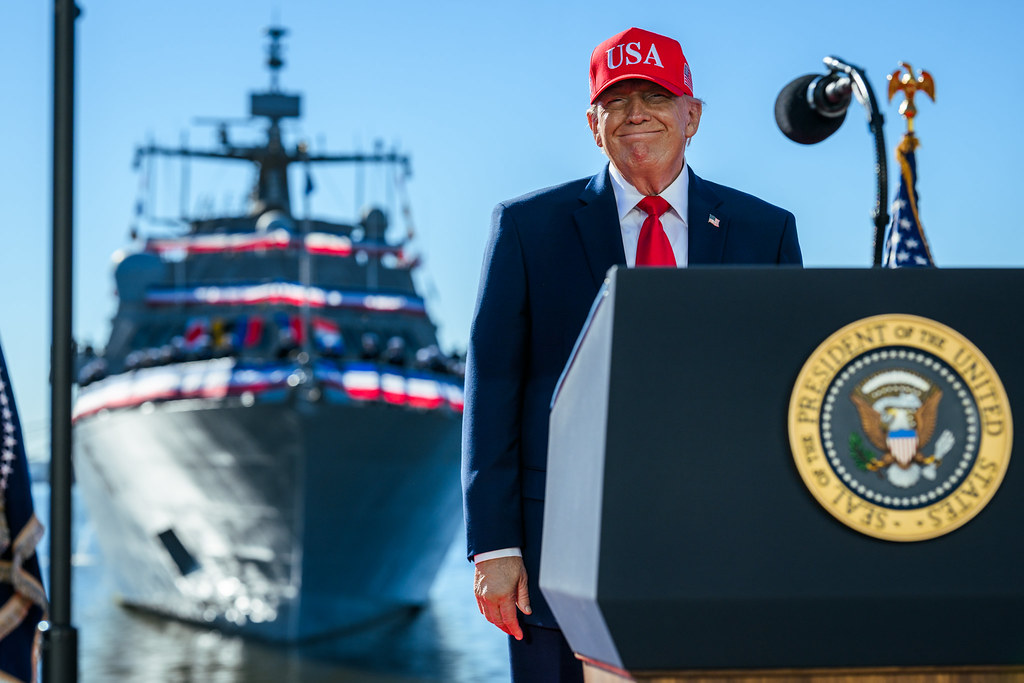
Indeed, his first taste of life without the major television networks that are now boycotting the White House press pool in protest of his ban on select news outlets was a sour one. He was left almost literally shouting into the wind on Monday as he cut the ribbon on his new helipad on the South Lawn of the White House, recorded only by a second-tier news broadcaster that could not capture his voice over the roar of Marine One. There was Mr. Trump moving his mouth, and no one could hear him.
Yet when it comes to attracting attention, the president still manages to find a way. By the end of the day, there he was live on CNN after all — not filmed by the White House television pool, which refused to follow him, but by other cameras that met him when he arrived in New York and were not part of the boycott agreement. He had to rely on Mayor Zohran Mamdani to get on air, not at his own White House but as a guest at Gracie Mansion in the heart of liberal America. But he crowed that he could still force his way onto the screen.
“They said they’re going to boycott me, but they never boycott me, so I wasn’t very worried about that,” Mr. Trump boasted with the mayor at his side and a large group of reporters in front of him. “Look at all that press.”
The moment reinforced the challenge of carrying out any kind of television blackout on the president in an age of proliferating media, and the limits of the news industry’s willingness to cut him off. While pool cameras will be gone for now, the networks under their agreement may still show footage from other sources that are not subject to White House control, like the United Nations camera feed that will carry his speech to the General Assembly on Tuesday.
But the walkout by the five major networks that follow the president everywhere he goes still represents a threat to the way Mr. Trump has governed. Television has been central to his rise to fame and power. His 14 seasons on reality television made him into a national force and helped propel him to the White House. His 10 seasons on political television since then have allowed him to dominate American life in a way that none of his predecessors ever did.
“This is the most important thing for Trump,” said Ramin Setoodeh, the author of “Apprentice in Wonderland,” a history of Mr. Trump’s career on reality TV. “When I interviewed him for my book, he told me the only thing that matters is ratings. It doesn’t matter if you’re a good person or a bad person. If you have good ratings, you’re successful.”
No politician in American history has dominated the news in the way Trump has for anywhere near as long. There has seldom been a day since he came down the escalator at Trump Tower in June 2015 that he hasn’t made the front pages. While I haven’t watched a nightly newscast during that period, I doubt that as much as a week has gone by without him making the cut. Even in the four years he was out of office, he was the central character in the national drama, almost certainly outpacing even President Biden.
Presumably, the courts will overturn his barring of CNN, MSNOW, and POLITICO as a violation of the 1st Amendment. Until then, I expect the (partial) ban to last. We’ll see how well he commands attention without the cameras.