
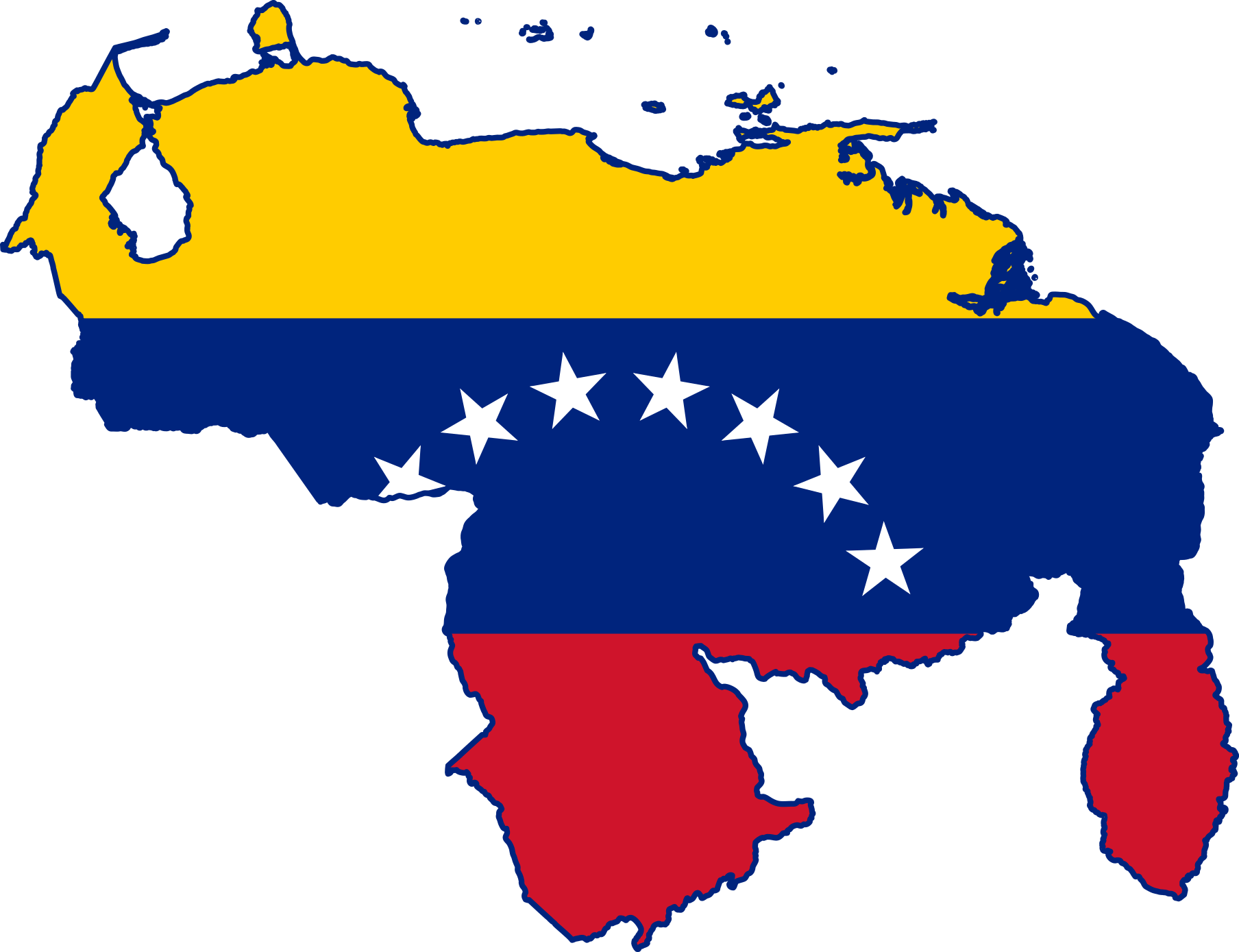
With his normal grace and aplomb, Trump announced the following this week:

And, as usual, we are all left trying to figure out what a social media post actually means in reality.
My basic interpretation is this: the United States used military force against another sovereign country to kidnap its chief executive, and handed power over to a leader who was willing to do business with the US government in exchange for getting to remain in power. The Trump administration, from the beginning, has claimed that one of its goals was access to that country’s natural resources.
In short, we essentially fomented a coup in a Latin American country so as to install a more favorable leader so as to extract resources. It is all very early-Twentieth Century.
And yes, Maduro was a terrible president who oversaw a ruinous regime. And while it may well be that Rodríguez is a more pragmatic leader, let’s not forget that the basics of the same ruinous regime remain in place.
A couple of other general points.
First, it may well be that some private companies have the grounds to claim compensation for the Chávez nationalizations, but that does not justify asserting control over another country’s resources.
Second, yes, Venezuela has been poorly governed for quite some time.
Third, these assertions by Trump about how much oil there may be rather ignore the fact that it is all currently in the ground in undeveloped fields. It is all potential oil at the moment.
Fourth, for a guy who wants to start a new red scare over communist take-overs in the US, he sure likes to engage in government-run enterprises.
Fifth, I have my doubts that all of this is costing/will cost the taxpayers nothing.
The AP has more: What we know about Trump’s deal giving US access to vast oil reserves in Venezuela.
The U.S. government and an unnamed private operator in Venezuela formed a new company that was given the rights to untapped oil fields for 100 years.
A statement from Rodríguez said the deal involves the development of 17 fields with a proven potential of 65 billion barrels. It said the agreement could draw $100 billion in investment into Venezuela’s oil industry and yield over $209 billion in taxes for Caracas.
Trump said the agreement was negotiated by Secretary of State Marco Rubio, Defense Secretary Pete Hegseth and Rodríguez.
The deal gives the United States 55% effective output of the new private company, including an ownership stake and rights to buy oil at cost. American purchases of the oil will go toward the U.S. strategic oil reserves along with the military, according to a U.S. official who was not authorized to discuss the matter publicly and spoke on the condition of anonymity.
I will start off by noting that a massive venture like this with a major partner being “unnamed” reeks of a combination of poor planning and likely corruption. I will again note that it is frustratingly ironic that administration/politicl party that keeps asserting that its political opponents are “communists” is actively involved in creating some kind of state-run oil company.
Also, any claims that this will help oil prices are, as anyone who understands the constraints of space and time, will not be forthcoming any time soon.
Trump says the deal will help lower gas prices for Americans. That is an important objective for the Republican president as the Iran war slows the shipping of Persian Gulf oil and keeps prices elevated months before November elections in the United States.
But experts have repeatedly warned that Venezuela’s dilapidated oil infrastructure will take years and billions of dollars to repair. A substantial boost in production is not expected to happen quickly.
And there is this teeny-tiny detail:
Neither side made clear who would pay for infrastructure investments and at what cost.
Ah well, who needs infrastructure?
And I am sure that domestic Venezuelan politics won’t matter at all.
Some in Venezuela considered it a betrayal of what their government has stated repeatedly for decades: Venezuelan resources are for Venezuela, and leaders would not allow the U.S. government access to those resources.
[…]
Harvard University professor Ricardo Hausmann, a former Venezuelan planning minister, called it a “shameful deal.”
“Venezuelans will not respect this illegitimate deal and no major US oil company will take it seriously because they know it will not last,” Hausmann said on social media, adding that Rodríguez “has no legitimacy or constitutional power to commit Venezuela to any such deal.”
Indeed, the deal almost certainly violates the Venezuelan constitution.
It seems worth noting that mismanagement of Venezuelan oil resources was a major part of the catalyst for the breakdown of what was once one of the most healthy democracies in Latin America and the ascension of Hugo Chávez to power. Oil was central to his power, and even as things went poorly over time, nationalism over those resources helped prop up the regime.
But, no doubt, the same level of geopolitical expertise that made sure Trump understood and took into account the geostrategic import of the Strait of Hormuz will be deployed in this case!
Meanwhile, much remains a bit up in the air.
Many important details remain unclear, including who will cover necessary investments, the identity of the private operator and how America’s stake in the company breaks down.
The U.S. will get 55% of the company’s effective output, but it was not clear what portion of that comes from an ownership stake and how much comes from the right to buy oil at cost.
It also is unclear how the industry will react. Persuading big American oil companies to return to the region could prove a challenge given the political uncertainty and damaged infrastructure.
Chevron, the only U.S. oil company actively producing in Venezuela, declined to comment. Separately from Trump’s announcement, Chevron already had been in talks to expand investment in the country. Exxon Mobil also declined to comment.
David Oxley, chief climate and commodities economist at Capital Economics, said that on its face, the deal could double U.S. oil reserves and reduce dependence on crude oil from Canada and Mexico. But Oxley, writing in a commentary, cautioned that there are logistical hurdles and said the value of Venezuela’s reserves may have been exaggerated under former President Hugo Chavez.
Even with legal and security guarantees, it is not clear that U.S. oil companies “would be eager to invest,’’ he wrote, noting that “there simply might be more enticing commercial opportunities on offer elsewhere.’’
Also not mentioned in the AP report is that the oil in Venezuela is what is referred to as “sour crude,” i.e., it is thick and has a high sulfur content. This makes it more expensive to extract and creates specific refining needs. This matters because it influences the financial incentives that companies need to decide to invest. Oil has to be sufficiently expensive to warrant the expenditure. There are reasons why all of that oil is still in the ground.
For further reading:
- Anthony Chan: Venezuela’s Oil Bonanza: Will it be a Game-Changer or a Long Wait?
- BloombergNEF: Venezuela’s Oil Renaissance Faces Several High Hurdles.
- Goehring & Rozencwajg Associates’ newsletter: Venezuela’s Crude Reality.
At a minimum, this is a decade(s?)-long enterprise–after all, to tap into the fields in question means largely starting from scratch. It is also, as is typical with Trump, backward-looking, given the increased emphasis globally on renewable energy and electric vehicles (a continued focus on the fossil fuels just helps China, I would note).
On balance, this is all very trumpy: benighted, backward-facing, and based in bullying and bluster.









