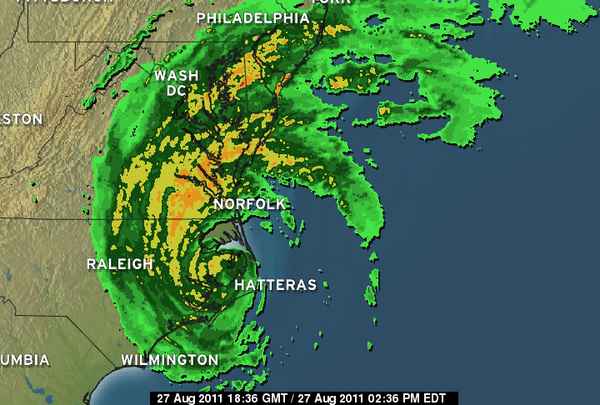

Within hours after Hurricane Irene had blown past the New York/New Jersey area, people were already starting to make light of a weekend’s worth of media coverage, both nationwide and locally in effected areas, that some say overhyped the story. Howard Kurtz leads the way this morning in his Daily Beast column:
Someone has to say it: cable news was utterly swept away by the notion that Irene would turn out to be Armageddon. National news organizations morphed into local eyewitness-news operations, going wall to wall for days with dire warnings about what would turn out to be a Category 1 hurricane, the lowest possible ranking. “Cable news is scaring the crap out of me, and I WORK in cable news,” Bloomberg correspondent Lizzie O’Leary tweeted.
I say this with all due respect to the millions who were left without power, to those communities facing flooding problems, and of course to the families of the 11 people (at last count) who lost their lives in storm-related accidents.
And I take nothing away from the journalists who worked around the clock, many braving the elements, to cover a hurricane that was sweeping its way from North Carolina to New England.
But the tsunami of hype on this story was relentless, a Category 5 performance that was driven in large measure by ratings. Every producer knew that to abandon the coverage even briefly—say, to cover the continued fighting in Libya—was to risk driving viewers elsewhere. Websites, too, were running dramatic headlines even as it became apparent that the storm wasn’t as powerful as advertised.
Kurtz goes on to note that the fact that the storm was baring down on the media capital of the world was likely one of the major reasons that it received the attention it did, and that a similar storm headed for, say, Pensacola would not have gotten the same amount of attention. Of course, there area few points worth mentioning there. Pensacola and the Gulf Coast are used to hurricanes. When residents there hear that a storm is coming, they know what to do. More importantly, the buildings in a place like Florida are built to withstand a Category 1 or 2 hurricane and are surrounded by trees that can withstand strong winds. The same isn’t necessarily true of the Northeast. Places like New Jersey and New York rarely see the full force of a hurricane. The last time in my memory that such a storm came anywhere close to that area was Gloria in 1985, which cut across the center of Long Island, causing major damage and knocking out power for many residents for weeks thanks to all of the fallen trees and power lines. Put simply, a hurricane in the Northeast, is not the same thing as a hurricane in the south.
Kurtz’s hindsight doesn’t take into account one important thing, the fact the people in the path of the storm may have actually appreciated the coverage. If The Weather Channel’s ratings spike for the weekend are any indication, this certainly seems to be the case. If the storm was being “overhyped” then why were people watching?
More important to note, though, is the fact that Irene’s weakening as it approached the Mid-Atlantic didn’t become apparent until very late in the day on Saturday. By that point, most of the emergency notices, evacuations, and warnings (such as Chris Christie’s comment that surfers in Asbury Park should “Get the hell of the beach”) had already been made. It would have been both impractical and stupid for political leaders and emergency services to wait until that point to decide whether or not Irene was a real threat. This was a storm on track for one of the most heavily populated areas in the United States; waiting until the last minute to warn them would have been Katrina-sized idiocy. For that reason, I’m somewhat reluctant to criticize the pre-storm coverage of Irene. Yes, in restrospect it looks like it was much ado about nothing, but we had no way of knowing that 48 or 72 hours ago, and that’s when the people living on the coast needed to make decisions, and when public officials needed to do things like decide to shut down the New York subway system in order to protect the equipment from possible flooding.
Things did get pretty ridiculous once the storm passed, however. All three cable networks had brought in their big guns for the weekend and, with Irene long gone and fortunately little damage left in her path, they needed to find something to do with them. So, we got much of the coverage that Kurtz bemoans and very little of what actually was happening, such as the massive flooding hitting Central New York and Vermont in the wake of the storm.
There was plenty of stupid about the way the media covered Irene. The obligatory scenes of reporters standing on the beach as the surf pounded are the summer version of the “reporter in the middle of a blizzard” shots that we’ll see about five months from now, and they’re just as utterly pointless. However, as far as warning people of the danger of what was still one of the strongest tropical storms to hit the northeast in generations, it strikes me that Katrina has taught us to err on the side of too much information rather than too little.