
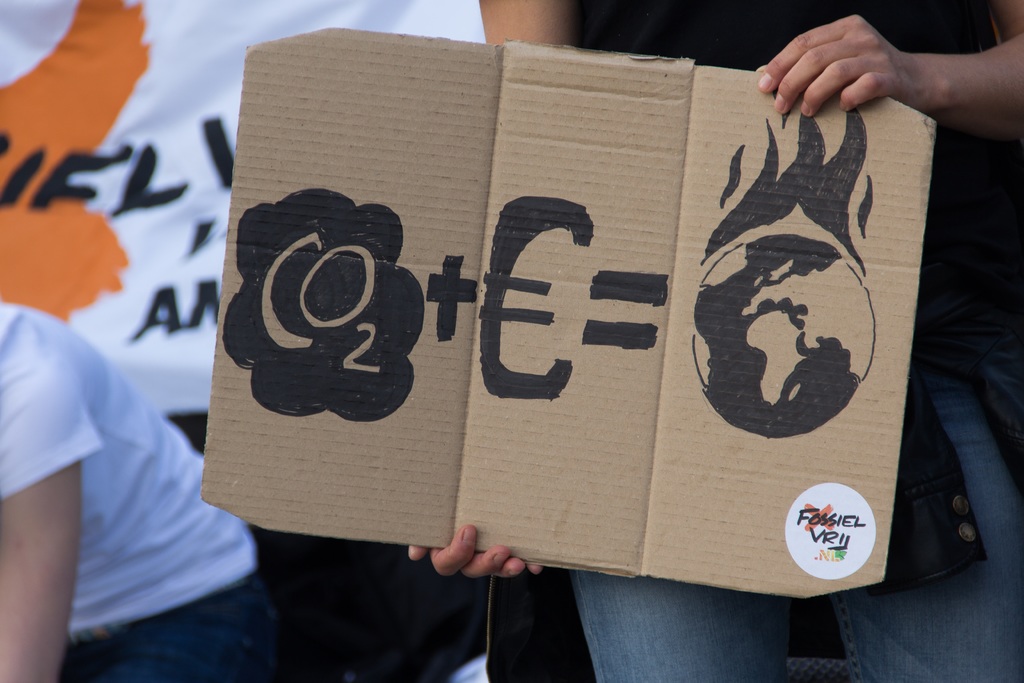

Late yesterday, as expected, the President announced that he was beginning the process of withdrawing the United States from the Paris climate accords, an announcement that has resulted in far more adulation or derision than the decision actually deserves under the circumstances:
WASHINGTON — President Trump announced on Thursday that the United States would withdraw from the Paris climate accord, weakening efforts to combat global warming and embracing isolationist voices in his White House who argued that the agreement was a pernicious threat to the economy and American sovereignty.
In a speech from the Rose Garden, Mr. Trump said the landmark 2015 pact imposed wildly unfair environmental standards on American businesses and workers. He vowed to stand with the people of the United States against what he called a “draconian” international deal.
“I was elected to represent the citizens of Pittsburgh, not Paris,” the president said, drawing support from members of his Republican Party but widespread condemnation from political leaders, business executives and environmentalists around the globe.
Mr. Trump’s decision to abandon the agreement for environmental action signed by 195 nations is a remarkable rebuke to heads of state, climate activists, corporate executives and members of the president’s own staff, who all failed to change his mind with an intense, last-minute lobbying blitz. The Paris agreement was intended to bind the world community into battling rising temperatures in concert, and the departure of the Earth’s second-largest polluter is a major blow.
Mr. Trump said he wanted to negotiate a better deal for the United States, and the administration said he had placed calls to the leaders of Britain, France, Germany and Canada to personally explain his decision. A statement from the White House press secretary said the president “reassured the leaders that America remains committed to the trans-Atlantic alliance and to robust efforts to protect the environment.”
But within minutes of the president’s remarks, the leaders of France, Germany and Italy issued a joint statement saying that the Paris climate accord was “irreversible” and could not be renegotiated.
The decision was a victory for Stephen K. Bannon, Mr. Trump’s chief strategist, and Scott Pruitt, the Environmental Protection Agency administrator, who spent months quietly making their case to the president about the dangers of the agreement. Inside the West Wing, the pair overcame intense opposition from other top aides, including Gary D. Cohn, the director of the National Economic Council, the president’s daughter Ivanka Trump, and his secretary of state, Rex Tillerson.
Ms. Trump, in particular, fought to make sure that her father heard from people supportive of the agreement, setting up calls and meetings with world leaders, corporate executives and others. But by Thursday, aides who pushed to remain part of the agreement were disconsolate, and it was Mr. Pruitt whom the president brought up for victory remarks at the Rose Garden event.
The president’s speech was his boldest and most sweeping assertion of an “America first” foreign policy doctrine since he assumed office four months ago. He vowed to turn the country’s empathy inward, rejecting financial assistance for pollution controls in developing nations in favor of providing help to American cities struggling to hire police officers.
“It would once have been unthinkable that an international agreement could prevent the United States from conducting its own domestic affairs,” Mr. Trump said.
In Mr. Trump’s view, the Paris accord represents an attack on the sovereignty of the United States and a threat to the ability of his administration to reshape the nation’s environmental laws in ways that benefit everyday Americans.
“At what point does America get demeaned? At what point do they start laughing at us as a country?” Mr. Trump said. “We don’t want other leaders and other countries laughing at us anymore. And they won’t be.”
But business leaders like Elon Musk of Tesla, Jeffrey R. Immelt of General Electric and Lloyd C. Blankfein of Goldman Sachs said the decision would ultimately harm the economy by ceding the jobs of the future in clean energy and technology to overseas competitors.
Mr. Musk, who had agreed to be a member of a two business-related councils that Mr. Trump set up this year, wrote on Twitter that he would leave those panels.
“Climate change is real. Leaving Paris is not good for America or the world,” he said.
Under the accord, the United States had pledged to cut its greenhouse gas emissions 26 to 28 percent below 2005 levels by 2025 and commit up to $3 billion in aid for poorer countries by 2020.
By stepping away from the Paris agreement, the president made good on a campaign promise to “cancel” an agreement he repeatedly mocked at rallies. As president, he has moved rapidly to reverse Obama-era policies aimed at allowing the United States to meet its pollution-reduction targets as set under the agreement.
“We are getting out,” Mr. Trump said Thursday. “But we will start to negotiate, and we will see if we can make a deal that’s fair. And if we can, that’s great.”
In his remarks, Mr. Trump listed sectors of the United States economy that would lose revenue and jobs if the country remained part of the accord, citing a study — vigorously disputed by environmental groups — asserting that the agreement would cost 2.7 million jobs by 2025.
But he will stick to the withdrawal process laid out in the Paris agreement, which President Barack Obama joined and most of the world has already ratified. That could take nearly four years to complete, meaning a final decision would be up to the American voters in the next presidential election.
The reactions to this decision are about what you’d expect.
On the right, Trump is being largely praised even by Republican critics of the Administration, largely due to the fact that the Paris Accords have been in the GOP’s crosshairs ever since they were entered into late in 2015. From their point of view, the accords were an affront to American sovereignty that unfairly tied the hands of American industry while allowing other nations such as China and India, which are becoming ever bigger contributor to worldwide carbon emissions even as the United States continues to lower its emissions thanks to increased use of cleaner energy sources such as natural gas. Ironically, these same critics often made the point that the accords themselves that were entirely voluntary and unenforceable and thus largely not worth the paper they were printed on. As I noted when the accords were passed two years ago, this is largely true and a strong argument in favor of the idea that the agreement was far less than meets the eye, and most certainly not the threat to American sovereignty that many on the right have claimed it to be.
On the left, the reaction was also about what you’d expect, and similarly completely overblown. Democratic lawmakers alleged that Trump’s decision would be a significant setback for efforts to ease global climate change, and many states and localities controlled by Democrats have already announced their own intention to continue voluntarily complying with the terms of the agreement which, of course, they were already free to do before yesterday. Internationally, the reaction has been largely negative, with many of America’s strongest allies expressing dismay as what they characterized as a withdrawal of American leadership and which many asserted would end up becoming something of a ‘gift’ to China. The reality, of course, is far different. Given the fact that this agreement was largely unenforceable, the idea that American withdrawal would contribute to some kind of environmental disaster is little more than political hyperbole.
None of this means that global climate change isn’t an important issue, or that there aren’t steps that nations that the United States and other nations ought to be taking to at least try to reduce the impact of something that at this point seems both inevitable and beyond our ability to control in any case. Among other things, we ought to be looking at policies that subsidize ‘dirty’ energy production methods like coal and reducing regulations that make new business creation difficult so that companies that are working on renewable forms of energy, or on cleaner burning sources such as natural gas, to grow. Additionally, there ought to be at least some awareness of the role that human behavior is playing in the process of climate change even while we recognize the fact that, in reality, there’s very little we can do about the fact that the climate is changing since this is something that has been happening for the entirety of the 4.6 billion years or so that the Earth has existed. At the same time, though, we deceive ourselves when we take pointless and unenforceable action like the Paris Accords and pretend that we’ve actually accomplished anything. y
In reality, Trump’s decision yesterday will have neither the positive impact he claimed nor the negative impact feared by his critics. In no small part, this is due to the fact that we won’t be formally out of the agreement until sometime after the 2020 election, meaning that this decision can be easily reversed if Trump loses reelection. Additionally, since the goals of the agreement were entirely voluntary, there’s nothing stopping individuals, companies, cities, or states from voluntarily complying with the provisions of the agreement that apply to them. At the same time, though, there’s also no punishment for failing to comply with the agreement, something that nations like China and India have already realized according to many reports. Given all of that, yesterday was a far less significant day than Trump’s supporters believe or his critics fear.









