2028 Primary Stupidity
A dumb way to choose candidates? Or the dumbest way?

This morning’s episode of The Daily, “Democratic Anger and Republican Revenge: Welcome to the Primaries,” illustrates yet again the absurdity of the way we choose candidates for high office.
The transcription is not yet available but, in a nutshell:
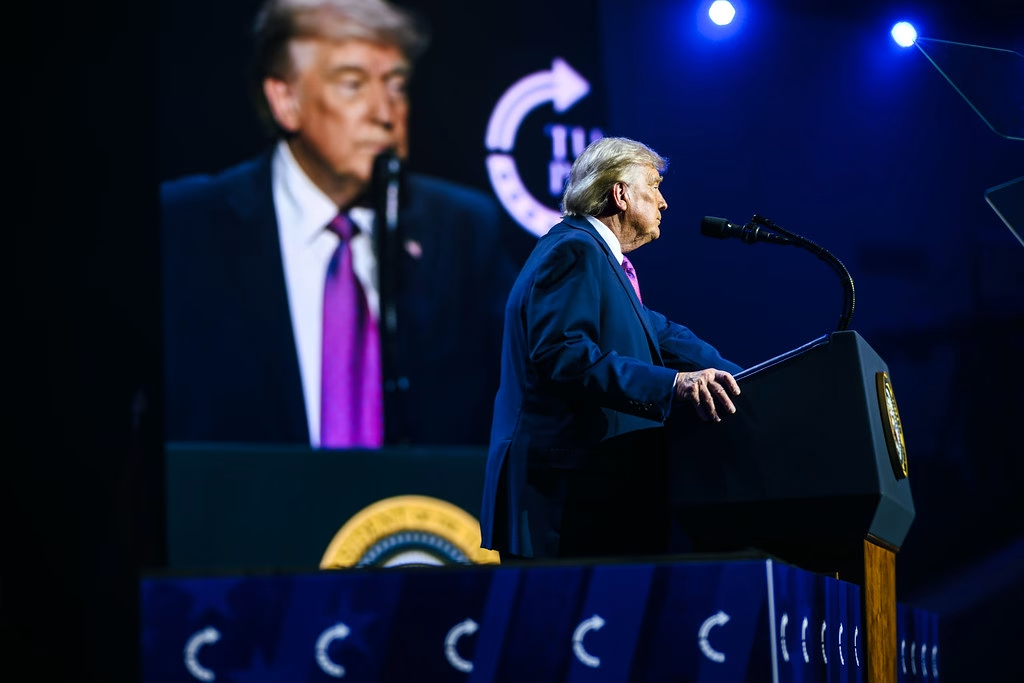
Republican primaries for key US Senate, US House, and even some state legislative races are being dominated by President Trump’s revenge tour against Republican politicians who have dared oppose him. It highlights a weekend report from one of the guests, Shane Goldmacher, “Trump’s Push for Electoral Retribution Heads to the Ballot Box,” which is more detailed that the podcast discussion.
But, basically, Republican-aligned groups are spending millions of dollars going after easily re-electable Republican incumbents, rather than saving their war chest to target Democrats in a crucial midterm election that will determine how much of Trump’s agenda can be passed in the remainder of his term. In particular, they’re going after Senator Bill Cassidy of Louisiana, who votes with Trump essentially all the time but voted to convict in the post-January 6 impeachment trial; Rep. Thomas Massie of Kentucky, who’s voted with Trump 91% of the time but opposed him on the release of the Epstein files and the Iran War; and several Indiana state legislators who voted against gerrymandering the state’s congressional districts.
This is all good news for Democrats and others who oppose Trump. But it’s just idiotic from a political strategy standpoint. The only thing Trump should be worried about is keeping his thin majorities in Congress.
Meanwhile, Democratic primary voters in Maine have nominated a Nazi* firebrand with no political experience rather than popular two-term Governor Janet Mills because she’s not sufficiently exciting. Since the party needs to run the table on the Senate races in November, and Republican Susan Collins is seemingly quite vulnerable, this seems wildly stupid. But Democrats are mad at Chuck Schumer, so they’re sticking it to him. Because reasons.
Choosing candidates based on the preferences of the angriest, most rabidly ideological voters makes no sense at all. And, of course, the fact that the House is gerrymandered such that 32 of 435 seats are considered competitive and we are so polarized that 46 of 50 states have both of their Senators from the same party means there’s seldom punishment at the ballot box for choosing the worst candidates. We’re just punished as a society.
*He had a Nazi symbol tattooed on his chest for twenty years. He claims he was unaware. I don’t believe he could possibly be that stupid.
Susan Collins, not Olympia Snowe.
Is there a better way? As I see it there are 2 issues that reinforce each other and with our current SCOTUS I see zero chance of making things better. First, only the true believers vote in primaries and they are happy to choose radical candidates. Second, we have gerrymandering which guarantees the radical candidate wins. Occasionally a radical nominated for a state level position like senator or governor where gerrymandering cant save them will result in a loss like when in Delaware the GOP nominated a witch for senator in 2016.
Steve
Janet Mills also doesn’t excite the boring moderate labor class in Maine. Maine is an extremely blue collar state with a still-large fishing industry, and Platner can talk that talk. Sounds like the locals dgaf about the Nazi tattoo because they see him as a more genuine person, which…fair. From the national perspective, he never should have gotten that far, but he built momentum at the right time to become the de facto alternative to the old guard that nobody’s happy with.
An even better example of what you’re talking about here is in Nebraska, where the Senate primary has one Dem who’s a pretty obvious GOP plant up against a latecomer who’s only there to drop out because the Nebraska Democratic Party recognizes that the best chance to flip the seat is the guy running as an Independent. Useful!
@steve222: The better way is to have parties chose their own candidates. This would likely lead to more parties because factions within parties who were denied access to the ballot would need to break away instead of staying in the party (think the DSA, MAGA, the Tea Party).
This is how the rest of the world works (with some limited exceptions).
See here for more.
To the point of the OP: NPR had a piece about Trump targeting GOP state senate candidates in their primaries because they didn’t vote for his gerrymandering scheme.
One last note: primaries are what gave us Trump. If the GOP used an elite-level process they never would have given him the keys to the party (just go back and see how party elites were reacting to him even before he was nominated, if even the way Ted Cruz acted at the 2016 RNC).
A plurality of GOP primary voters and then the EC led to what we have been living with for the last decade. To give a slight variation on my mantra: flawed institutions matter.
@Michael Reynolds: Fixed. They’re interchangeable in my mind.
@Steven L. Taylor: 100%. Trump would have been like the 8th choice from the 2016 field had party elites done the nominating. Of course, Jeb/Marco/Kasich/Cruz may well have lost to Hillary, since it would have been a radically different dynamic.
IMO, “Idiots Acting Idiotically” ranks alongside “Dogs Bites Man” in the headline impact department.
@James Joyner:
Given the flukey nature of 2016, that is quite possible. But I still don’t think that the lesson they would have learned is “we should have nominated Trump.”
All of this reminds me that every time I see Lindsey Graham sloppily kissing Trump’s ass in public, I think of this video.
And this one.
And stuff like this.
@Steven L. Taylor: Thanks! I think you are probably correct though I remain a bit skeptical that it would work as well in the US as elsewhere. IIRC, we didnt really adopt the primary system until after WW2 and not widely until after the 60s and I dont think our congressmen were much better in the past. However, I do agree that we dont get a Trump if the party elites had a choice.
Query- What’s cause and effect here? Did the switch to the primary system lead to our extreme polarization? Did the long term efforts of the political elites to control the media and create hyper-partisanship set up a population in which the most extreme candidates would thrive? How much of this is general voter apathy? If turn out in primaries was high we also, I think, have fewer of these awful candidates.
Steve
@steve222: FWIW, we have been using primaries as the main nomination mechanism for everything but president for well over a century. It has profoundly shaped partisan competition in the US.
Primaries as the controlling mechanism for the president came in 1972 (prior to that time, presidential primaries were basically “beauty contests” with the conventions being the main nomination meachnism.
My point is not that primaries cause polarization. My point is that primaries stifle new party formation. Primaries also amplify the more ideological elements of the parties because those voters are more likely to vote in primaries.
Higher turnout in primaries might ameliorate that to a degree, but the reality is that turnout in the US in low as a general matter, for a variety of reasons and it will never be high for nomination races since they aren’t the “real” elections in many people’s minds.






