Robert Mueller, 1944-2026
An American patriot is gone at 81.
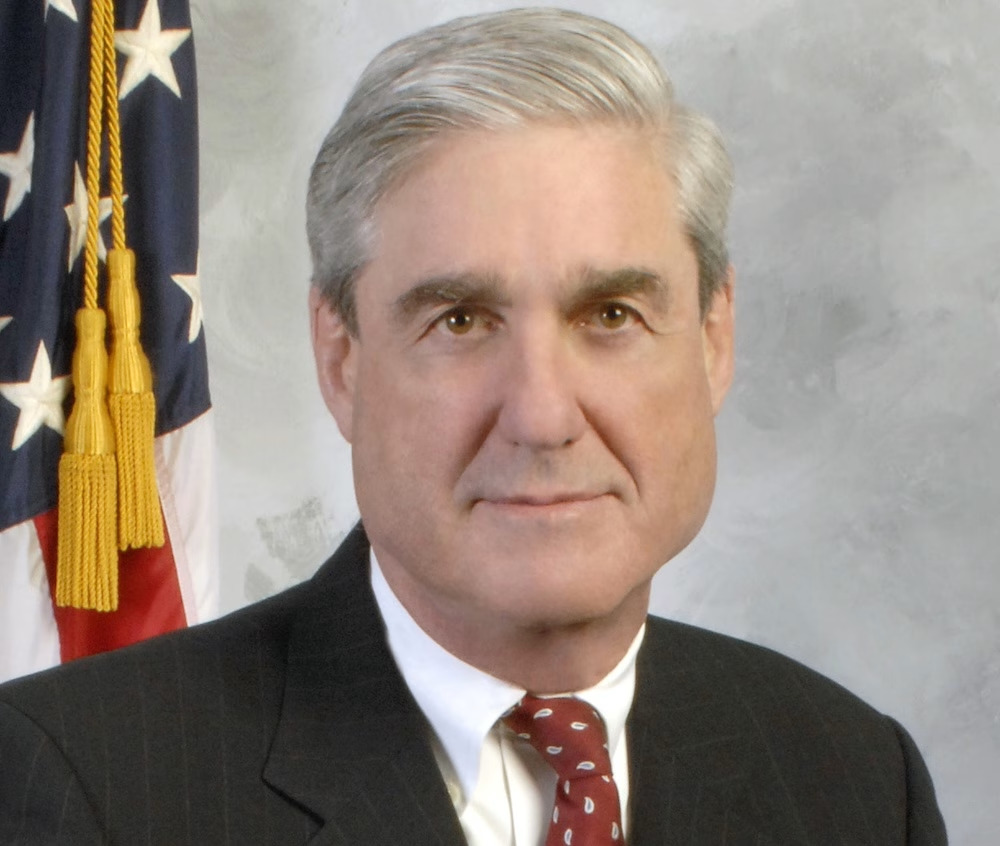
Associated Press, “Former FBI Director Robert Mueller, who investigated Russia-Trump campaign ties, dies“
Robert S. Mueller III, the FBI director who transformed the nation’s premier law enforcement agency into a terrorism-fighting force after the Sept. 11, 2001, attacks and who later became special counsel in charge of investigating ties between Russia and Donald Trump’s presidential campaign, has died. He was 81.
[…]
At the FBI, Mueller set about almost immediately overhauling the bureau’s mission to meet the law enforcement needs of the 21st century, beginning his 12-year tenure just one week before the Sept. 11 attacks and serving across presidents of both political parties. The cataclysmic event instantaneously switched the bureau’s top priority from solving domestic crime to preventing terrorism, a shift that imposed an almost impossibly difficult standard on Mueller and the rest of the federal government: preventing 99 out of 100 terrorist plots wasn’t good enough.
Later, he was special counsel in the Justice Department’s investigation into whether the Trump campaign illegally coordinated with Russia to sway the outcome of the 2016 presidential race. His investigation concluded that Russia interfered in the election on Trump’s behalf and that the Trump campaign welcomed the help, but Mueller and his team ultimately found insufficient evidence of a criminal conspiracy and did not make a prosecutorial decision about whether Trump had obstructed justice.
Mueller was maligned throughout the two-year investigation by Trump, who regularly derided it as a “witch hunt.” But the patrician Princeton graduate and Vietnam veteran who walked away from a lucrative midcareer job to stay in public service remained silent throughout the criticism, exhibiting an old-school, buttoned-down style that made him an anachronism during a social media-saturated era.
[…]
Republican President George W. Bush, who nominated Mueller, said in a statement that he was “deeply saddened” by Mueller’s death and praised him for having “dedicated his life to public service” and for overhauling the FBI’s mission. Democratic President Barack Obama, who kept Mueller on even after his 10-year term had expired, called him “one of the finest directors in the history of the FBI” who saved “countless lives” after transforming the bureau.
“But it was his relentless commitment to the rule of law and his unwavering belief in our bedrock values that made him one of the most respected public servants of our time,” Obama added.
[…]
The second-longest-serving director in FBI history, behind only J. Edgar Hoover, Mueller held the job until 2013 after agreeing to Obama’s request to remain on the job after the conclusion of his term.
After several years in private practice, Mueller was asked by Deputy Attorney General Rod Rosenstein to return to public service as special counsel in the Trump-Russia inquiry.
Mueller’s stern visage and taciturn demeanor matched the seriousness of the mission, as his team spent nearly two years quietly conducting one of the most consequential, yet divisive, investigations in Justice Department history. He held no news conferences and made no public appearances during the investigation, remaining quiet despite attacks from Trump and his supporters and creating an aura of mystery around his work.
All told, Mueller brought criminal charges against six of the president’s associates, including his campaign chairman and first national security adviser.
His 448-page report released in April 2019 identified substantial contacts between the Trump campaign and Russia but did not allege a criminal conspiracy. Mueller laid out damaging details about Trump’s efforts to seize control of the investigation, and even shut it down, though he declined to decide whether Trump had broken the law, in part because of department policy barring the indictment of a sitting president.
But, in perhaps the most memorable language of the report, Mueller pointedly noted: “If we had confidence after a thorough investigation of the facts that the president clearly did not commit obstruction of justice, we would so state. Based on the facts and the applicable legal standards, however, we are unable to reach that judgment.”
The nebulous conclusion did not deliver the knockout punch to the administration that some Trump opponents had hoped for, nor did it trigger a sustained push by House Democrats to impeach the president — though he was later tried and acquitted on separate allegations related to Ukraine.
New York Times, “Robert S. Mueller III, 81, Dies; Rebuilt F.B.I. and Led Trump Inquiry“
Robert S. Mueller III, who led the Federal Bureau of Investigation for 12 tumultuous years, brought politically explosive indictments as a special counsel examining Russia’s attack on the 2016 presidential election, and then concluded that he could neither absolve nor accuse President Trump of a crime, died on Friday. He was 81.
[…]
A button-down, lockjawed, rock-ribbed exemplar of a vanishing caste, the liberal Republican, Mr. Mueller became the F.B.I. director just a week before the terrorist attacks of Sept. 11, 2001.
He went on to impose the most significant structural and cultural changes in the history of the F.B.I., seeking to transform the bureau into a 21st-century intelligence service that could protect both national security and civil liberties. And his counterterrorism agents were the first to blow the whistle on abuses at the secret prisons that the C.I.A. had established after 9/11 to detain, interrogate and, in some cases, torture terrorism suspects.
But he may be best remembered for what he did after he left the F.B.I., when he was summoned to investigate a sitting president.
[…]
Upon hearing of Mr. Mueller’s appointment, and knowing his reputation, Mr. Trump was despondent. “Oh, my God,” he said. “This is terrible. This is the end of my presidency.
He knew, as Mr. Mueller later put it, that “a thorough F.B.I. investigation would uncover facts about the campaign and the president personally that the president could have understood to be crimes.”
One potential charge was obstruction of justice, the statute that had paved the way to President Richard M. Nixon’s resignation in 1974 and President Bill Clinton’s impeachment in 1998. Justice Department guidelines, never tested in court, decreed that a sitting president could not be indicted. Yet Mr. Trump’s many political foes hoped that the special counsel might somehow help unseat him.
Mr. Mueller hired a team of federal prosecutors whose collective experience reached back to the Watergate scandal. They brought indictments against a cohort of Russian spies and the command structure of a troll farm in the Russian city of St. Petersburg, the Internet Research Agency, which had conducted a misinformation campaign in the 2016 election at the direction of the Kremlin.
They sent Paul Manafort, Mr. Trump’s first campaign manager, to prison for fraud. They won a guilty plea from retired Lt. Gen. Michael Flynn, Mr. Trump’s first national security adviser, and a conviction of Roger Stone, one of Mr. Trump’s oldest political advisers, for lying to investigators.
The investigation reversed the polarity of public perceptions of the F.B.I., whose agents executed Mr. Mueller’s orders. Liberals who had long loathed the bureau now claimed to love it. Conservatives who had long revered it now reviled it. The American Civil Liberties Union held rallies championing Mr. Mueller. For his part, Mr. Trump assailed the F.B.I., the Justice Department and, eventually, Mr. Mueller himself, writing repeatedly on Twitter that the case was a “WITCH HUNT!”
Mr. Mueller stood above the fray, never commenting, never showing his hand. But when he confronted the issue of holding the president accountable for obstruction of justice, he balked.
[…]
Mr. Mueller became the sixth F.B.I. director on Sept. 4, 2001. His second week in office brought an epochal catastrophe.
Early on Sept. 12, the day after airplanes hijacked by the terrorist group Al Qaeda had hit the World Trade Center and the Pentagon, killing 2,977 people, President George W. Bush asked Mr. Mueller bluntly what the F.B.I. was doing to thwart the next attack.
The president posed that question to him daily at dawn briefings for years thereafter. But the bureau Mr. Mueller had inherited was fatally incapable of carrying out its counterterrorism and counterintelligence missions.
The F.B.I. had “failed again and again and again,” in the words of Thomas H. Kean, the Republican chairman of the 9/11 Commission, which investigated the systemic governmental flaws that enabled the plot to succeed.
The bureau’s chains of command had buckled and snapped. Computer systems constantly crashed. Wiretaps of foreign terrorists went unread for want of translators. When anthrax-laced letters sent to senators and journalists killed five people, only a few days after 9/11, it took the F.B.I. nearly seven years to identify a suspect, a government biodefense scientist.
“We have to smash the F.B.I. into bits and rebuild it,” the F.B.I.’s assistant director for counterterrorism, Dale Watson, had told his White House counterpart, Richard A. Clarke, before the attacks.
Smashing things was not Mr. Mueller’s way. But in his effort to transform the F.B.I., the first goal required, among many other things, repairing lines of communication with political leaders at the White House and in Congress, the electronic eavesdroppers at the National Security Agency, and the spies at the Central Intelligence Agency. Those channels had been broken for years; the imperious J. Edgar Hoover, who founded the bureau and led it from 1924 to 1972, had seen the C.I.A. as his greatest enemy, after Communism and the civil rights movement, and the rivalry had persisted long after his death.
When it came to preserving civil liberties in an age of counterterrorism, Mr. Mueller was largely on his own in an administration that saw itself engaged in a zealous crusade. He had to enforce the provisions of the newly enacted Patriot Act, which vastly expanded the government’s surveillance powers, while upholding the Constitution. That was a treacherous tightrope to walk.
The F.B.I. rounded up more than 1,200 people in the eight weeks after 9/11; none were members of Al Qaeda. In the process, it violated some elemental legal protections. The bureau also sharply increased the use of informants who served as agent provocateurs in Islamic communities. All this was done under the president’s command to put the F.B.I. on a military footing in the aftermath of the attacks.
But Mr. Mueller’s counterterrorism agents also exposed the C.I.A.’s secret “black sites.” They reported torture and abuses at those facilities and in the bleak chambers of the Abu Ghraib prison in Iraq. In October 2002, F.B.I. agents at Guantánamo Bay in Cuba, where terrorism suspects were imprisoned and interrogated, opened a running file that they later labeled War Crimes.
[…]
Early in 2004, Mr. Mueller and his immediate superior at the Justice Department, the deputy attorney general, Mr. Comey, learned that Mr. Bush had authorized the N.S.A. to spy on Americans. The program, code-named Stellarwind, was so secret that very few people were aware of how it worked.
[…]
At 1:30 a.m. on March 12, he sat at his kitchen table and drafted a letter of resignation. “I am forced to withdraw the F.B.I. from participation in the program,” he wrote; if the president did not back down, he would resign. Both Mr. Comey and Mr. Ashcroft were determined to go with him.
Eight hours later, with the resignation letter in the breast pocket of his suit, Mr. Mueller sat alone with Mr. Bush in the White House.
[…]
In May 2005, Mr. Comey told a select audience at the N.S.A. what Mr. Mueller had done: “It takes far more than a sharp legal mind to say ‘no’ when it matters most,” he said. “It takes moral character. It takes an ability to see the future. It takes an appreciation of the damage that will flow from an unjustified ‘yes.’” Stellarwind stayed secret for seven months thereafter, until The New York Times revealed its outlines.
Mr. Mueller never spoke publicly of his confrontation with the president.
[…]
After Hoover’s 48-year reign, a tenure unmatched in the high offices of American government, Congress had mandated a 10-year term of office for F.B.I. directors. None ever lasted it out, except Mr. Mueller. In 2011, President Barack Obama asked him to stay on two more years. Congress concurred. Its members widely regarded him as the best director in the bureau’s 100-year history, Hoover being relegated to a category all his own.
The Washington Post, “Robert Mueller, ex-FBI director at center of political tempest, dies at 81“
Robert S. Mueller III, a career prosecutor who became a central figure in two searing national traumas, first as FBI director in the aftermath of the 9/11 terrorist attacks and later as special counsel investigating ties between President Donald Trump’s campaign and Russia, died Friday in Charlottesville, Virginia. He was 81.
[…]
During more than four decades in law enforcement — as line prosecutor, U.S. attorney and FBI chief — Mr. Mueller developed a reputation as a stickler for detail who savored methodical investigation and nearly always got his man. Some colleagues privately spoke of the decorated Marine veteran as “Bobby Three Sticks,” referring to his patrician pedigree and the three-fingered Boy Scout salute.
Mr. Mueller was confirmed as FBI director by a 98-0 Senate vote and reported for duty on Sept. 4, 2001 — one week before the al-Qaeda assaults on the World Trade Center and the Pentagon that would define his tenure. Over the next 12 years, he became the longest-serving leader of the FBI since J. Edgar Hoover, and he guided the bureau under Presidents George W. Bush and Barack Obama through its transformation from a domestic crime-fighting agency to a global intelligence organization focused on the war against terrorism.
At the FBI, in an era of increasingly partisan national division, he built a reputation for nonpartisan rectitude and stone-faced reserve, frustrating speechwriters by crossing out every “I” they wrote into his prepared remarks. It wasn’t about him, he told them: “It’s about the organization.”
At the FBI, in an era of increasingly partisan national division, he built a reputation for nonpartisan rectitude and stone-faced reserve, frustrating speechwriters by crossing out every “I” they wrote into his prepared remarks. It wasn’t about him, he told them: “It’s about the organization.”
[…]
Mr. Mueller’s team of prosecutors believed they had shown that Trump’s actions were improper, and they assumed that Congress would take up their findings in an impeachment process. But the investigators declined to pursue any criminal charge against Trump, writing that an “accusation against a sitting President would place burdens on the President’s capacity to govern.”
As a result, Mr. Mueller’s report said, the investigators decided to avoid any “approach that could potentially result in a judgment that the President committed crimes.”
Mr. Mueller’s reluctance to return Trump’s fire in public comments and his decision to steer clear of impinging on a president’s ability to govern opened him to withering criticism that he had failed to hold Trump to account.
[…]
“The very qualities that got Mueller appointed and enabled him to push through with the investigation — his reputation as the sole figure in Washington who was above partisanship — turned out to be the qualities that made him stop short of concluding what most people thought he should conclude about the president,” Garrett M. Graff, author of a book about Mr. Mueller’s FBI years, “The Threat Matrix,” said in a 2020 interview for this obituary.
“So despite his incredible legacy of service,” Graff continued, “the verdict from history on Bob Mueller is going to end up being much more complex because of the final months of his career.”
Indeed.
Robert Mueller III was an American patriot and hero. He grew up wealthy, attending elite private prep schools—John Kerry was a classmate—and then Princeton. After earning a master’s at NYU, he volunteered for the Marine Corps and Vietnam at the height of the war’s unpopularity, which he decidedly did not have to do, serving with distinction and being decorated for valor.
After law school at Virginia, he served a dozen years as an assistant US attorney. He continually left lucrative stints in private practice for various higher-ranking Justice Department positions, seemingly culminating with his long and distinguished tenure as FBI Director.
He retired from the FBI shortly after his 69th birthday, was feted with every award imaginable (although, shockingly, not the Presidential Medal of Freedom), and finally cashed in making big money as a partner in one of the nation’s most prestigious law firms. He had every right to rest on his laurels, his debt to his country paid in full many times over.
Instead, at almost 73, he agreed to take on the Special Counsel job that would consume the next two years of his life and that he had to know was thankless. There is simply no winning in investigating the President of the United States under any circumstance, much less during highly polarized times and with a President as spiteful as Trump.
But Graff is right: fair or not, it will be for that tenure that Mueller will be most remembered.
The OTB gang wrote a whole lot about the Mueller investigation as it unfolded. Two of my own observations after the investigation concluded stand out:
“Post-Mueller Recriminations,” March 26, 2019
[W]hile I have long argued that Trump has committed impeachable offenses outside the scope of the Mueller investigation—violations of the Emoluments Clause and otherwise funneling taxpayer money into his private businesses in a positively shameless manner—my fundamental conservatism comes down to where Brooks and Will land: absent overwhelming, bipartisan consensus that the President is unfit to serve, the way to remove them is through the ballot box. Relatedly, as I have noted repeatedly through the process, I’m highly skeptical of independent counsel system and the massive fishing expeditions that they invite. Not only are innocents invariably caught up in the fishing net but it leads naturally to a criminalization of politics.
All that said, the recriminations and mea culpas are premature. Even though I’m a staunch critic of this President and his appointees, I will believe until and unless proven wrong that the Attorney General’s letter fairly represents Mueller’s principal findings. [I would indeed be proven wrong. Mea culpa. -ed.] But the fact that they did not find sufficient evidence to warrant charging Trump or his top advisors with conspiracy or the President with obstruction of justice by no means exculpates them. We must, after all, hold our leaders to a higher standard than not having committed provable felonies. What we already know about Team Trump’s interactions with Russian sources and attempts to hinder and derail the investigation into same are damning. It’s likely, indeed, given all of the indictments, convictions, and spin-off investigations that Mueller and company spawned that the details of the full report will provide more grist for that mill.
“Ennui and the Mueller Report,” April 19, 2019
For critics of the President, myself included, the report is woefully unsatisfying. It catalogs a variety of misdeeds and attempts at collusion and obstruction, none of which quite amount to enough for a prudent man like Robert Mueller to recommend the indictment of the President of the United States.
Sure, Congress could impeach him, anyway, as it’s ultimately a political act. But Speaker of the House Nancy Pelosi, rightly in my view, decided that pursuing Trump via that process simply isn’t worth it—especially given that it’s inconceivable that three-quarters of a majority-Republican Senate would vote to remove him from office. Trump would wind up vindicated and no other business would get done.
At the same time, only the most blinkered Trump supporters can see the result as a vindication. Falling just short of committing indictable crimes—and mostly because even hand-picked cronies wouldn’t carry out their orders to do so—is hardly the gold standard for Presidential conduct.
Even the most charitable reading of Mueller’s findings leaves a portrait of a man supremely unsuited for the highest office in the land. But he’ll continue to occupy it, with all the powers attached to it, for at least another 21 months.
Given the position he was in, I continue to believe Mueller played it straight. I have come to believe, though, that he was shockingly naive for someone who had been in such high roles in the American system in his faith that the Attorney General and Congress would do the right thing.
I was, however, highly critical of Mueller’s own performance in Congressional hearings a few months later.
“Mueller Doesn’t Deliver,” July 25, 2019
Mueller was just awful. I was expecting an incredibly well-prepared, brilliant legal analyst who brought enormous gravitas. Instead, I got a listless old man stumbling through answers and referring people to a report that, if they haven’t read it by now, aren’t gonna.
What critics of President Trump were hoping for was a captivating sound byte or three that would help crystalize for the American public that, yes, the President committed crimes. We didn’t get it.
[…]
My co-blogger Doug Mataconis is not wrong when he points out that the result was well short of an exoneration for the President.
On both the issue of collusion between the Trump campaign and the potential for obstruction of justice on the President’s part, Mueller directly contradicted the claims of the President, the Attorney General, and the President’s supporters on Capitol Hill and elsewhere, Mueller made clear that his report did not exonerate the President.
It’s just that this is the real takeaway:
In the end, it’s unlikely that Mueller’s testimony will have moved the needle of public opinion significantly on either the Russia investigation itself or the question of impeachment. I say this because Mueller’s professorial delivery and demeanor is unlikely to have made a huge impact on a public that has only been following this story tangentially and because the public seems to be decidedly disinterested in impeachment at this time.
Moving the needle, alas, was the only reason to have the hearing in the first place.
The more the report has settled, the more I think Mueller did us a disservice by failing to reach conclusions and therefore punting to the Attorney General and Congress. Yesterday, he made it much harder for Congress to advance the ball.
But, again, it was a thankless job that he decidedly didn’t have to take. He was chosen for it because he was so thoroughly respected by Democrats and Republicans alike and did not flinch when called upon. Critics might have wished that he had been a little more forceful in defending the work from Attorney General Barr and others. But that’s just not who he was.

A good man. RIP, Mr. Mueller.
My sympathies to his next of kin. I have insufficient information to judge his whole career, but I thought the judgement of Trump was bad. He should not have become an Inspector Javert, but saying that something stinks and not pursuing it seemed wrong to me at the time.