A Clear Example of Christian Nationalism
Hegseth's pulpit.
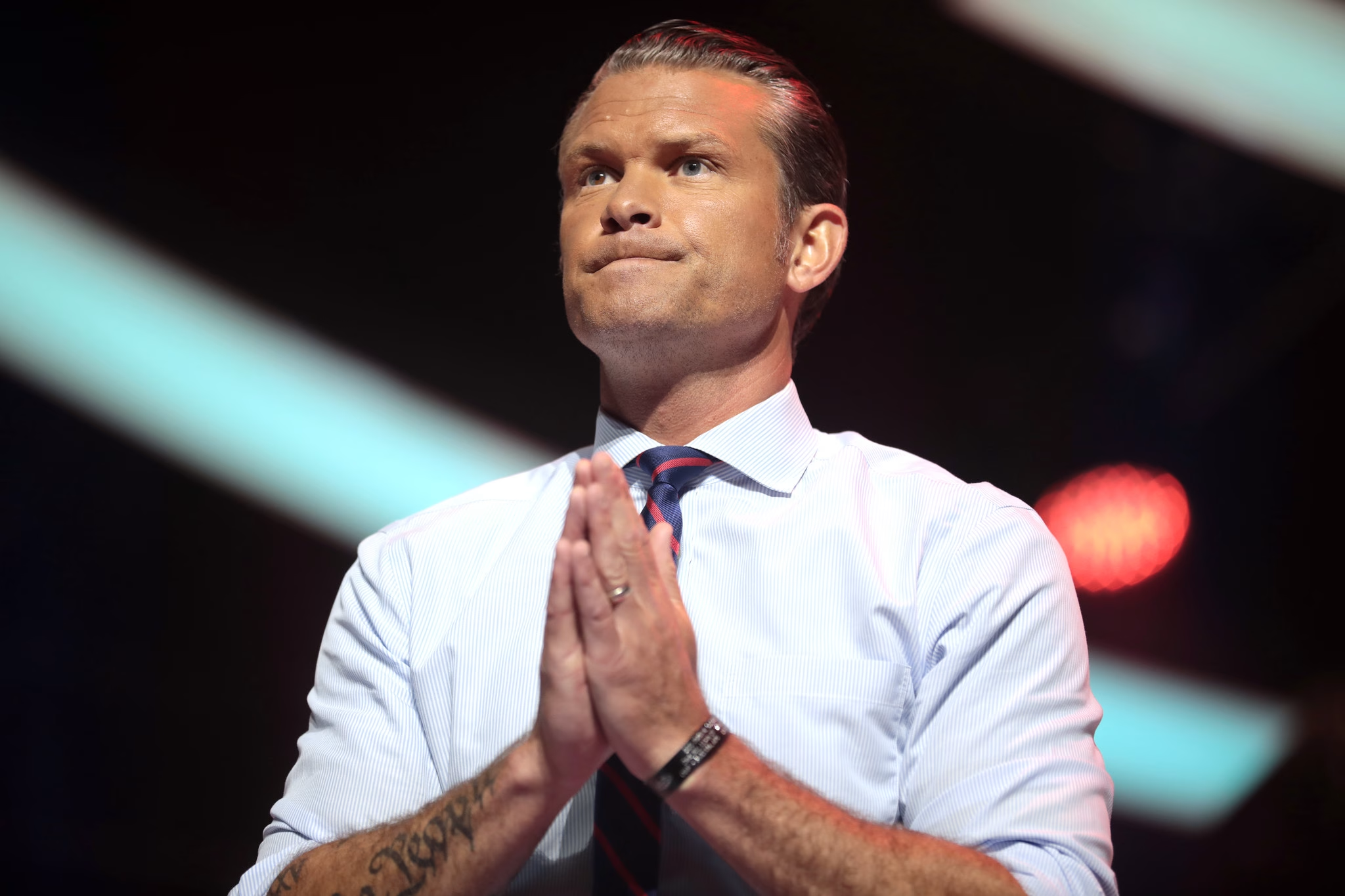
Via Public Witness: Hegseth Borrows Violent Prayer from ‘Pulp Fiction’ to Bless Iran War at April Pentagon Worship Service.
For the second month in a row, Pete Hegseth, who likes to call himself “secretary of war,” read a violent prayer — that echoes a scene in the Quentin Tarantino film Pulp Fiction — during a worship service at the Pentagon on Wednesday (April 15) to bless the U.S. war against Iran and call for “great vengeance and furious anger.” Hegseth also argued that what they hear in the worship service should impact the policy and military decisions they make — including decisions related to the war.
Let me note that this is a crass illustration of the Christian Nationalism rampant in this government. It is one thing for the Secretary of Defense to be a self-professed Christian, and even to be very public about it. It is another for that SecDef to be leading Bible studies at the Pentagon and directly linking US military action to some kind of scriptural purpose.
This is fusion of religion with state action (and not just any state action, but state-sanctioned violence, to include killing of civilians on the other side of the world), may strike some as exulting Christian values, but this is really trying to whitewash state action via religion. It should further be noted that, as a historical matter, attempts to fuse church and state in this fashion sully the religion far more than they lift up the state.
If Pete Hegseth wanted to be a pastor, he should have at.
Side-note: Hegseth’s focus on a God of vengeance and not a God of love is, well, telling, is it not?
Along similar lines, I noted this from Wired the other day: Government Workers Say They’re Getting Inundated With Religion.
The whole piece is worth a read, but here is the bit on the Pentagon:
The move towards religion in government has been most apparent at the Department of Defense. Under secretary of defense Pete Hegseth, the Pentagon has hosted a monthly prayer service featuring well-known evangelicals like Franklin Graham and his son Edward Graham, as well as Doug Wilson, a Christian Nationalist preacher who has argued for the establishment of a theocracy and said that women should lose the right to vote.
In a sermon delivered before Christmas, Franklin Graham told members of the military that “God is also a god of war.” On Good Friday, the DOD hosted a prayer service only for Protestants. A Pentagon spokesperson later told HuffPo that the “Pentagon Chaplain Office’s priest is not in town.” Hegseth has repeatedly framed the US war in Iran as a “holy war,” calling Iranians “barbaric savages” and called on Americans to pray for victory “in the name of Jesus Christ.”
Hegseth, who has controversial religious tattoos, attends a church that is part of the Communion of Reformed Evangelical Churches (CREC), a group of ultra-conservative congregations where Wilson is a cofounder. The church’s pastor, Brooks Potteiger, has also spoken at the Pentagon. (Last month, while speaking on a podcast, Potteiger called for James Talarico, the Texas Democratic nominee for Senate, to be “crucified with Christ.”)
“Prayer services at the Pentagon are 100 percent voluntary and are not mandated whatsoever,” DOD press secretary Kingsley Wilson told WIRED in response to a request for comment. “Anyone at the Pentagon is welcome to attend. It is not against the law to worship Christ voluntarily anywhere in the United States.” Wilson added that Hegseth is a “proud Christian” and that the Pentagon does not consider the prayer services to be a violation of the distinction between church and state.
While presidents from all parties have long attended religious events like the annual National Prayer Breakfast, Don Moynihan, a professor of public policy at the University of Michigan, says that this differs from the way religion—and specifically Christianity—is showing up in the federal workplace.
“The Trump administration has opened a new chapter in the integration of Christianity into the daily work of government,” says Moynihan.
One thing is for certain: when the view is that expressions of faith in a government workplace are “optional” and “voluntary,” but those expressions are of the majority religion, or are being propagated by supervisors, well, that clearly puts pressure on minorities to, at best, be quiet, doesn’t it?
There is also the practical question of whether any time or resources should be going towards these kinds of “voluntary” activities.
It does seem worth pointing out that what we are seeing is ultimately about power and not faith, per se. And this helps explain why a lot of evangelicals are pro-Trump, even given his rather obvious lack of faithful adherence to Christianity, shall we say

My gawd, another one? On the other hand, there’s an old adage that the third generation will kill family business. (Founder worked hard and established the business. Son worked hard in the small company, following dad’s example, and grew the company. Grandson grew up rich. For which see Donald Trump.)
It’s not discrimination. Other religions are separate but equal. Hegseth epitomizes religion as a tribal identifier. Has it occurred to Hegseth that come Pearly Gates time, murdered brown people count?
It’s rich that Hegseth, so smitten with his own religiosity, doesn’t know the bible well enough to recognize a fake verse.
Gosh, if only there was a clause in the Constitution that prohibited the establishment of a state religion…
I’m beginning to think that one of the main issues in this country is that people had become too accustomed to normalcy. With vaccinations came the decline in disfiguring illnesses, which has led some to think childhood diseases “aren’t that serious” when in fact it used to be pretty normal for HALF of children born would die in childhood. Same for this sort of overt pushing of Christianity–people seem to have forgotten how annoying proselytizing Christians can be. I had my fill of this sort of thing when I worked in politics in Missouri. I found it so annoying to be forced into prayers, etc. in work situations.
It’s a perfect MAGAt day…Whiskey Pete quoting fake Bible passages and Bobby Jr playing w raccoon cock.
How does the day get better?!?
@Sleeping Dog: In my opinion, Hegseth knew he was quoting – paraphrasing really – Pulp Fiction. That’s the point.
Also, the paraphrase makes it clear that he is celebrating the rescue of downed aviators in Iran. I know a bit about that operation. It was big, complex, difficult, and ultimately successful. I don’t begrudge that celebration.
I do not think that celebration as such belongs in a church service, nor do I think focusing on the OT god of vengeance and wrath is a good look. Meanwhile, there are several bullet points that to me are a much, MUCH bigger problem.
* He fired all the women and black people in senior leadership positions.
* He denied promotion to same
* He changed the name (unofficially) to Department of War
* He fat shamed senior leadership
* He complained about “stupid rules of engagement”
* He banned trans people from service – I don’t recall the exact action.
* He has shown favor to a particular religion/religious tradition
Several, maybe most, of these actions harm readiness or “warfighting” ability, by choking off or denying legitimate talent.
Among that bullet list, the quoting of Pulp Fiction barely registers.
@Jen: Yes. Related to normalcy, I’m sure I’ve said here before that people got complacent and comfortable with modern life. Took it for granted and were ripe to find meaning in foolish things.
Bulwark says American Catholics are on the same path Evangelical Protestants pioneered:
“Bulwark+”
And Adam Kinzinger:
“Kinzinger”
This alcoholic was not having a moment of clarity.
@charontwo: The two biggest drops for Catholics voting for Democrats were in 2016 and 2024.
Hmmm…what was similar about the Democratic presidential candidates in those two cycles? I can’t quite put my finger on it…I know there was something…/s
Seriously, the fact that a Church that refuses to allow women to have leadership roles didn’t vote for female candidates shouldn’t really be a surprise.
Almost certainly capable of ordering the US Army to establish martial law if Trump/Jesus is about to be tossed out of office. I rather doubt it will be an order that will be obeyed, and if he gives it, it will be his last.
@charontwo:
One difference is institutional; a lot of evangelical pastors may be able to argue themselves into some contorted concept of Trump as the “instrument of divine providence”.
I doubt many Catholic priests are going to regard Trump and Vance as more theologically authoritative than the Pope and the College of Cardinals.
That in itself is going to provide a brake mechanism.
Of course some, like Gaines and Bishop Barron, are going to continue to attempt to maintain an alignment with MAGA Christian Nationalism, which sustains their hopes of a reversal of “secular humanism”.
And then, of course, in God’s good time, the Protestants will return to the fold of Catholicism.
(While the Protestants in turn think the same in reverse; and for that matter of other Protestants, lol.)
However, I doubt more than a handful of the hierarchy are likely, when it comes to the crunch, to go full-schismatic and institute an “American National Catholic Church”.
If that happens, its likely to be fairly small minority, imho.
The rest will just “pray one way and vote another”, as has happened often enough.
Christians have always been able to rationalize anything. Murder. Slavery. Torture. Genocide. The Bible is everyone’s bitch, it will give you whatever you want from it.
I’ll let you in on a little secret: no one believes in God. Not really, not for many decades at least. The universe is approximately 93 billion light years across, containing more than a trillion galaxies. The Biblical God in that context is self-evidently nonsense, nothing but the absurd narcissism of a race of apes who, just two seconds ago in cosmic time thought Earth was the center of existence and a tree could be a god.
@Jen:
Since the birth of exit polls in the late ’60s, the winner of the Catholic vote has always won the national popular vote, except in 2016.
@Michael Reynolds: You aren’t wrong. But you aren’t making a general enough statement.
Humans have always been able to rationalize stuff. Pretty much anything, as long as it’s done to Them on behalf of Us.
@Michael Reynolds:
Ah, that’s the Catholic’s secret super-power; they have not had much truck with Biblical literalism for a long time.
They can adapt.
Same applies to a lot of Anglicans; and I suspect Orthodox also.
American “fundamentalist” types are the ones with real problems, lol.
@Michael Reynolds: The reality is, to be clear, that you and I probably are closer in our general views of religion than you think is the case. Certainly, you and I are closer than I am with a typical evangelical, or even with, say, my 25-year-old self.
Having said that, you are coming across as pompous here. Yes, there are many people who believe in God, and it really isn’t necessary, productive, or even accurate to make the assertion you do on this topic.
Its obnoxious, and I suspect it is offensive to many people who are otherwise your allies.
@Jay L. Gischer: Beat me to it.
I would shorten it to simply: Humans have always been able to rationalize stuff.
@JohnSF:
Even they are more adaptable than they think they are.
Simple example: 50 or so years ago, they didn’t really care about abortion, and yet here we are.
@Steven L. Taylor:
Well, imho that’s because American “evangelicalism” seems to have become more a political movement than a religous one.
Abortion seems to have got picked as a symbol of anti-secular bona fides and it enabled a link-up with Catholics.
The thing is how even in terms of theology American “evangelical fundamentalists” have become rather, well, odd. They appear to value most the Book of Revelations, some bits of St. Paul’s letters, and some selected bits of the Old Tertament (mostly Leviticus and Genesis, it seems).
And then go on to construct a system largely alien to much of historical Christianity.
(eg Rapture, and dispensationalism, various)
As an Anglican priest I know has said, only half-joking,: “Both heretics and lunatics.”
@Steven L. Taylor:
Yes, before Roe v Wade most protestant denominations believed “life” began at birth. I’m old enough to recall the general lack of pushback when R v W was announced. The cynical, i.e. realistic, story I’ve read many places is pretty much only Catholics objected to R v W. They started raising a lot of money on the issue and some Evangelical preachers saw an opportunity. Theology was rewritten to fit. Hence somebody’s line, “Last year Jerry Falwell couldn’t even spell abortion.” Then, seeing so many churchgoing voters fired up on the subject, Republicans decided they too had always opposed abortion and jumped on the bandwagon.
@JohnSF: I’ve seen commentary that in the U. S., without a dominant state church, the field was wide open for more, shall we say entrepreneurial, approaches to religion. Hence we have remained more religious on average than Europe, as state churches lost influence.
And yes, I’ve often snarked that Evangelicals seem basically Jewish. Except for, as you note, bits of the Gospels and Revelations, they don’t seem to have much use for the New Testament.
@gVOR10:
Well, once the Protestants went for a vernacular Bible, the Old Testament was up for grabs, lol
Odd thing: in late antiquity the Bible often was in vernacular, be it Latin or Greek or German or Slavonic.
But the Christians of that period mostly ignored the Old Testament.
I have a vague recollection that most circulated vernacular “Bibles” of that period were New Testament only.
Plus the Book of Psalms, iirc.
Could be wrong.
In the UK, Methodism and “Anglican Evangelism” were quite big things in the late 19th Century; but always had to struggle with the social impact of the industrial revolution etc.
In Europe, as in most of the world, a lot of “religion” has always been more about social custom and tradition than individual conviction.
Whereas, in the US, people have felt more free to “shop around” for a congenial denomination. Though sheer familial/local habit still seems to be a massive factor.
I wonder how one says “Secretary of Jihad Crimes” in Farsi.
@Michael Reynolds: On reflection, I find myself wondering if you are ok. You kinda don’t seem ok. Like maybe you’ve hit some serious anti-Semitism somewhere or something.
And yes, I’ve often snarked that Evangelicals seem basically Jewish. Except for, as you note, bits of the Gospels and Revelations, they don’t seem to have much use for the New Testament. Here is my favorite response regarding Christian preachers interpreting the Old Testament @gVOR10:https://www.google.com/search?client=safari&rls=en&q=lewis+Black+on+fundamentalist+preacher+quoting+the+old+testament&ie=UTF-8&oe=UTF-8#fpstate=ive&vld=cid:6c7dff70,vid:SC-nz71kmWE,st:0
@Jay L. Gischer: Rationalization is less than half the problem. It’s an essential part of the creative processing which separate us from the majority of critters on this planet, actually. The problem is the granting of completely unwarranted absolute certainty to our ruminations.
“Mark my word, if and when these preachers get control of the [Republican] party, and they’re sure trying to do so, it’s going to be a terrible damn problem. Frankly, these people frighten me. Politics and governing demand compromise. But these Christians believe they are acting in the name of God, so they can’t and won’t compromise. I know, I’ve tried to deal with them.”
― Barry Goldwater
@dazedandconfused: I mean, yeah, it’s an important component to disaster to have people who are not only devoted to their way of understanding the world and doing things, but seek to impose that on everyone else.
But the former does not imply the latter. It is possible for someone to have strong devotion and strong tolerance at the same time.
Possible, not easy.
@Jay L. Gischer:
@Steven L. Taylor:
The human ability, and penchant, for rationalizing their position through whatever means they can find, makes books like the Bible, which is supposed to be a moral guide of sorts, much less valuable and useful.
If the same book can be used to justify, to take a real example, both slavery and abolition, then it might as well say nothing either way.
A big part of the problem is that people regard the Bible as the word of God. In actual fact it’s not one book, but a collection of writings, not necessarily books as we understand the term, by diverse authors through a rather long span of time, written under very diverse circumstances.
It’s no surprise, therefore, God’s character changes between eras and authors, despite the weight of tradition and custom. Nor that social mores, morality, and other aspects also change along the same lines.
TL;DR: the Bible is no more the word of God, than any other writing by any other people anywhere else is.
However, when you think the ultimate power in the whole universe grants you license to indulge in your worst impulses, there’s little that can restrain or stop you. and that’s what’s wrong with religious radicals, fundamentalists, and/or nationalists, regardless of what religion they practice. The Iranian “Islamic” theocracy is not any better than the American “Christian” one being set up right now.
@dazedandconfused: I think I remember that quote. My father was a John Bircher and he made me help out at Goldwater headquarters in our area in the presidential campaign. Still, at present I think its a bit more that the GOP, Trump in particular, has learned how to benefit from catering to and placing evangelicals in positions of power and then openly claiming to be advancing the faith. The balance is teetering if someone made a strong argument that it’s now more tilted to the Christian nationalists dominating the GOP I could be convinced.
Steve
@Kathy:
Indeed. And this is at least part of the reason I asserted that MR was wrong that no one believes in God.
I would note, however, that a lot of people have used non-religious texts to do a lot of what you are saying in your post. I say this not to defend religious persons, but to simply point out that humans have demonstrated over time an ability to use moral certitude, as derived from any number of sources, to justify behaving badly.