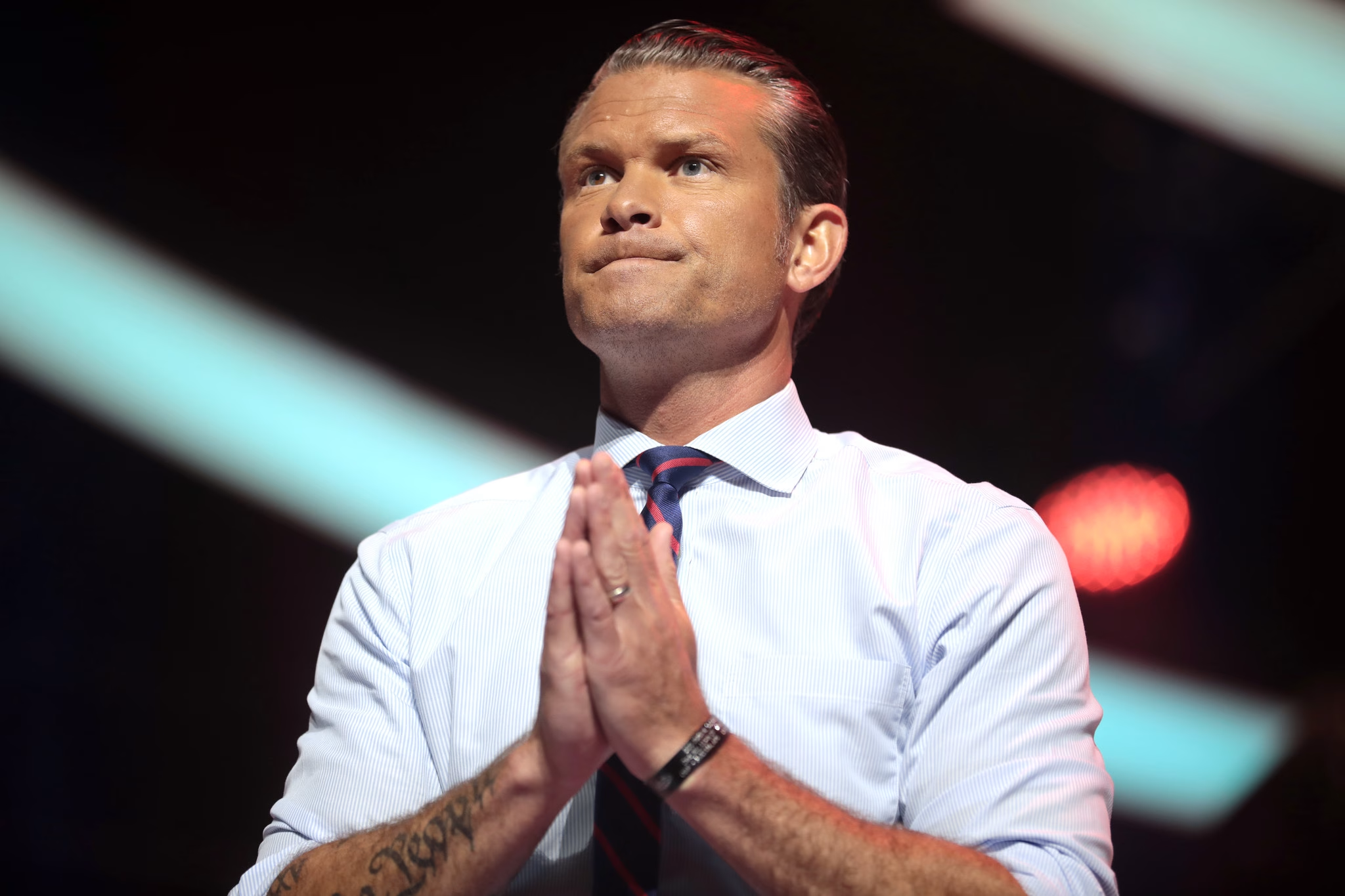
A Clear Example of Christian Nationalism

Hegseth's pulpit.

Via Public Witness: Hegseth Borrows Violent Prayer from ‘Pulp Fiction’ to Bless Iran War at April Pentagon Worship Service.

For the second month in a row, Pete Hegseth, who likes to call himself “secretary of war,” read a violent prayer — that echoes a scene in the Quentin Tarantino film Pulp Fiction — during a worship service at the Pentagon on Wednesday (April 15) to bless the U.S. war against Iran and call for “great vengeance and furious anger.” Hegseth also argued that what they hear in the worship service should impact the policy and military decisions they make — including decisions related to the war.

Let me note that this is a crass illustration of the Christian Nationalism rampant in this government. It is one thing for the Secretary of Defense to be a self-professed Christian, and even to be very public about it. It is another for that SecDef to be leading Bible studies at the Pentagon and directly linking US military action to some kind of scriptural purpose.

This is fusion of religion with state action (and not just any state action, but state-sanctioned violence, to include killing of civilians on the other side of the world), may strike some as exulting Christian values, but this is really trying to whitewash state action via religion. It should further be noted that, as a historical matter, attempts to fuse church and state in this fashion sully the religion far more than they lift up the state.

If Pete Hegseth wanted to be a pastor, he should have at.

Side-note: Hegseth’s focus on a God of vengeance and not a God of love is, well, telling, is it not?

Along similar lines, I noted this from Wired the other day: Government Workers Say They’re Getting Inundated With Religion.

The whole piece is worth a read, but here is the bit on the Pentagon:

The move towards religion in government has been most apparent at the Department of Defense. Under secretary of defense Pete Hegseth, the Pentagon has hosted a monthly prayer service featuring well-known evangelicals like Franklin Graham and his son Edward Graham, as well as Doug Wilson, a Christian Nationalist preacher who has argued for the establishment of a theocracy and said that women should lose the right to vote.

In a sermon delivered before Christmas, Franklin Graham told members of the military that “God is also a god of war.” On Good Friday, the DOD hosted a prayer service only for Protestants. A Pentagon spokesperson later told HuffPo that the “Pentagon Chaplain Office’s priest is not in town.” Hegseth has repeatedly framed the US war in Iran as a “holy war,” calling Iranians “barbaric savages” and called on Americans to pray for victory “in the name of Jesus Christ.”

Hegseth, who has controversial religious tattoos, attends a church that is part of the Communion of Reformed Evangelical Churches (CREC), a group of ultra-conservative congregations where Wilson is a cofounder. The church’s pastor, Brooks Potteiger, has also spoken at the Pentagon. (Last month, while speaking on a podcast, Potteiger called for James Talarico, the Texas Democratic nominee for Senate, to be “crucified with Christ.”)

“Prayer services at the Pentagon are 100 percent voluntary and are not mandated whatsoever,” DOD press secretary Kingsley Wilson told WIRED in response to a request for comment. “Anyone at the Pentagon is welcome to attend. It is not against the law to worship Christ voluntarily anywhere in the United States.” Wilson added that Hegseth is a “proud Christian” and that the Pentagon does not consider the prayer services to be a violation of the distinction between church and state.

While presidents from all parties have long attended religious events like the annual National Prayer Breakfast, Don Moynihan, a professor of public policy at the University of Michigan, says that this differs from the way religion—and specifically Christianity—is showing up in the federal workplace.

“The Trump administration has opened a new chapter in the integration of Christianity into the daily work of government,” says Moynihan.

One thing is for certain: when the view is that expressions of faith in a government workplace are “optional” and “voluntary,” but those expressions are of the majority religion, or are being propagated by supervisors, well, that clearly puts pressure on minorities to, at best, be quiet, doesn’t it?

There is also the practical question of whether any time or resources should be going towards these kinds of “voluntary” activities.

It does seem worth pointing out that what we are seeing is ultimately about power and not faith, per se. And this helps explain why a lot of evangelicals are pro-Trump, even given his rather obvious lack of faithful adherence to Christianity, shall we say

FILED UNDER: Religion, , , , , , , , , , ,
Steven L. Taylor
About Steven L. Taylor
Steven L. Taylor is a Professor Emeritus of Political Science and former College of Arts and Sciences Dean. His main areas of expertise include parties, elections, and the institutional design of democracies. His most recent book is the co-authored A Different Democracy: American Government in a 31-Country Perspective. He earned his Ph.D. from the University of Texas and his BA from the University of California, Irvine. He has been blogging since 2003 (originally at the now defunct Poliblog). Follow Steven on Twitter and/or BlueSky.

Comments

  1. gVOR10 says:

    Franklin Graham and his son Edward Graham

    My gawd, another one? On the other hand, there’s an old adage that the third generation will kill family business. (Founder worked hard and established the business. Son worked hard in the small company, following dad’s example, and grew the company. Grandson grew up rich. For which see Donald Trump.)

    It’s not discrimination. Other religions are separate but equal. Hegseth epitomizes religion as a tribal identifier. Has it occurred to Hegseth that come Pearly Gates time, murdered brown people count?

    ReplyReply
    1
  2. Sleeping Dog says:

    It’s rich that Hegseth, so smitten with his own religiosity, doesn’t know the bible well enough to recognize a fake verse.

    ReplyReply
    3
  3. Jen says:

    One thing is for certain: when the view is that expressions of faith in a government workplace are “optional” and “voluntary,” but those expressions are of the majority religion, or are being propagated by supervisors, well, that clearly puts pressure on minorities to, at best, be quiet, doesn’t it?

    Gosh, if only there was a clause in the Constitution that prohibited the establishment of a state religion…

    I’m beginning to think that one of the main issues in this country is that people had become too accustomed to normalcy. With vaccinations came the decline in disfiguring illnesses, which has led some to think childhood diseases “aren’t that serious” when in fact it used to be pretty normal for HALF of children born would die in childhood. Same for this sort of overt pushing of Christianity–people seem to have forgotten how annoying proselytizing Christians can be. I had my fill of this sort of thing when I worked in politics in Missouri. I found it so annoying to be forced into prayers, etc. in work situations.

    ReplyReply
    3
  4. Daryl says:

    It’s a perfect MAGAt day…Whiskey Pete quoting fake Bible passages and Bobby Jr playing w raccoon cock.
    How does the day get better?!?

    ReplyReply
    2
  5. Jay L. Gischer says:

    @Sleeping Dog: In my opinion, Hegseth knew he was quoting – paraphrasing really – Pulp Fiction. That’s the point.

    Also, the paraphrase makes it clear that he is celebrating the rescue of downed aviators in Iran. I know a bit about that operation. It was big, complex, difficult, and ultimately successful. I don’t begrudge that celebration.

    I do not think that celebration as such belongs in a church service, nor do I think focusing on the OT god of vengeance and wrath is a good look. Meanwhile, there are several bullet points that to me are a much, MUCH bigger problem.

    * He fired all the women and black people in senior leadership positions.
    * He denied promotion to same
    * He changed the name (unofficially) to Department of War
    * He fat shamed senior leadership
    * He complained about “stupid rules of engagement”
    * He banned trans people from service – I don’t recall the exact action.
    * He has shown favor to a particular religion/religious tradition

    Several, maybe most, of these actions harm readiness or “warfighting” ability, by choking off or denying legitimate talent.

    Among that bullet list, the quoting of Pulp Fiction barely registers.

    ReplyReply
    1
  6. reid says:

    @Jen: Yes. Related to normalcy, I’m sure I’ve said here before that people got complacent and comfortable with modern life. Took it for granted and were ripe to find meaning in foolish things.

    ReplyReply
  7. charontwo says:

    Bulwark says American Catholics are on the same path Evangelical Protestants pioneered:

    Bulwark+

    On The Next Level this week Tim said that some Christians were criticizing Trump for his attack on Leo and/or serial blasphemy. I’m sure that’s true. It’s a big country.

    But from where I sit, I think the net effect is the opposite. It looks to me like Trump is accelerating the move of Christian nationalists away from Christianity and towards pure Trumpist nationalism—even among Catholics.

    At the elite levels, I only saw token criticisms of Trump. Religious influencers such as Riley Gaines and Bishop Robert Barron offered the gentlest rebukes possible and even then slathered their words with praise for Trump’s general greatness.

    That’s not criticism; it’s brand protection.

    And at the grassroots level? We’ll have to wait a week or so for polling. I do not get the sense that this fight will cause Christians to break with Trump.

    But it may well cause them to break with the tenets of Christianity.

    I have said for several years now that my general sense is that American Catholics are walking down the same path that evangelicals trod in the 1990s when they consolidated behind the Republican party and became more of a political bloc than a religious movement.

    Look at how the Catholic vote has moved since 2008:

    2008:

    General: 52.9 percent (D); 45.7 (R)

    Catholics: 54.0 percent (D); 45 (R)

    2012 :

    General: 51.1 percent (D); 47.2 percent (R)

    Catholics: 50 percent (D); 48 percent (R)

    2016:

    General: 48.2 percent (D); 46.2 percent (R)

    Catholics: 45 percent (D); 52 percent (R)

    2020:

    General: 51.31 percent (D); 46.86 percent (R)

    Catholics: 49 percent (D); 50 percent (R)

    2024:

    General: 48.34 percent (D); 49.81 percent (R)

    Catholics: 43 percent (D); 55 percent (R)

    Let’s talk about these numbers.

    I include the popular vote splits to illustrate that the Catholic vote does correlate somewhat with the swings in the general vote. But it is distinct enough to have its own obvious trend. Catholic voters have become more Republican over the last eighteen years and this trend accelerated when Donald Trump—the least Christian presidential candidate in history—appeared on the scene.

    During that period we saw something similar happen with white evangelical voters, who were +50 R in 2008 but grew to +66 R in 2024.

    That 16-point swing looks pretty big. But during the same period, Catholics swung even harder. Catholics went from -9 R in 2008 to +12 R in 2024—a 21-point shift.

    This is what I mean when I say that Catholics look to be on the kind of curve that white evangelicals went on in the ’90s.

    Maybe Catholics will turn away from this road, but I’m not optimistic. If anything, Trump’s open blasphemy seems likely to accelerate the trend by forcing these people to make a choice between the teachings of the Church and the demands of a nationalist political cult.

    From where we sit in 2026, I’ll be surprised if most Trumpist Catholics end up choosing Catholicism in such a showdown

    And Adam Kinzinger:

    Kinzinger

    What the Trump administration has built, and what Graham and a handful of others have spent years theologically dressing up, is not Christianity. It is Christian nationalism — the belief that America is uniquely chosen, that a particular strain of conservative Protestantism should be privileged in law and culture, and that the strongman in the Oval Office is, in some sense, divinely ordained to deliver it.

    This is why Trump can post an image of himself being guided by Jesus and face no serious pushback from the movement’s clergy. Within the logic of Christian nationalism, it is not blasphemy. It is branding. The president is the vessel. The nation is the covenant. Anyone who objects — a Catholic bishop, a mainline pastor, a pope — is not a fellow Christian offering correction. They are an enemy of the project.

    You can see it in Graham’s own word choice today: “his enemies are always foaming at the mouth.” That is not pastoral language. That is campaign language with a cross stapled to it.

    ReplyReply

Speak Your Mind

*







