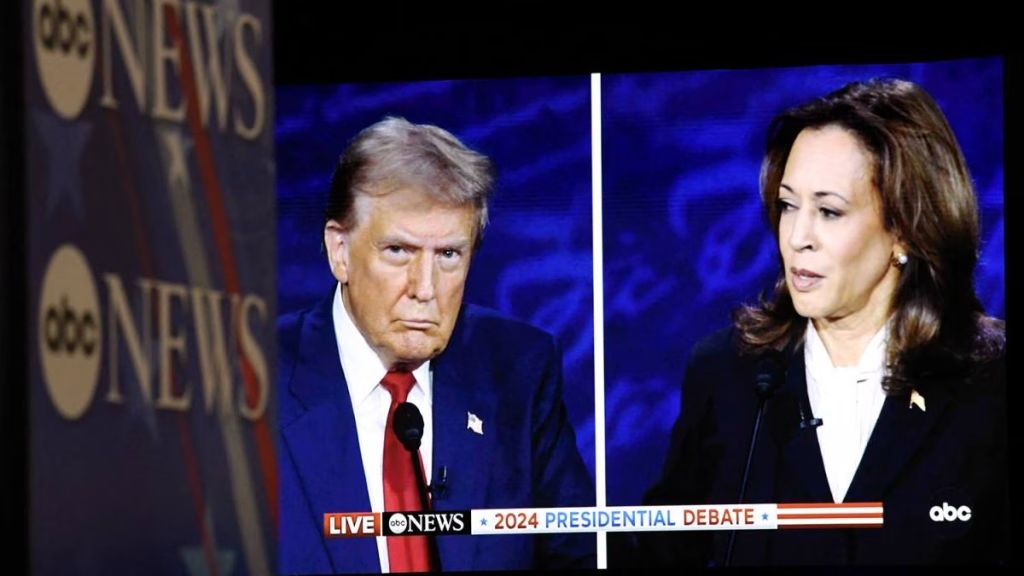
Let me start with the main criticism of Harris’ performance last night: that she didn’t directly answer the questions asked in many cases. I certainly noted this with her first response, which was more an opening statement than anything else. Part of me wanted a direct rebuttal to the notion that the country was better off four years ago (which she got to later). But, clearly, she had some things she wanted to communicate to the public watching, and she took her time to do so.
That is just smart.
Reall, these things aren’t debates in any real sense and never have been. I have often called them “joint press conferences” and to some degree, they have that quality when two serious candidates are on the stage. But, of course, when facing Donald Trump, that description goes out the window.
Speaking of Donald Trump, he didn’t answer all the questions asked, either.
At any rate, the notion that complex policy issues can be summarized effectively in two-minute blocks is absurd and always has been.
What massive policy issue does anyone remember about any of these things? They have been, to use a term currently in vogues, always about the vibes.
Off the top of my head:
1960? Man, Nixon sure looks sweaty! Didn’t he even shave? That JFK sure is dreamy on TV!
1984? In the first debate, Reagan sure looks old and tired! But in the next one, he got off an awesome zinger against Mondale!! So, it’s all good.
1988: All I remember from that cycle is Lloyd Bentsen’s zinger against Quayle in the VO debate. It was one for the ages! But I would note, Quayle got to be the veep, not Bentsen.
2012: Obama seemed disinterested in the first debate. Oh no!
2016: Puppet? Not a puppet.
2024 (take 1): Biden is old!
And so forth.
From last night the things that are resonating are things like Trump’s slur that Haitian immigrants are eating people’s pets (more on that in another post).
I understand the desire for serious policy discussion. But that isn’t going to happen in this context. Indeed, save for general outlines, campaigns aren’t as much about complex policy discussions as I would like to be the case.
It is as if we reduce done general policy directions to two groups that have symbols and labels and choose one.
Also: given the US system of separated powers and the various exigencies of US bicameral, a president really doesn’t know what exact policy agenda they can pursue until all the pieces are in place post-election and even then, they only have two years before a likely reset of those conditions.
If we want a system wherein a party leader can campaign on specific policy goals that they likely can implement, we need to change to a parliamentary system.
The debate last night was not about detailed policy disagreements and never was going to be. It was about trying to show the public the leadership options at their disposal and hitting on mostly general policy preferences along the way.
And, I would note, it is the candidate’s job to know when to use their limited time trying to adhere to the rules of the debate and when not to. Harris, in particular, had to take her shot when she could, as this was likely her last and only chance to reach a certain segment of the electorate (whether as viewers in the moment or via sound bite later).
But I will say, there are some big-ticket policy items on the table. One candidate is promising mass deportations that will be violent and disruptive. Another candidate is promising to uphold the right of women to make their own medical choices.
I would note, too, that one candidate couldn’t even bring himself to state that it is important that Ukraine win the war. He also listed Victor Orban as a character reference.
So, yes, there was some policy in there. But it just may not have been in the answers to specific questions at the exact moment the moderators wanted the responses.