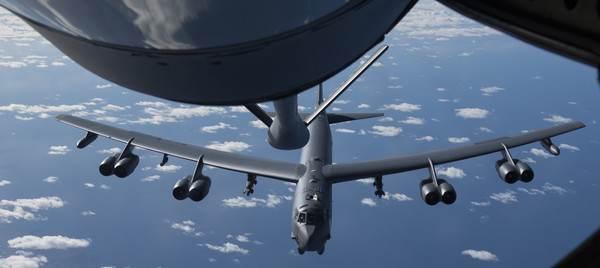
The top two men in the United States Air Force have been sacked for not keeping track of nuclear missiles, bomb fuses, and such.
The military and civilian chiefs of the Air Force are resigning, U.S. officials said Thursday. Defense officials who spoke on condition of anonymity said that Defense Secretary Robert Gates asked Air Force Chief of Staff Gen. Michael Moseley and Air Force Secretary Michael Wynne to step down. A public announcement was expected later in the day.
[…]
Wynne is the second civilian chief of a military service to be forced out by Gates. In March 2007 the defense secretary pushed out Francis Harvey, the Army secretary, because Gates was dissatisfied with Harvey’s handling of revelations of inadequate housing conditions and bureaucratic delays for troops recovering from war wounds at Walter Reed Army Medical Center in Washington, D.C.
The Air Force has endured a number of embarrassing setbacks over the past year. In August, for instance, a B-52 bomber was mistakenly armed with six nuclear-tipped cruise missiles and flown across the country. The pilot and crew were unaware they had nuclear arms aboard. The error was considered so grave that Bush was quickly informed. Moseley later announced that in response to flaws exposed during the nuclear weapons error, the Air Force would change the way bomber crews organize for their nuclear training mission.
Gates also has been trying to learn more about how fuses for Air Force ballistic missiles were mistakenly shipped to Taiwan. Gates has been briefed on the conclusions of an internal investigation of that matter but the results have not been made public. Four cone-shaped electrical fuses used in intercontinental ballistic missile warheads were shipped to the Taiwanese instead of the helicopter batteries they had ordered. The fuses originated at F.E. Warren Air Force Base in Cheyenne, Wyoming, but the mix-up apparently occurred after the parts were shipped to Hill Air Force Base in Utah.
In another incident, the Pentagon inspector general found in April that a $50 million contract to promote the Thunderbirds aerial stunt team was tainted by improper influence and preferential treatment. No criminal conduct was found. Moseley was not singled out for blame, but the investigation laid out a trail of communications from him and other Air Force leaders that eventually influenced the 2005 contract award. Included in that were friendly e-mails between Moseley and an executive in the company that won the bid.
“It is my sense that General Moseley’s command authority has been compromised,” Sen. Claire McCaskill, a Missouri Democrat on the Senate Armed Services Committee, said at the time.
So, let me get this straight: Three incredibly high profile, big-time screw-ups is enough to get you fired from a high Pentagon post nowadays?
Who knew?
Photo: Tim Sloan, AFP/Getty Images
UPDATE: Noah Shachtman suggests the issues behind this are even more complicated.
The move, initially reported by Inside Defense and Air Force Times, isn’t exactly a shocker. The Air Force has come under fire for everything from mishandling nukes to misleading ad campaigns to missing out on the importance of the Iraq and Afghanistan wars. Most importantly, the Air Force’s leadership has been on the brink of open conflict for months with Defense Secretary Robert Gates and Deputy Defense Secretary Gordon England. That’s because in the halls of the Air Force’s chiefs, the talk has been largely about the threats posed by China and a resurgent Russia. Gates wanted the service to actually focus on the wars at hand, in Iraq and Afghanistan. “For much of the past year I’ve been trying to concentrate the minds and energies of the defense establishment on the current needs and current conflicts,” he told the Heritage Foundation. “In short, to ensure that all parts of the Defense Department are, in fact, at war.”
Last fall, the Pentagon’s civilian chiefs shot down an Air Force move to take over almost all of the military’s big unmanned aircraft. “There has to be a better way to do this,” Moseley complained at the time. Things only got more tense when Gates said that the future of conflict is in small, “asymmetric” wars — wars in which the Air Force takes a back seat to ground forces. Then Gates noted that the Air Force’s most treasured piece of gear, the F-22 stealth fighter, basically has no role in the war on terror. And when a top Air Force general said the service was planning on buying twice as many of the jets — despite orders from Gates and the rest of the civilian leadership — he was rebuked for “borderline insubordination.”
Relations between Gates and the Air Force chiefs soured further when the Defense Secretary called for more spy drones to be put into the skies above Iraq and Afghanistan. The Air Force complained that all those extra flight hours were turning the roboplane’s remote pilots into virtual “prisoners.” Gates then publicly chastised the service during the drone buildup, comparing it to “pulling teeth.”
Much more, including several links to previous stories about these turf wars, at the link.