
POLITICO’s Kelly Hooper compares both versions to answer an admittedly esoteric question in the face of the evaporation of rather important civil liberty that had existed for almost half a century: “What changed from Justice Alito’s draft opinion to final ruling on Roe“?
The short answer: not much.
Despite fierce lobbying from outside forces to pull back from the precipice of overturning Roe, Alito’s writing contains all 10 key passages POLITICO identified in early May as the critical pieces of the abortion ruling.
The longer answer is that Alito added several passages directly responding to attacks on his ruling from dissenting and concurring Justices.
Roberts in his concurring opinion attempted to stake out a middle ground for the court, arguing that it didn’t need to end Roe in its entirety and instead could have upheld upheld Mississippi’s 15-week limit on abortion.
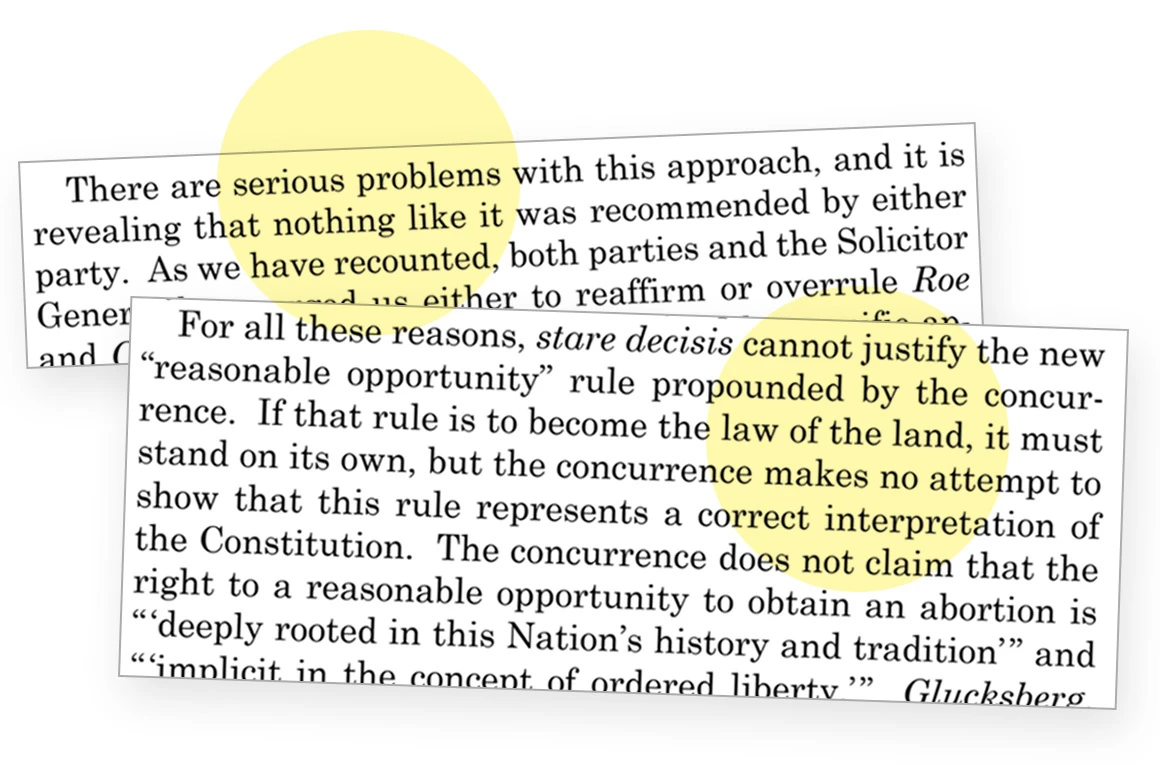
Alito in his final opinion takes issue with Robert’s reasoning — in which the chief justice supports leaving the constitutionality of tighter abortion restrictions to future cases — claiming there are “serious problems with this approach.”
Alito blasts Roberts for attempting to find a “middle way” in the contentious decision, which Alito claims will only “prolong” the “turmoil” of Roe. Alito argues that by only ruling that Mississippi’s 15-week law is constitutional, the high court would soon be called upon to decide the constitutionality of other states’ laws with shorter or longer deadlines for obtaining an abortion.
“The concurrence’s quest for a middle way would only put off the day when we would be forced to confront the question we now decide,” Alito writes. “The turmoil wrought by Roe and Casey would be prolonged. It is far better—for this Court and the country—to face up to the real issue without further delay.”
While I believe the basic tenet of Roe, as reaffirmed in Casey years later, that a woman’s right to control her body trumps those of the fetus before viability, should be considered “settled law” at this point, I actually agree with Alito on this narrow point. Since conservatives became a majority on the Court, they have allowed the precedent to be chipped away bit by bit, practically inviting states to continue pushing the envelope. In many states, the right to abortion was essentially fiction as the restrictions were so onerous that no doctors would provide abortions. It’s likely best to just admit that the Court does not see abortion as a real right than to continue that torturous process.
Alito also took aim at the argument Roberts laid out for giving people seeking an abortion a “reasonable opportunity” to obtain one, such as in Mississippi’s ban on abortion after 15 weeks of pregnancy. Alito said there are no constitutional grounds for upholding that rule, and that since Roberts made no claim that the right to an abortion is constitutional, his proposal to uphold the Mississippi limit would also not be supported by the Constitution.
“If the Constitution protects a woman’s right to obtain an abortion, the opinion does not explain why that right should end after the point at which all ‘reasonable’ women will have decided whether to seek an abortion,” Alito writes.
This, on the other hand, strikes me as pure sophistry. Surely, if there’s a right to an abortion, it’s meaningless if it evaporates before the woman knows she’s pregnant.
Alito’s final opinion also differs from the draft document because it adds a rebuttal to the three liberal justices’ dissent.
Justices Stephen Breyer, Sonia Sotomayor and Elena Kagan delivered the scathing dissent that rebuked the court for upending the “balance” Roe had cemented for nearly 50 years between “respecting a woman as an autonomous being” and protecting the life of a fetus.
But Alito undermined the justices’ argument in his final opinion, claiming they failed to show that a constitutional right to abortion exists or identify any pre-Roe authority that supports the right.
The dissenters, like Roberts, are relying on stare decisis. Abortion is a right because Roe said it was a right and Casey and subsequent decisions reaffirmed that ruling.
Alito also shot down the dissenters’ argument that Roe could be defended on prior court precedent, since none of the precedents the case was based on “involved the destruction of what Roe called ‘potential life.’”
That abortion is sui generis is arguably true. The silver lining here, possibly, is that it draws a distinction that Justice Thomas does not that distinguishes the court-discovered right to abortion from other substantive due process rulings striking down sodomy laws and allowing same-sex marriage.
The justice also argued that “adherence to precedent is not ‘an inexorable command.’” He went on in his opinion to name instances in which the court did overrule prior precedents, such as overturning the “separate but equal” doctrine in both Brown v. Board of Education and Plessy v. Ferguson.
Again, that’s true insofar as it goes. The obvious counter, though, is that this is the first time longstanding precedent has been abandoned in order to take away rather than expand civil liberties.
The liberal justices highlighted in their dissent the potential fallout the decision could have, such as states using the newfound power to impose criminal penalties on abortion providers or people seeking abortions.
Alito slammed the justices on this point, claiming they have no “regard for a State’s interest in protecting prenatal life.” He said their implication in their dissent is clear — that the liberal justices believe the Constitution doesn’t permit states “to regard the destruction of a ‘potential life’ as a matter of any significance.”
He also took aim at the justices for their praising of the “balance” that a viability line for abortion can strike between a woman’s autonomous being and the state’s interest in protecting the life of a fetus. Alito instead argued that a viability line “makes no sense.”
“It was not adequately justified in Roe, and the dissent does not even try to defend it today,” Alito writes.
So, again, I believe Roe‘s trimester framework, later amended to a viability standard in Casey, amounted to legislating from the bench. But, to the extent those Courts were trying to balance the interest of the states in protecting the rights of the fetus and the privacy rights of women to control their own bodies, surely fetal viability makes more than a little sense as a test. An abortion at the point where the fetus, if delivered, could sustain itself outside the womb—and thus be a baby rather than a fetus—is manifestly a different thing than one in the very early weeks. Only extremists in the debate dispute this.