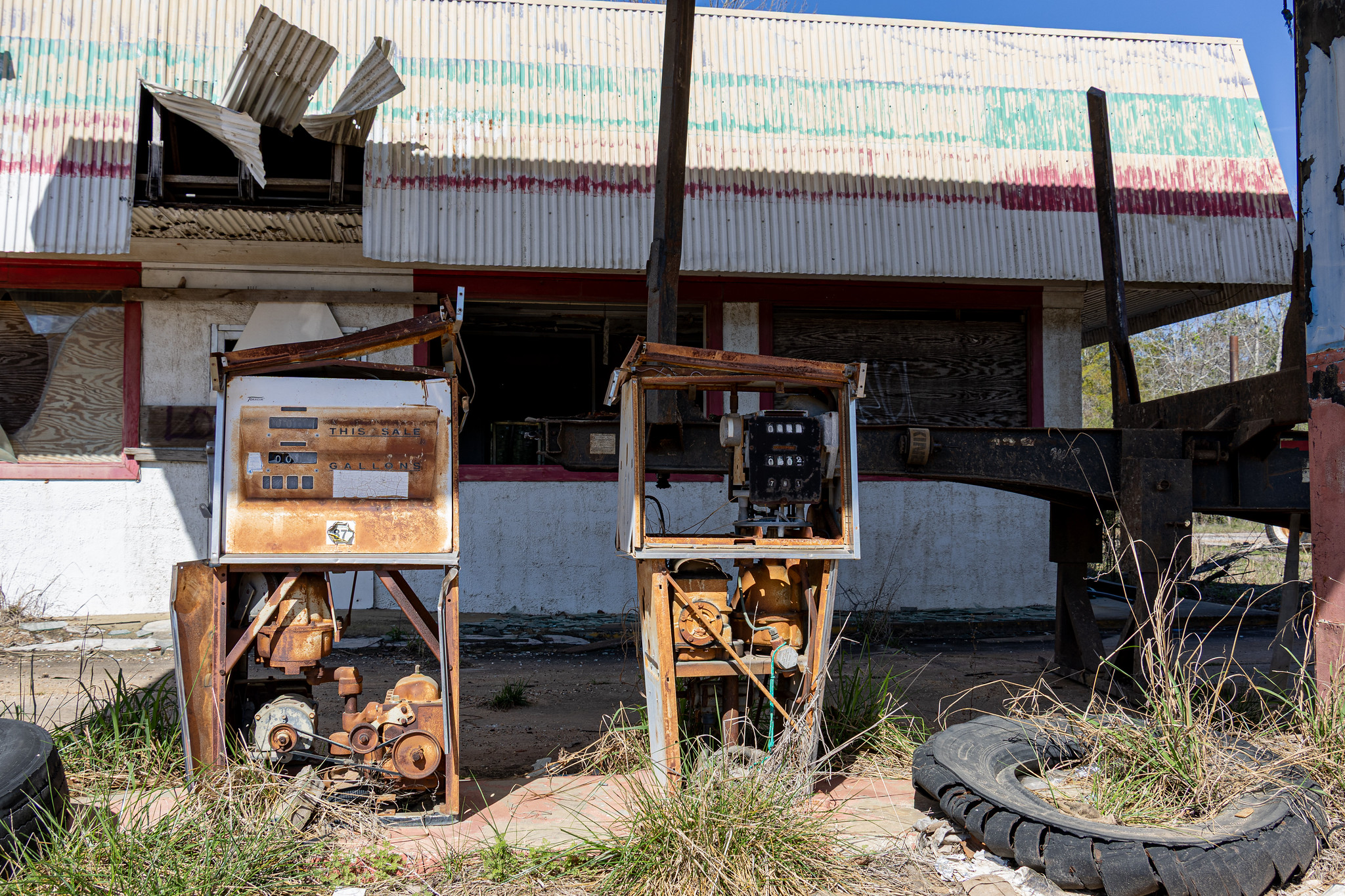
Photo by SLT

Who Could Have Predicted Oil Prices Would Continue to Go Up?

Good thing the war will be over right after the mid-terms!

31

Comments

I mean, who could have predicted that a protracted conflict in the Middle East would affect oil prices? And yet, CNBC reports: Brent crude oil tops $101 to close at highest level since May as fighting escalates in Persian Gulf.

Crude oil prices jumped more than 3% on Wednesday as fighting between the U.S. and Iran escalates in the Persian Gulf, raising investors’ fears that energy exports through the Strait of Hormuz will fall.

[…]

The U.S. military destroyed five Iranian crude oil tankers Tuesday in retaliation for attempted attacks on an American warship. The U.S. warship successfully evaded Iranian attack and no American personnel were harmed, U.S. Central Command said.

When I heard news yesterday about tankers being hit, I wondered about likely market effects. But as CBS News reports, it goes beyond that:

Yemen’s Houthis have seized the key Red Sea port of Mokha, according to military sources speaking to the AFP and Reuters. If confirmed, the move would make it easier for the Houthis to target ships transiting the Bab el-Mandeb Strait, a crucial waterway for Saudi Arabian oil exports.

Plus, this means both a higher bill, in general, for the US, and likely retaliation.

Several U.S. fighter jets at a Jordanian military base were damaged in Iranian strikes on Wednesday, sources tell CBS News. Iran’s state media had previously said Tehran targeted U.S. assets across the region in retaliation for American attacks on Iranian oil tankers.

I continue to wonder how much damage we have actually suffered, as this administration has hardly been forthcoming on that count.

But, never fear, the war is almost over!

President Trump said Wednesday that Iran is desperate to affect the midterm elections and mused that the conflict would end right afterward. “I think the war will end immediately after the election, because they can’t hold out any longer,” he told reporters.

Well, that’s a relief.

Meanwhile, here’s GasBuddy’s national average for gasoline, which certainly makes me think that Joe Biden has some ‘splainin’ to do.

Fret not! Truckers and farmers don’t use unleaded for all that haulin’ and growin’; they use diesel!.

Wait.

What?

Via FleetOwner: U.S. diesel prices approach $6 as Iran conflict drives oil higher.

Good thing I don’t drive a diesel vehicle

Wait.

What?

Via Grist: What the record-high cost of diesel means for you.

All told, the rising price of diesel has cost U.S. consumers an additional $46 billion, or about $350 per household, according to a Brown University tracker. That’s slightly less than the impact of rising gasoline prices — at $55 billion — but the 61 percent jump in diesel prices has outpaced the 41 percent increase in gas. 

Huh!

But seriously, who could have predicted it?

31 responses to “Who Could Have Predicted Oil Prices Would Continue to Go Up?”

  1. Brent Crude sounds like the name of the forgotten Sex Pistol.

    Sorry, carry on.

    7
  2. I mean, who knew they had oil in the Middle East? Why did no one mention this?

    1
    1. Lost in the details of one of the briefings, no doubt.

      1
  3. Iran was not processing weapons grade uranium until Fatso tore up the JCPOA.
    The Strait of Hormuz was open until Fatso attacked Iran.
    Now Fatso is promising $2 gas right after the election. The last time gas was $2 was at the beginning of the Trump Plague when no one was driving. Another time was during the Bush Contraction in 2008.
    Fuck Fatso.

    4
    1. Surging gas prices were a (somewhat under-discussed) factor in what led to the 2008 crash. But yeah, following the crash, they absolutely plummeted, which was hardly a sign of the nation’s economic health. The current circumstances aren’t exactly analogous (we aren’t in a housing bubble), but if Trump were not an utter economic dodo, he would not be constantly describing sharp price drops of any commodity as something worth hoping for.

      1
      1. Well, the global oil glut had various reasons: the US shale boom was underway, and (one faction in) OPEC was pumping hard to curb it.
        Plus alternative energy sources and steady increase in use efficiency were having an impact.

        Europe had (and has) a policy of keeping consumer prices high by flat duties to drive economy of use; which the US has never adopted.
        Hence rises in global market prices cause a much greater percentage increase in consumer prices in the US than in Europe

    2. Since I drive an EV the promise of $2 gas doesn’t excite me. But my $5K check, don’t forget about that!!!

      1
  4. Given the Houthis are currently advancing towrds the Bab-el-Mandab, as it looks like the Saudis have screwed up an attempt to drive them back using rival Yemeni groups, prices are likely to continue to increase.

    That’s despite some signs of increased oil flow out of Hormuz by independent shippers using small tankers “gone dark” and taking the southern track, and indicators Iranian interdiction has declined.

    The question now is whether Pakistan military (and possibly Turkey) are willing to back up the Saudis in Yemen, if KSA decides to step in directly on the ground, and the UAE and Saudis patch up their differences.
    So far, Pakistan seems reluctant.

    1. it looks like the Saudis have screwed up an attempt to drive them back using rival Yemeni groups, prices are likely to continue to increase.

      Surely, the Saudis may use their own forces to directly confront the Houthis. (snicker)

      2
      1. It may end up, for once, that the Saudis can’t rely on proxies or “allies”, and have to fight their own battles.
        Because I doubt the Houthi are amenable to being bought out.

        The interesting thing is that the recently vaunted “Mecca Alliance” seems to have fallen flat, with Pakistan wary, Turkey cautios, and the (previously excluded) Egyptians going “New number. Who dis?”

        We shall see if shrieks and baksheeh from Riyadh can produce anything.
        It seems a pretty sure bet that even Hegseth and Trump are not foolish enough to get the US involved in a new battle.
        But if it goes really bad, it’s going to hit oil prices.
        Bigly.

        The ironic thing is that the Saudis were, in my judgement of all the reports, urging the US not to embark on this adventure, and if they must, to limit it to some strikes on nuclear programme targets.
        Trump going all-in with Netanyahu’s “decapitation and insurrection” pitch sandbagged the Saudi’s, who simply did not expect this degree of stupidity.

        1
        1. And they don’t have a spare luxury jumbo jet to trade for US troops?

  5. President Trump said Wednesday that Iran is desperate to affect the midterm elections and mused that the conflict would end right afterward.

    Perhaps a Democratic congress will reign in the Trump reign.

    That doesn’t sound like what a Democratic congress would do, as I expect there would be enough saying they want to “support the troops” that when added to Republicans the blank check would continue, but it’s technically possible a Democratic congress could cut all funding.

    1
  6. Reading that the Houthis had attacked and seized Mokha made me very anxious. I read more, and it seems that the majority of the world’s arabica is grown in Brazil and Colombia, and Brazil is anticipating a very good crop yield this year. I will sip a good cup of coffee while watching the unfolding of the brilliant, genius war plan of Trump, Hegseth, and Bessent.

    1
    1. Sold a pup by Bibi, and trying to put the best face on it.

  7. I think I’ve seen that photo before, or perhaps a similar one. But I just love the use here.

    1. It reminds me of the Stuckey’s that we stopped at earlier this year… except the Stuckey’s was open for business.

  8. I have thought since not long after the war started that Iran has figured out control of the strait is now in play for them, something they weren’t sure about before the war. I think that their goal is to disrupt it long enough for gas prices to go scary high which will accomplish a couple of things. First, they make a lot of money when it opens. Second, they likely end effectively being able to charge tolls. Current prices are high but compared with other historical highs adjusted for inflation they are not that elevated. Let oil get to $150-$200 and stay there for a while. I think that will be different.

    Steve

    1. It still looks like more oil is getting out via the Straits than there was (albeit not enough to get prices down) with small “gone dark” tankers making the southern run at night, and some attrition of Iranian interdiction.

      Also, I still think it gets overlooked that the Straits of Hormuz are a sword with two edges: Iran can use drones and missiles, and small boats.
      But so can the Gulfies various.
      Iran does not somehow have a magical drone monopoly.
      It’s a game more than one can play, and Iran also, in the longer run, also needs the export routes.

      The outcome may be the Trump declaring a win (or a Dem “stab in the back” after November?) and walking away, and then the GCC and Iran coming to a local arrangement between themselves.

      1
    2. An additional goal, related to control of the strait and therefore its impact on oil supply, appears to have been driving the US out of military bases in the gulf states and Jordan, making the projection of US force in that region more difficult.

      1. Iran may manage it in the Gulf; Jordan is more doubtful, because that requires ballistic strikes not reinforced by drones.
        otoh, if the Gulf becomes no-go for US forces, what is the utility of Jordan?

        It sometimes looks like Colby et al’s vaunted “pivot to the Far East” may come to pass not so much by design as by default.

        And contra some, this is not necessarily a good thing either for US interests, Western interests, or regional stability.

        If the US is out, there are others who may well want in.

  9. Mokha has been taken by the Houthis.
    They are now about 50 miles from the Bab-al-Mandab.

    1. Apologies to Slugger, who actually mentioned Mokha earlier but I forgot.
      Mea culpa
      Should have had more coffee.
      😉

  10. The last reported weekly drawdown of oil from the SPR was only about 1.2 million barrels. This is down from an average of about 4.5 million barrels withdrawn per week over the previous four weeks, and an average of more than 6 million barrels per week over the previous four months.

    It appears the administration is in no hurry to reach the SPR’s statutory threshold level of 252.4 million barrels, as going below that is supposed to require a declared energy emergency. At the recent withdrawal pace of 4.5 million barrels per week, the threshold would’ve been reached before the end of October…and before the election.

    The SPR withdrawals comprise only a small percentage of the oil used in the US, but the extra supply—or lack of it—should have a marginal effect on fuel prices.

    1
    1. I’ve seen some MAGA-chatter about how the Venezuela “oil deal” either obviate the SPR (“petroleum” is perhaps misleading as it actually seems to be crude), or enables rapid refill.

      Ignoring the fact that using Venezuelan heavy/sour for refill would require at least some pre-processing, and that Venezuelan output is choked, and needs investments to increase it.

      The real impact on global oil prices so far seems to have been China’s reserves and its urgent drive to economise on use.
      But this seems liable to run out of room in the not too distant future.

  11. It would be nice if the media treated the relentless good news stories from the regime with more scepticism. To hear the White House, oil is flowing freely through the Strait of Hormuz, and Iran is in terrible economic trouble, as if they are the only factors influencing the outcome of the war.

    For context:

    Saudi Arabia has reported to OPEC that its oil production plunged to its lowest since 1990 last month as the kingdom’s export routes have been squeezed by attacks by Iran and Yemen’s Houthi militia.

    Six months since the Iran war crippled Qatar’s LNG exports via the Strait of Hormuz, the world’s second-largest liquefied natural gas exporter has lost $24 billion in sales as exports tumbled by as much as 96%, Reuters calculations showed on Wednesday.

    Six months after the closure of the Strait of Hormuz, the global fertiliser supply chain has collapsed in key regions, creating a dual crisis of physical shortages and soaring costs. Since March, commodity intelligence platform CropGPT has directly surveyed thousands of farmers every month, across eight countries to measure the impacts of the crisis. The data shows a potentially catastrophic impact on global food and beverage – coffee included – supplies and prices in 2027.

    The pressure on Trump to end his war is not only domestic. The regime must be copping constant vigorous demands from countries all around the world to stop the chaos. They may not be satisfied with pious exhortations to put up with some temporary inconvenience to make sure Iran can never have a nuclear weapon (a goal which was always ludicrously impossible anyway).

    1. There are indications that tanker transits are up.
      But nowhere near pre-war levels.
      And getting data on non-oil transits is a bastard.
      But the indications are, on the non-oil, which most seem to forget, but are still major: fertilisers, aluminium, urea, etc are all massively up in price.
      Add to that the Ukraine war impact on both grains and fertilisers, and the impact on global price chains is not good.
      To put it mildly.

      1. The problem is, countries various are telling the US this is absurd.
        But nobody in DC seems to be listening.

  12. Oh dear.
    Reports the Houthis have hit the Saudi EW pipeline.
    There goes the neighbourhood.

    Oil prices up.
    Saudis likely to directly attack Houthis: probability increasing.
    Key questions: do Pakistan, Turkey and Egypt step in.

  13. Latest reports are Houthi forces attempting landing on Perim in the Bad-el-Mandab.
    This is potentially disastrous, and never mind if you think the world must suffer for the sins of Trump or MBS.
    Probability of non-US intervention is increasing rapidly.

    1. More than 100 US military advisers are on the ground in Saudi Arabia providing intelligence and targeting support to the Kingdom in its military campaign against the Iran-backed Houthis in Yemen, multiple sources familiar with the effort say. The assistance comes as fighting on the peninsula intensifies and risks spilling into open war with the Houthis, threatening a second major shipping corridor out of the Middle East.

      The US military personnel are working as part of a newly-established joint forces command, which was formed in recent weeks amid signs Iran was ramping up its own efforts to aid Houthi attacks against Saudi Arabia, one of the sources, a US official, said. That official put the total at roughly 200 troops.

      The presence of US troops assisting Saudi Arabia was described to CNN by five sources familiar with the operations.

      https://edition.cnn.com/2026/09/10/politics/us-military-support-saudi-arabia-houthi-iran-yemen

      Anybody familiar with the beginnings of the Vietnam catastrophe will find that news ominous.

      1. Uhh…
        Yeah, at least ominous.
        (Fortunately[??], few people remember history, it happened sooooo long ago.)

Leave a Reply

This site uses Akismet to reduce spam. Learn how your comment data is processed.