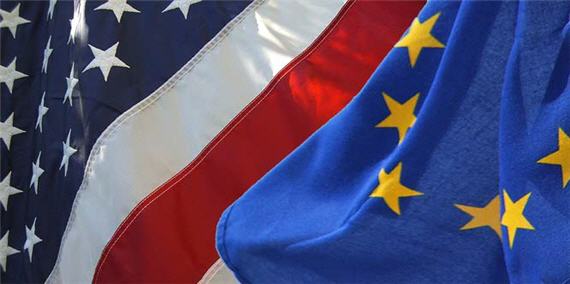

David Brooks points out that, despite the mythology of America as a land of rugged individuals and Europe as a socialist experiment gone wrong, the amount of social welfare spending is roughly the same.
The U.S. does not have a significantly smaller welfare state than the European nations. We’re just better at hiding it. The Europeans provide welfare provisions through direct government payments. We do it through the back door via tax breaks.
For example, in Europe, governments offer health care directly. In the U.S., we give employers a gigantic tax exemption to do the same thing. European governments offer public childcare. In the U.S., we have child tax credits. In Europe, governments subsidize favored industries. We do the same thing by providing special tax deductions and exemptions for everybody from ethanol producers to Nascar track owners.
These tax expenditures are hidden but huge. Budget experts Donald Marron and Eric Toder added up all the spending-like tax preferences and found that, in 2007, they amounted to $600 billion. If you had included those preferences as government spending, then the federal government would have actually been one-fifth larger than it appeared.
The Organization for Economic Cooperation and Development recently calculated how much each affluent country spends on social programs. When you include both direct spending and tax expenditures, the U.S. has one of the biggest welfare states in the world. We rank behind Sweden and ahead of Italy, Austria, the Netherlands, Denmark, Finland and Canada. Social spending in the U.S. is far above the organization’s average.
You might say that a tax break isn’t the same as a spending program. You would be wrong.
David Bradford, a Princeton economist, has the best illustration of how the system works. Suppose the Pentagon wanted to buy a new fighter plane. But instead of writing a $10 billion check to the manufacturer, the government just issued a $10 billion “weapons supply tax credit.” The plane would still get made. The company would get its money through the tax credit. And politicians would get to brag that they had cut taxes and reduced the size of government!
This is essentially what’s been happening in sphere after sphere. Government controls more and more of the economy. It just does it by getting people to do what it wants by manipulating the tax code. Politicians get to take credit for addressing problem after problem, but none of their efforts show up as unpopular spending.
Many of these individual tax expenditures are good for the country, like the charitable deduction and the earned income tax credit. But, as the economist Bruce Bartlett demonstrates in his impeccably fair-minded book, “The Benefit and the Burden,” the cumulative effect of these tax breaks is terrible. Like overgrown weeds, the tangle of tax breaks distorts behavior, clogs the economy and deprives the government of revenue.
And because they are hidden, many of the tax expenditures go to those who need them least, the well connected and established over the vulnerable and the entrepreneurial.
Additionally, in disguising welfare as tax policy, we have a much less efficient welfare state. We’d doubtless be far better off with the dreaded European Socialized Medicine than our current patchwork of taxpayer subsidized insurance plans. Not only do we get much less bang for the buck than our European, Canadian, and Australian counterparts but there are gaps in our coverage for those temporarily unemployed, moving in between jobs, and so forth.