
The United Nations Foundation has released a new survey showing that Americans overwhelmingly prefer multilateral solutions to foreign policy issues. Mark Leon Goldberg provides an executive summary:
The United Nations Foundation released the results of a major survey of Americans’ foreign policy attitudes today. Americans, the poll finds, are virtually unanimous (86% of all voters) in the belief that working with allies and through international organizations is a wiser strategy for achieving America’s foreign policy priorities.
The poll also finds that 73% of all voters are more likely to vote for a candidate for President who understands that “solutions to world problems require international cooperation, whether they are economic problems, environmental problems, or problems of peace and war and that international cooperation is a better way of solving some of the world’s key problems.” Voters also show a strong preference for a candidate who can put an end to anti-Americanism and “restore trust in America through strong diplomatic efforts and cooperative partnerships with other nations around the world.”
The full report, in PDF format, is here.
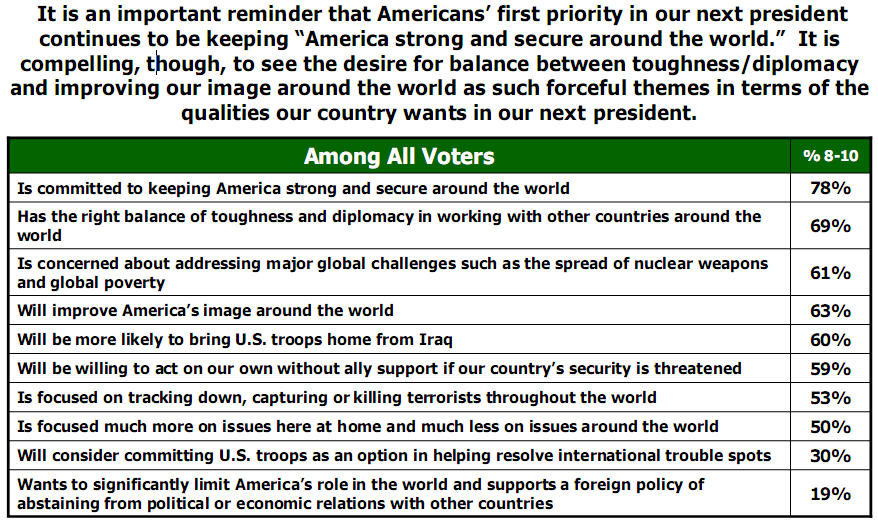
The results, frankly, aren’t that surprising. Indeed, in the abstract, Americans have preferred working with allies since roughly the end of World War I. But, when push comes to shove, most Americans want a leader who puts America first, is tough, and willing to act alone if international cooperation can’t be secured:

So, while the top-line numbers are encouraging for liberal internationalists, the bottom line remains what it always has.
Indeed, readers might recall that the Bush Administration spent months trying to bring the United Nations on board for the invasion of Iraq. Umpteen Security Council resolutions were passed, Hans Blix and crew were dispatched, President Bush and Colin Powell gave passionate speeches to the General Assembly, and so forth. That was done out of both genuine conviction that multilateralism was preferable but also out of domestic political calculation. At the end of the day, though, we reserved the right to build a Coalition of the Willing and take on the fight without the U.N. on board. That’s not likely to change anytime soon.
Note, too, the paltry support (30%) for committing U.S. troops to help out in international trouble spots.
It would seem that Americans still want the foreign policy George W. Bush campaigned on in 2000.








