Angela Merkel, who has served as Chancellor of Germany since 2005, won re-election to a fourth term in that position, but the election also saw gains by a far-right party that has raised the concerns of many in Germany:
BERLIN — Angela Merkel won a fourth term as chancellor in elections on Sunday, placing her in the front ranks of Germany’s postwar leaders, even as her victory was dimmed by the entry of a far-right party into Parliament for the first time in more than 60 years, according to preliminary results.
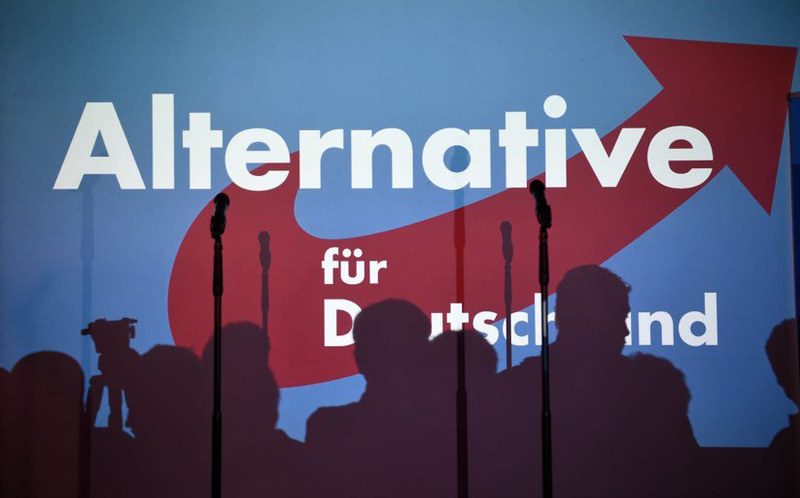
The far-right party, Alternative for Germany, or AfD, got some 13 percent of the vote — nearly three times the 4.7 percent it received in 2013 — a significant showing of voter anger over immigration and inequality as support for the two main parties sagged from four years ago.
Ms. Merkel and her center-right Christian Democrats won, the center held, but it was weakened. The results made clear that far-right populism — and anxieties over security and national identity — were far from dead in Europe.
They also showed that Germany’s mainstream parties were not immune to the same troubles that have afflicted mainstream parties across the Continent, from Italy to France to Britain.
“We expected a better result, that is clear,” Ms. Merkel said Sunday night. “The good thing is that we will definitely lead the next government.”
She said that she would listen to those who voted for the Alternative for Germany, or AfD, and work to win them back “by solving problems, by taking up their worries, partly also their fears, but above all by good politics.”
But her comments seemed to augur a shift to the right and more of an emphasis on controls over borders, migration and security.
Despite her victory, Ms. Merkel and her conservatives cannot lead alone, making it probable that the chancellor’s political life in her fourth term will be substantially more complicated.
The shape and policies of a new governing coalition will involve weeks of painstaking negotiations. Smiling, Ms. Merkel said Sunday night that she hoped to have a new government “by Christmas.”
The center-left Social Democrats, Ms. Merkel’s coalition partners for the last four years, ran a poor second to her center-right grouping, and the Social Democrats announced Sunday evening that the party would go into opposition, hoping to rebuild their political profile.
But the step would also make sure that the AfD stays on the political sidelines and does not become the country’s official opposition.
The Alternative for Germany nonetheless vowed to shake the consensus politics of Germany, and in breaking a postwar taboo by entering Parliament, it already had.
Alexander Gauland, one of AfD’s leaders, told party supporters after the results that in Parliament: “We will go after them. We will claim back our country.”
To cheers, he said: “We did it. We are in the German Parliament and we will change Germany.”
Burkhard Schröder, an AfD member since 2014 from Düsseldorf, was ecstatic. “We are absolutely euphoric here,” he said. “This is a strong victory for us that has weakened Angela Merkel.”
Up to 700 protesters gathered outside the AfD’s election night party, chanting slogans like “All of Berlin, hate the AfD.”
“It’s important to show that it’s not normal that a neofascist party got into the German Parliament,” said Dirk Schuck, 41, a political scientist at the University of Leipzig.
While both Ms. Merkel and the Social Democrats lost significant voter support from 2013, her victory vaults her into the ranks of Konrad Adenauer and Helmut Kohl, the only postwar chancellors to win four national elections.
The election is a remarkable capstone for Ms. Merkel, 63, the first East German and the first woman to become chancellor.
It also represents a vindication of her pragmatic leadership and confidence in her stewardship of Europe’s largest economy and of the European Union itself in the face of populism, challenges from Russia and China and uncertainty created by the unpredictable policies of President Trump.
Even so, the advance of the far right was a cold slap for her and the Christian Democratic Union, or CDU. The AfD made particular inroads in the former East Germany but also in Bavaria, where Ms. Merkel’s sister party, the Christian Social Union, or CSU, has long led but lost some 10 percent of its vote over 2013.
Horst Seehofer, the CSU leader, said, “We made the mistake of having the right flank open.”
From the pre-election polling that I was able to follow over the summer leading up to yesterday’s polling, it wasn’t entirely surprising that Merkel’s coalition managed to pull of this victory. Notwithstanding the strains that immigration has placed on the country, the German economy remains the strongest in Europe and, thanks in no small part to the decision of the United Kingdom to leave the European Union, Merkel has become the most prominent politician in Europe and, in some ways, the de facto leader in Europe. Combine that with the rise of Donald Trump here in the United States, and that means that both Germany as a whole and Merkel herself have become far more prominent voices in a Western coalition that is still unsure about just how reliable a partner the United States will be over the next four to eight years. To be sure, Merkel faced a ton of criticism at home due to the influx of immigrants and refugees from the civil war in Syria, but as we saw in the recent elections in France as well as elsewhere in Europe, the center has largely held in the face of attempts to make inroads from groups representing the nationalist right.
As for the rise of the AfD, that is likely explained by two distinct phenomena that have little to do with actual voter endorsement of the more extreme elements of their agenda. As Dave Schuler notes in his post on the election, at least part of what happened there can be explained by the manner in which Germany conducts its elections. Unlike the United States and other Parliamentary democracies, Germany does not have “winner take all” elections. Instead, voters actually vote twice, once for so-called “direct candidates” running for election in their particular constituency, and once for a particular political party, based on the candidate list that each party provides prior to the election. In the end, one-half of the Bundestag is made up of direct candidates and the other half is made up of candidates from the party list. This gives voters the opportunity to split their ballots between parties if they so choose. It appears that this is what may have helped contribute to the increased vote for the AfD. Additionally, as Dave notes, it’s likely that some of the people who ended up backing the AfD did so not because they are neo-Nazis, but as a way to express their frustration about the government’s open borders and refugee policies. In other words, the vote for the AfD looks as though it may have been largely a protest vote to send a message to Merkel and her coalition that they need to proceed more carefully on immigration policy or potentially face an even harsher dose of blowback from voters in the future. In any case, as noted, the AfD will not have any voice in the governing coalition, and will not have a status as the official opposition in the Bundestag. This will cut down significantly on the party’s ability to have any real influence going forward.
That being said, it would be foolish of Merkel and the rest of the coalition to ignore either the fact that their margin of victory was smaller than in the past or the fact that they have been put on notice regarding the nation’s immigration and refugee policies. German voters are clearly worried about the impact such policies are having on their economy and their culture, and they sent a pretty loud message regarding how they feel about it.