
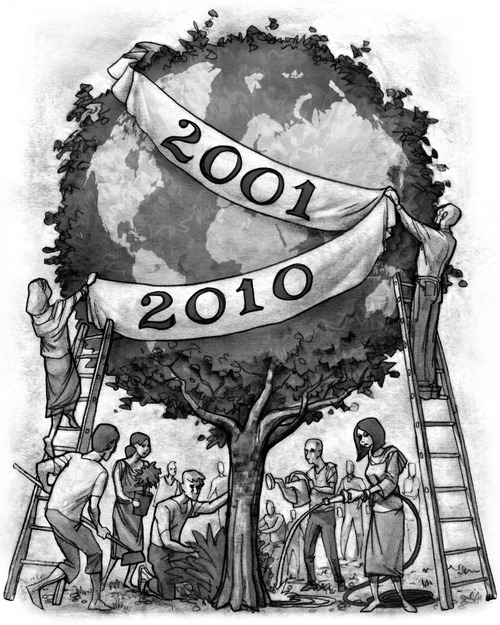
George Mason economist Tyler Cowen argues that, “It may not feel that way right now, but the last 10 years may go down in world history as a big success.”
That idea may be hard to accept in the United States. After all, it was the decade of 9/11, the wars in Iraq and Afghanistan, and the financial crisis, all dramatic and painful events. But in economic terms, at least, the decade was a remarkably good one for many people around the globe.
[…]
Putting aside the United States, which ranks third, the four most populous countries are China, India, Indonesia and Brazil, accounting for more than 40 percent of the world’s people. And all four have made great strides. Indonesia had solid economic growth during the entire decade, mostly in the 5 to 6 percent annual range. That came after its very turbulent 1990s, marked by a disastrous financial crisis and plummeting standards of living.
[…]
Elsewhere in South America, Colombia and Peru have made enormous progress and Chile is on the verge of becoming a “developed” country; it will soon be joining the Organization for Economic Cooperation and Development.
To be sure, in Africa, there is still enormous misery. Nonetheless, overall standards of living rose in a wide variety of countries there, with economic growth for the continent as a whole at more than 5 percent in most years. Many basic essentials, like water, sanitation, electricity and especially telephones, are more commonly available.
[…]
One lesson from all of this is that steady economic growth is an underreported news story — and to our own detriment. As human beings, we are prone to focus on very dramatic, visible events, such as confrontations with political enemies or the personal qualities of leaders, whether good or bad. We turn information about politics and economics into stories of good guys versus bad guys and identify progress with the triumph of the good guys. In the process, it’s easy to neglect the underlying forces that improve life in small, hard-to-observe ways, culminating in important changes.
In a given year, an extra percentage point of economic growth may not seem to matter much. But, over time, the difference between annual growth of 1 percent and 2 percent determines whether you can double your standard of living every 35 years or every 70 years. At 5 percent annual economic growth, living standards double about every 14 years.
Nonetheless, despite the positive news in much of the world, it’s questionable whether the decade as a whole has been good for Americans, economically speaking. Median wages have not risen much, if at all, and the costs of the financial crisis and irresponsible fiscal policies have become increasingly obvious. Those facts support a pessimistic interpretation.
Still, most economic models suggest that the fundamental source of growth is new ideas, which enable us to produce more from a given set of resources. To the extent that the rest of the world becomes wealthier, there’s more innovation, as my colleague and co-blogger Alex Tabarrok, professor of economics at George Mason University, argued recently. China, for instance, is moving toward the research frontier in areas such as solar power, scientific instruments, engineering and nanoscience, all of which can benefit the United States. Unlike the situation of just a few decades ago, a genius born in Mumbai now stands a good chance of becoming a notable scientist, whether at home or abroad.
It occurs to me that, at this time in 1960, the previous decade must have been looked upon rather unfavorably. We were, for the first time in the history of mankind, under serious threat of annihilation from man-made weapons. People were building bomb shelters in their back yards. We had spent three years fighting a war in Korea to a stalemate. We’d had two presidents, Truman and Eisenhower, universally viewed as lackluster. Politics could not have been more divided; it was the era of McCarthyism and Brown vs Board of Education. Toward the end of the decade, the scourge of rock and roll music was creating generational rifts and stoking racial tensions.
By the early 1970s, however, we were looking back upon the decade fondly and it remains fixed in our minds as a halcyon age.
Whether we’ll look back on the aughts (or naughts, or whatever we’re calling the decade) as fondly remains to be seen. But I doubt we’ll think of it as a horrible time once we gain some perspective.
It was, after all, the decade that gave us Wikipedia, Gmail, iPods, iPhones, wireless internet, ubiquitous GPS, and myriad other technological wonders. In 1999, Google barely existed and most people were relying on public libraries for their information — which is to say, they generally weren’t getting much information, since it was so much trouble. Blogs had been around for a couple years but they were the province of computer geeks; the mass media was still writing articles explaining — usually, incorrectly — what blogs were in 2004 and 2005.









