
Andrew Exum has an interesting interview with Daveed Gartenstein-Ross, author of the new book Bin Laden’s Legacy: Why We’re Still Losing the War on Terror. In addition to useful insights on the subject at hand, they branch off into a sidebar about the nature of online debate:
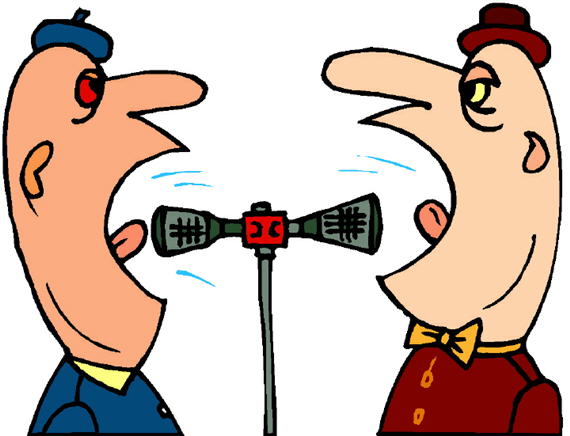
While we’re on personal subjects, it’s no secret that the blogosphere and Twitter encourage the worst snark, sarcasm and ugliness from people. You and I have talked about our mutual struggles to remain civil and polite while engaging with others, but unlike me, your reputation is unimpeachable: you always respond to your critics and other readers with politeness and courtesy. Why does civility matter in our line of work? And how do you discipline your own speech in the public sphere? Is there a trade-off? Do we lose something in terms of honesty by being polite?
I’ve come to see civility as important for a variety of reasons, but honestly, practical reasons loom rather large. First of all, it’s generally hard to win a name-calling contest. If I call someone an America-hating pinko, they can fire back that I’m a right-wing tool of the military industrial complex. Those two insults seem essentially to cancel each other out: why give someone an area that can end up a draw if I believe that I can prove all of my other arguments to be correct? Second, I find that if I’m civil, I can actually (sometimes) persuade people I’m arguing against that they’re wrong about an issue. In contrast, if I begin a debate by insulting someone, it only further entrenches him in his initial position, thus making it more difficult to talk sense into him.
I’ve found the balance I strike in my own small corner of the public sphere to be rather intuitive and comfortable. I’m unyielding when making arguments, but generally try not to belittle the people I’m engaging. If they really are so dumb that I feel like I can’t help but insult them, it’s almost always easier to disengage than to tell them how I really feel.
I don’t think there’s a trade-off involved in being polite. Being polite isn’t the same as being a pushover, nor is it the same as false collegiality that needlessly avoids confrontation. Indeed, I think that kind of fake collegiality should be avoided: the review I published this year of Robert Pape and James Feldman’s Cutting the Fuse is probably one of the harshest critiques a graduate student has produced of a work of that stature. But again, it eviscerates their argument without really personalizing the matter.
Finally, I think it’s much more important to be polite or collegial to people who are just breaking into the public sphere and are feeling their way around than to those who are well established. For those who are young and realize they have a lot to learn, it’s possible to help them in that process. People who are better established are usually more hardened in their views. For those who have become tenured professors or have been part of the National Security Staff, if I don’t like what they stand for now, then I probably never will.
On Twitter, especially, I’m quite a bit snarkier than Daveed but we share the same overall philosophy about the nature of the enterprise. He’s a former national champion debater, which explains his coming up with a strategic calculation about the tit-for-tat that had never really occurred to me. But he’s absolutely right that going negative assures that you won’t persuade anyone who didn’t already agree with you.
We also agree that one can both challenge weak arguments and remain civil and that there’s a hierarchy of harshness, with those who are more senior and powerful deserving less deference.
Perhaps the hardest bit of Daveed’s advice to take is to avoid engaging stupid people. It’s fairly easy as a blogger–I’ve always thought posts of the nature “stupid, unimportant person on the other side of the aisle said something stupid so let me use that to make some larger point about that side” among the weakest tropes of punditry. But it’s harder to avoid engaging commenters and tweeters who are dense, wildly uninformed, and unwilling to accept evidence that goes against their preconceptions.