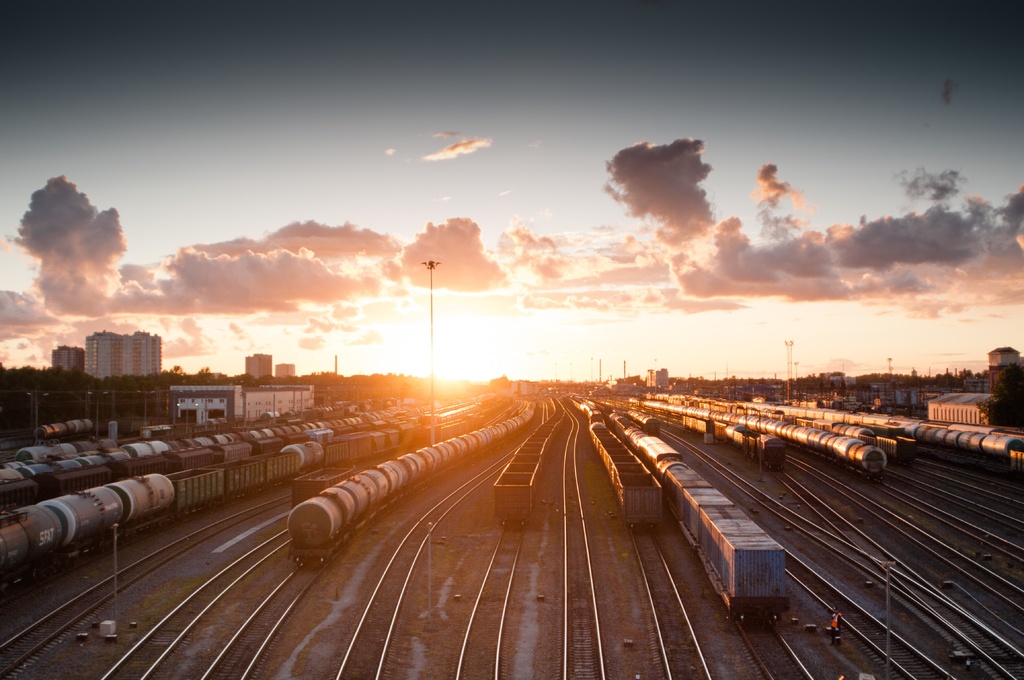

Back in September, a nationwide rail strike threatened to derail the economy. The Biden administration ultimately stepped in and brokered a deal, saving both a calamity and the Democratic Party’s electoral prospects. Alas, two of the unions ultimately rejected the deal last week and, now, Congress has stepped in and ordered them back to work.
NYT (“Biden Signs Legislation to Avert Nationwide Rail Strike“):
President Biden signed legislation on Friday to impose a labor agreement between rail companies and workers who had been locked in a bitter dispute, averting a strike that could have upended the economy just before the holiday season.
“Without freight rail, many U.S. industries would literally shut down,” Mr. Biden said before signing the bill, adding that many communities would not have received crucial resources during the strike. “Thanks to the bill Congress passed and what I’m about to sign, we spared the country that catastrophe.”
Mr. Biden had called on Congress earlier this week to intervene in the stalemate and avoid the work stoppage that could have cost the economy $2 billion a day. It was a significant move for Mr. Biden, a staunch union backer who has previously argued against congressional intervention in railway labor disputes, arguing that it unfairly interferes with union bargaining efforts.
But he called for an exception in this case because a rail strike could have devastated the economy, snapping supply chains for commodities like lumber, coal and chemicals and delaying deliveries of automobiles and other goods.
The measure forces the companies and their workers to abide by a tentative agreement reached in September, which Mr. Biden helped to broker. That deal includes a 24 percent increase in wages over five years, more schedule flexibility and one additional paid day off. Several rail unions had rejected it because it lacked paid sick leave.
While railroad workers get more holiday and vacation time than most workers, myself included, the notion that they’re not allowed any sick days struck me as bizarre and inhumane when I first learned of it in September. New York‘s Intelligencer has a good explainer, “Why America’s Railroads Refuse to Give Their Workers Paid Leave.”
Unlike nearly 80 percent of U.S. laborers, railroad employees are not currently guaranteed a single paid sick day. Rather, if such workers wish to recuperate from an illness or make time to see a doctor about a nagging complaint, they need to use vacation time, which must be requested days in advance. In other words, if a worker wants to take time off to recover from the flu, they need to notify their employer of this days before actually catching the virus. Given that workers’ contracts do not include paid psychic benefits, this is a tall order.
[…]
Why do these rail barons hate paid leave so much? Why would a company have no problem handing out 24 percent raises, $1,000 bonuses, and caps on health-care premiums but draw the line on providing a benefit as standard and ubiquitous throughout modern industry as paid sick days?
The answer, in short, is “P.S.R.” — or precision-scheduled railroading.
P.S.R. is an operational strategy that aims to minimize the ratio between railroads’ operating costs and their revenues through various cost-cutting and (ostensibly) efficiency-increasing measures. The basic idea is to transport more freight using fewer workers and railcars.
One way to do this is to make trains longer: A single 100-car train requires less track space than two 50-car ones since you need to maintain some distance between the latter. More critically, one very long train requires fewer crew members to run than two medium ones.
Another way to get more with less is to streamline scheduling so that trains are running at full capacity as often as possible.
All this has worked out poorly for rail workers writ large. Over the past six years, America’s major freight carriers have shed 30 percent of their employees. To compensate for this lost staffing, remaining workers must tolerate irregular schedules and little time off since the railroads don’t have much spare labor capacity left.
Of course, the railroads are in the business of moving freight, not creating jobs. In theory, if these firms could cut labor costs without degrading service, the broader economy could benefit. The railroads could pass on their savings to shippers in the form of lower rates, thereby putting downward pressure on a wide range of consumer prices. Furthermore, the more cost-competitive freight rail becomes relative to trucking, the lower the American economy’s carbon emissions will be.
All of which makes sense. Except that railroad workers are human beings, not robots. Being constantly on call and being unable to take care of oneself or one’s family when illness strikes is inhumane and, frankly, unsustainable. Large enterprises simply have to employ enough people to allow for emergencies.
Beyond that, it just doesn’t work.
Eliminating spare labor or train cars may render railroads more efficient mechanisms for translating investment into profits. But such fragile systems aren’t necessarily efficient for bringing freight from one place to another, especially in a world where natural disasters and public-health crises exist.
In early 2021, when the acute phase of the COVID pandemic ended and economic demand spiked, freight carriers’ operations were derailed by their own “efficiencies.” For a week last July, Union Pacific had to suspend service between Chicago and Los Angeles while it reopened shuttered rail ramps and reconfigured operations in order to keep pace with rising orders. Similar disruptions afflicted the other major carriers, as The American Prospect details.
By summer 2022, the freight carriers were still failing to meet customer expectations. In a July survey from the American Chemistry Council, 46 percent of chemical manufacturers said rail service was getting worse, while just 7 percent said it was getting better. “Freight rail has been a constant thorn in our side and been a significant challenge for our members for quite some time,” Chris Jahn, the council’s chief executive, told the New York Times in September.
And this is why the freight carriers won’t give ground on paid leave: Already understaffed and underperforming, the railroads cannot allow unanticipated absences to become significantly more prevalent without either pulling back from P.S.R. or suffering even more frequent disruptions and customer complaints.
[…]
The freight carriers can afford to make concessions on pay. It isn’t that painful to increase wages by a sizable amount when you’ve recently slashed your head count by 30 percent (and hope to continue innovating your way to a smaller payroll in the years to come). But providing rail workers with ordinary time-off benefits would threaten the industry’s core business strategy, an operating procedure that has helped to nearly double its profits over the past decade.
Not shockingly, railroad workers aren’t happy with Washington stepping in here.
NPR (“Some rail workers say Biden ‘turned his back on us’ in deal to avert rail strike“):
Four of the 12 freight rail unions, collectively representing more than half of the 115,000 freight rail workers covered by the deal, had voted down the agreement, citing the lack of paid sick days as a primary reason.
Workers who voted no say they are frustrated and disappointed — especially with President Biden, who on Monday called on Congress to pass legislation to adopt the tentative agreement with no modifications in order to avoid a crippling rail strike.
“It feels like President Biden ushered this in a little too early,” says Weaver. “He kind of cut us off at the knees on our ability to have some real negotiations or real change after voting no.”
In Richmond, Virginia, roadway mechanic Reece Murtagh says it sets a bad precedent when even the most pro-labor of presidents will force an agreement rather than allow workers to strike.
“In future negotiations, the carriers are going to remember that and use it against us,” says Murtagh. “It’s going to be even harder for us to negotiate a fair contract because they realize when it comes down to it, there’s not going to be a strike.”
Murtagh says guys in his shop felt especially disillusioned thinking back on Biden’s decades in the Senate, when he’d take Amtrak home to Delaware every night.
“Joe relied on us to get him home to his family,” Murtagh says. “But when it was his turn to help us out… to better our life, he turned his back on us.”
On Monday, Biden acknowledged it was a tough move to make.
“As a proud pro-labor President, I am reluctant to override the ratification procedures and the views of those who voted against the agreement,” he said in a statement. “But in this case – where the economic impact of a shutdown would hurt millions of other working people and families – I believe Congress must use its powers to adopt this deal.”
As he signed the rail legislation into law on Friday, Biden didn’t dodge the issue.
“Look, I know this bill doesn’t have paid sick leave that these rail workers and frankly every worker in America deserves. But that fight isn’t over,” he said. “I’ve supported paid sick leave for a long time. I’m going to continue that fight ’til we succeed.”
And, in fairness, compared to the previous contract, the one being imposed on them is pretty good:
Because the new contract covers a five-year period dating back to 2020, workers will see an average payout of $16,000 in back raises and bonuses within about 60 days, according to the Association of American Railroads. The trade group also says by the end of the contract, total average annual pay and benefits will reach $160,000 a year.
“Let’s be clear railroading is tough, essential work that keeps our nation moving, and our employees deserve our gratitude for moving America’s freight and doing so safely every day,” said AAR president and CEO Ian Jefferies. “Without a doubt, there is more to be done to further address our employees’ work-life balance concerns, but it is clear this agreement maintains rail’s place among the best jobs in our nation.”
As to the rather obvious question of where in the hell does Congress get the authority to impose a labor contract on these people, CNN Business has another explainer (“How an arcane 96-year-old law stopped the rail strike“):
Most labor disputes never end up being debated in Congress. But thanks to a nearly century-old law that regulates labor relations only when it comes to railroads and airlines, what otherwise would be strictly an economic issue became a political one.
The Railway Labor Act was passed in 1926 as one of the very first labor laws in the nation. At that point most of the railroads already had been unionized, some all the way back to the mid-19th century. The structure was therefore set up to regulate labor negotiations between unions and management, rather than oversee organizing campaigns for new unions and additional members.
[…]
Under the Railway Labor Act, the federal agency that oversees railroad and airline labor relations is the National Mediation Board, which tries to bring the two sides together, and it set up a series of limits and cooling off periods during which unions can not strike and management can not lock out the workers. And if all those efforts fail, then Congress can step in and impose a contract under which both sides will have to operate.
In negotiations at other businesses, the workers’ ability to strike is the most powerful option unions have to achieve their goals at the bargaining table. And even the railroads admit that the law makes strikes extremely unlikely.
“The goal of the Railway Labor Act was to reduce the likelihood of a work stoppage,” said Ian Jefferies, the CEO of the Association of American Railroads, the trade group that represents the railroads. “And it’s been remarkably effective in doing that.”
As much as management likes the law and its limits on strikes, the unions hate it. They say it would be far easier to reach a deal that their members can support if they had the leverage of a possible strike. And they say that management, when weighing the cost of that possible strike, would realize that they have the resources needed to meet those demands without an actual work stoppage.
[…]
If they were covered by the National Labor Relations Act, the labor law that oversees worker-management relations at most of the nation’s businesses, the unions could threaten to go on strike. But under the Railway Labor Act, management can fall back on hopes that Congress will give them the deal it wants.
“This action prevents us from reaching the end of our process, takes away the strength and ability that we have to force bargaining or force the railroads to…do the right thing,” said Michael Baldwin, president of the Brotherhood of Railroad Signalmen, one of the four unions whose members voted against the tentative agreements reached last fall that Congress is now poised to impose on members.
The railroads deny they wanted this to end up with Congress, and they preferred to reach a deal with the unions that could be ratified by membership.
“I don’t think it’s anyone’s goal to get Congress involved, but Congress has shown a willingness historically to intervene if necessary,” said AAR’s Jefferies.
But Biden, in his statement calling on Congress to act to impose the rejected tentative agreements on the rail workers to keep them on the job, seemed to acknowledge that there was no chance that rail management would reach a deal with the unions.
“During the ratification votes, the Secretaries of Labor, Agriculture, and Transportation have been in regular touch with labor leaders and management,” he said. “They believe that there is no path to resolve the dispute at the bargaining table.”
The railroads refused to accept union demands for paid sick days. Jefferies also said the railroads would only agree to make changes in sick day rules if it was within the “framework” of the proposal put forth by a presidential panel this summer that was charged with trying to find a compromise agreement.
That means for the unions to get the sick pay they wanted, they’d have to give up some other pay or benefit in order to keep the overall economics of the package unchanged. The likelihood that Congress will impose a deal along the lines of the presidential panel’s recommendations, or the tentative agreements, means that management has little incentive to agree to union demands.
Strikes of major industries can be incredibly damaging to the economy and it’s especially frustrating in situations like this one, where most of the unions agreed to the contracts but would still stop work in sympathy with those who didn’t. At the same time, negotiations in which one side has little leverage because an outsider will surely intervene are problematic.
In terms of the rail industry, it’s probably reasonable that Congress has the power to settle labor disputes to avert massive disruptions to the economy and even the national security. But it should work both ways; the baseline can’t be whatever industry is willing to concede. Alas, our undemocratic structure once again intervened: despite a majority in both the House and the Senate supporting adding seven days of paid sick leave to the contract, the measure fell short because it required a 60 vote supermajority and couldn’t attract enough Republican support to achieve that.
Beyond that, a WSJ report (“Threat of Rail Strike Reveals Persistent Supply-Chain Risks to U.S. Economy“) shows how precarious the whole system is.
Railroads move almost 30% of U.S. freight by ton-mile, a measure of weight and distance traveled. Some products such as coal, fertilizer, grains or chemicals are particularly reliant on rail. Anderson Economic Group, a consulting firm, put the costs of a strike at $60 million on the first day, then rising as the strike continues.
Other estimates have put the ultimate costs in the billions of dollars, based in part on prolonged shortages resulting from a lack of alternative delivery channels for key items. The American Trucking Associations said that shifting freight from railcars to trucks would have required more than 460,000 additional trucks and drivers—and when the trucking industry is already facing an acute driver shortage.
[…]
Federal Reserve officials, who once viewed supply-chain problems as a temporary effect of the pandemic, now say they could be here to stay. Vice Chair Lael Brainard on Monday warned of the “fragility of global supply chains.” On Wednesday, Fed Chair Jerome Powell said supply constraints could be creating a “new normal” for the U.S. economy.
“Are we going into a situation a little bit like the ’70s where there will be ongoing repeat shocks which would tend to put more upward pressure on inflation over time?” Mr. Powell asked at a Brookings Institution event.
The strike threat highlighted a distribution network in which businesses have sought to reduce delivery costs by becoming as lean as possible, said Balaji Guntur, chief operating officer at Hoptek, a logistics technology company. While the approach has improved profits, it also has made it more difficult to respond to shocks such as a global pandemic.
“We are exposing cracks in our supply chains’ ability to handle all of the things that we demand of it,” he said. “Supply chains used to move a little bit more slowly and there was enough slack in the system that provided some resilience.”
And yet, adding more slack into the system would also drive up long-term costs that would be borne by businesses and consumers. “I may want to get the best price on my next bag of chips,” Mr. Guntur said. “But if I want to be guaranteed a bag of chips tomorrow and the next day and so on I may have to pay.”
Over the past three years, the global supply chain has absorbed blows that have driven up consumer prices. First, Covid-related shutdowns slashed factory production around the world but particularly in China. At the same time, government stimulus programs in the U.S. and elsewhere boosted demand for goods despite supply constraints.
Ocean shipping rates rose eightfold between March 2020 and September 2021 but have since fallen back to near prepandemic levels, according to the Freightos Baltic Index.
Earlier this year, Russia’s invasion of Ukraine disrupted global energy flows as the supply of Russian oil and natural gas shrank following Western sanctions. Starting in the summer, shipping suffered when dry weather lowered water levels on major inland waterways in China, Europe and the U.S.
Labor disputes have also flared as pandemic-related worker shortages gave unions more leverage over employers. Strikes and protests have hampered ports in the U.K. and France. Uncertainty over labor talks at Southern California ports caused some shippers to divert cargo to East Coast ports.
“The supply chain network as a whole, both domestically and globally, is just not catching any breaks,” said Nick Vyas, a professor at the University of Southern California Marshall School of Business.
The understandable capitalist drive for greater efficiency has given us some amazing things. It’s simply remarkable that I can search millions of products on my phone and get pretty much whatever I needed delivered within 48 hours, often at ridiculously low prices. But it has also created a system where workers in key industries are over-stressed and with essentially no room for disruption before the whole thing breaks down.