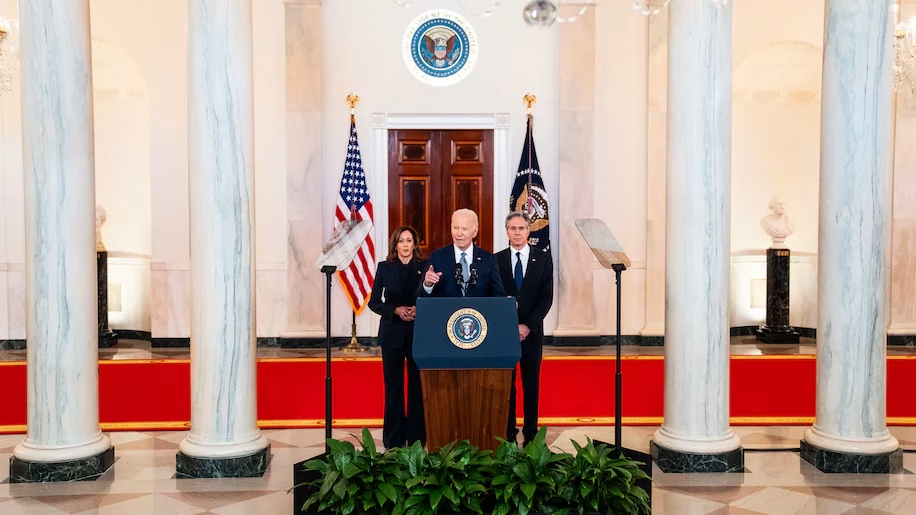
In one of his last official actions as President, Joe Biden made the understandable and still poor decision to pardon several people who all but certainly have committed no crimes. Details from AP:
President Joe Biden has pardoned Dr. Anthony Fauci, retired Gen. Mark Milley and members of the House committee that investigated the Jan. 6 attack on the Capitol, using the extraordinary powers of his office in his final hours to guard against potential “revenge” by the incoming Trump administration.
The decision by Biden comes after Donald Trump warned of an enemies list filled with those who have crossed him politically or sought to hold him accountable for his attempt to overturn his 2020 election loss and his role in the storming of the U.S. Capitol on Jan. 6, 2021. Trump has selected Cabinet nominees who backed his election lies and who have pledged to punish those involved in efforts to investigate him.
The story is still developing. Some accounts I’ve read stated that the pardon also includes members of the DC and Capitol police who testified in front of the January 6th commmittee.
On the one hand, this is understandable. On the campaign trail and via surrogates, the Trump Campaign made it clear that the were more than “open” to the idea of prosecution Fauci and others. To that point, only yesterday, one of the Truth Social accounts controlled by the incoming President posted the following “poll:”
For those who are unaware, that is Capitol Police Officer Lt. Michael Byrd, who shot and killed Ashli Babbitt during the January 6th Capitol riot. It was an action that was investigated and deemed “lawful and within Department policy” and “potentially saved Members (of Congress) and staff from serious injury and possible death”. And yet, we have the soon-to-be President of the United States (or at least one of his close staffers) asking the mob if Byrd should be prosecuted.
There’s going to be a lot of this in the days to come. And from that perspective, the decision to issue blanket pardons can be seen as understandable.
But that doesn’t make it right. Or a good idea from a political process.
From a logical standpoint, presumptive pardons don’t make sense. First and foremost, a law must be broken (or, if you are a pedant, someone must have been convicted of a crime) for a pardon to exist. Outside of fringe theorists, none of these individuals appear to have committed any crimes related to the activities for which they are being pardoned.
There is then the legal question of whether or not accepting a pardon is a binding admission of guilt. At MSNBC, former Prosecutor Jordan Rubin writes that in his opinion this is legally an unsettled matter:
In 1915’s Burdick v. United States, the Supreme Court said that a pardon “carries an imputation of guilt and acceptance of a confession of it.” At first glance, that language would seem to answer your question in the affirmative. But the question in Burdick wasn’t whether accepting a pardon means admitting guilt. Instead, that appeal asked whether a person could turn down a pardon (the high court’s answer was “yes”).
The court’s observation about guilt in Burdick is known as “dicta” — meaning language that’s unnecessary to an opinion — as opposed to the case’s “holding,” which announces the binding rule for the future in our common law system of precedent. At least, a federal appeals court said so a few years back when it rejected a broad reading of that Burdick language and said that “not every acceptance of a pardon constitutes a confession of guilt.” Of course, whether opinion language counts as dicta or binding law can be the subject of litigation — as we saw in Trump’s classified documents case — and we don’t know what the Supreme Court would say if the issue were presented to the justices today.
So it is possible to say, from a legal standard, that Fauci and others can accept these pardons without inherently accepting any guilt.
We also know that concepts of “guilt” exist beyond the legal sphere and, in many cases, can carry more weight. From political and public perception perspectives, it’s easy to see how accepting this pardon will be interpreted as admitting guilt. Heck, I expect that in this post’s comment thread, some people will take the existence of these pardons as definitive proof that crimes were committed–even if the recipients decide not to take them.
I understand some readers will not be moved by the “perception of guilt” argument. I understand that anyone who seriously believes “Fauci is a criminal” will not be motivated by any counter-facts.
At the same time, I’m still enough of a l believer that the rule of law is an important thing, even if I don’t necessarily agree with all the laws, that these presumptive pardons are bad from a system perspective.
I think that by issuing these pardons, Biden is essentially legitimizing the lawless prosecution theories that they are tied to. It’s acknowledging that it would be possible to prosecute Fauci, Milley, and these others and that said prosecutions have a strong possibility of making it through our legal system, leading to convictions.
Given that position, any purchase is toxic to our criminal and civil legal systems, as it gets to the idea that the concept of breaking the law no longer matters for purposes of prosecution. Accepting that idea really takes us to Putin’s Russia-style “show trials” that MAGA supporters have accused the Democrats of.*
Addendum 2: As expected, I see a lot of folks are disappointed in this take and think that this is the only “rational” thing to do. I want to press back that after weeks of talking about “don’t obey in advance,” this is (to me) a very clear case of obeying in advance. If it works, it will essentially spare the Trump Administration any negative political fallout from prosecuting (or, with its base, NOT prosecuting) these people. That’s pretty much the opposite of resistance.
It’s doubly problematic as it appears that some of the people pardoned were not planning to “obey in advance” and were prepared to be prosecuted. So it’s also not respecting their wishes either.
Addendum 1: None of the above should be taken as a denial of the deep pain and hardship created when someone is unfairly prosecuted for a crime. Heck, I’m even prepared to talk about the deep pain and hardship created when ANYONE is prosecuted for a crime. I’m also not moved by the idea that we should risk sacrificing our overall legal systems to protect people who–for the most part–are already in positions of great power and privilege. If you want to make this argument, I’d start with the Capital Police Officers rather than Dr Fauci.
* – I am sure some commentator will bring up the NY State Conviction of Donald Trump as an example. This is a flawed comparison for many reasons, not the least of which is that there were laws that the prosecutors were able to convince a jury that Trump broke. BTW, a “Trump can’t get a fair trial anywhere” isn’t a great defense unless, of course, you are willing to follow it as a broader attack on the jury-of-peers system–unless you want to have a serious talk about the composition of juries (and the manipulation of said composition) in all cases.