

AP (“President touts ‘Bidenomics’ though new poll shows just 34% approve his handling of the economy“):
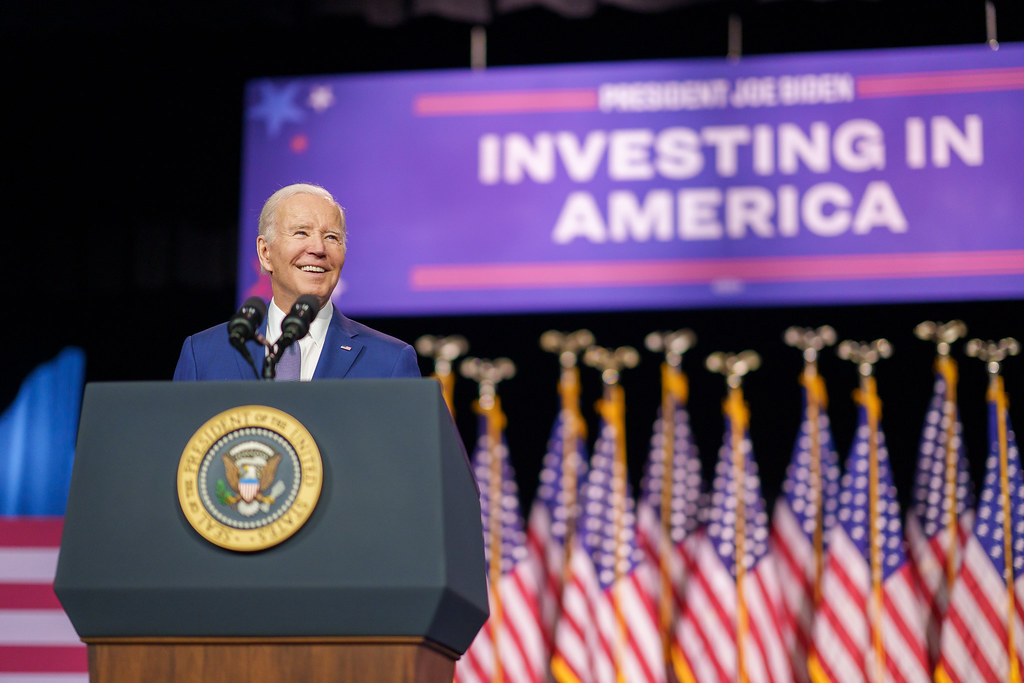
President Joe Biden made his pitch Wednesday to a skeptical public that the U.S. economy is thriving under what he now touts as “Bidenomics” — even as a new poll showed that could be a hard sell as the foundation for his 2024 reelection campaign.
In a major economic speech in Chicago, Biden said his administration’s efforts were sparking recovery after Republican policies had crushed America’s middle class. But the poll said only one in three U.S. adults approve of his economic leadership.
That 34% figure is even lower than his overall approval rating of 41%, according to the survey from The Associated Press-NORC Center for Public Affairs Research.
Biden’s approval figures have barely moved for the past year and a half, a source of concern for a president pursuing a second term on his ability to govern and focus on workers. He wants voters to connect local roads and bridge projects, factory construction and the rise of electric vehicles and renewable energy to the millions of dollars in initiatives he signed into law during the first two years of his administration.
“Bidenomics is about the future,” he declared in his Wednesday speech to cheering supporters. “Bidenomics is just another way of saying: Restore the American dream.”
At the same time, he sought to paint previous Republican tax cuts as deeply flawed, saying they helped the rich but failed the middle class for decades as the promised “trickle down” benefits never seemed to come to the less wealthy.
“The trickle down approach failed the middle class,” he said. “It failed America. It blew up the deficit. It increased inequity. And it weakened our infrastructure. It stripped the dignity, pride and hope out of communities, one after another.”
[…]
The new poll identifies a weakness within Biden’s own base. Many of the Democrats he needs to marshal in 2024 are comparatively unenthusiastic about his economic record. Seventy-two percent within his party say they approve of his handling of his job overall, but just 60% say they approve of his handling of the economy.
By comparison, during the depths of the pandemic as unemployment spiked, Republicans approved by overwhelming numbers of then-President Donald Trump’s economic leadership. Only about 1 in 10 Republicans now approve of Biden overall or on the economy, a testament to the polarization that defines modern U.S. politics.
[…]
Overall, 30% of U.S. adults say they think the national economy is good, up slightly from the 25% who said that last month, when the president and congressional Republicans were in the midst of negotiations over raising the nation’s debt limit and a historic government default was a risk. No more than about a third have called the economy good since 2021.
The administration is making a data-driven argument in addition to Biden’s speech. The Treasury Department released an analysis showing that spending on factory-related construction has doubled since 2021 after adjusting for inflation. White House economists issued a report that shows inflation is lower in the U.S. than the rest of industrialized nations in the Group of Seven.
White House aides believe that Biden’s speech on Wednesday can generate greater awareness of his policies and increase Democratic voters’ appreciation of the economy. While the president’s allies acknowledge that many Americans still hold dim views of the economy, they note that the actual economic data was far worse last November, when Democrats mounted a stronger-than-expected showing in the midterm elections.
Biden aides say they are encouraged by data showing Americans’ views can be changed by a consistent message reinforced on multiple fronts, which is what the president and his Cabinet are setting out to do by touring the U.S. over the next three weeks. Their hope is that repetition of Biden’s accomplishments, coupled with a contrast to GOP proposals to undo those initiatives, will stick with voters for 2024.
POLITICO (“Biden puts all his chips on the table with a push on ‘Bidenomics’“):
President Joe Biden is tying his political fate to the U.S. economy — recessionary risks be damned.
The White House this week is going all in on a campaign to claim credit for the nation’s post-pandemic resurgence, touting an economic vision that aides see as so central to Biden’s presidential legacy they’ve gone as far as giving it a name: “Bidenomics.”
It’s a fresh messaging push that marks the most aggressive attempt yet by Biden world to convince the public that the economy is, in fact, good. It’s also a major bet that the bottom won’t fall out, at least through November 2024.
“They’re going to wrap their arms fully around the economic strategy and economic results,” said Seth Harris, the former deputy director of Biden’s National Economic Council. “And I think their expectation is that there will not be a recession.”
The question of how strongly to tout the economy has vexed virtually every president running during a time of recovery. Boast too hard and voters may perceive you as out of touch. Stay too quiet and risk the perception of taking hold that times are bleak and getting bleaker.
Biden has pledged to avoid the missteps of his former boss, Barack Obama. He was reluctant in real time to play up good economic news after voters recoiled at his first attempt to do so though an infamous 2010 tour dubbed “Recovery Summer.” The current effort is an implicit recognition that Biden has more work to do.
Key to the sales pitch, which will include a speech Wednesday by the president formally outlining his economic case, is defining what exactly Bidenomics is. Ahead of the address, White House aides described the term as a broad collection of policies aimed at using government muscle to revive and reshape the economy to help the middle class. They pointed to a range of efforts, including bolstering manufacturing investments, expanding high speed internet access and cracking down on industries that charge so-called junk fees.
If the definition is a bit all-encompassing, the implication is clear. Biden’s political fortunes, his top aides believe, will hinge on how effectively they can hammer home the idea that voters are better off than just a few years ago — and have the Biden administration to thank for it.
“There’s going to be billions of dollars spent laying out what Joe Biden has done,” said one Democratic national political consultant familiar with the campaign strategy. “All these things are incredibly popular. But people don’t really know about them.”
[…]
Biden advisers privately acknowledge the hazards of centering an economy that’s likely closer to a peak than a valley, especially more than a year out from Election Day. Branding whatever happens over these next 17 months as the result of Bidenomics reflects an even bigger gamble, opening Biden up to a raft of attacks from his Republican opponents if the U.S. hits a downturn.
The administration’s attempt to label Biden’s economic legacy just more than halfway through his first term has struck even some Democrats as premature, and a potential unforced error.
“Bidenomics sounds like bad math,” said a Democratic strategist who was granted anonymity to speak frankly. “Bidenomics sounds like when my parents tell me something costs $2 and it’s $20.”
Shockingly, the WSJ Editorial Board (“Bidenomics in One Lesson“) is not impressed:
As it gears up for the 2024 re-election campaign, the White House is undertaking a political salvage operation over the economy. President Biden is now embracing what we have long called Bidenomics as a badge of honor, and he’s telling tales about how spthelendid everything is and why he deserves credit for it
The White House is going on this PR campaign because it can read the polls. Mr. Biden’s approval rating on the economy is 38.3% in the latest Real Clear Politics average. People don’t think the economy is all that great. So in Chicago on Wednesday Mr. Biden touted all the new construction going on from the spending that Democrats passed in the last Congress. And there’s no denying that when you spend literally hundreds of billions of dollars to subsidize certain industries, you can get new plants.
But then why are voters so unhappy? The answer can be found in one lesson by looking at the nearby chart. It tracks average real hourly earnings for all workers in the private economy across the Biden Presidency, and it tells an ugly story about the impact of the worst inflation in 40 years and the standard of living. This is the inflation that Mr. Biden did so much to ignite with all of his spending.
Here’s the chart (the version at the link is interactive):

It is, to say the least, odd. First, the y axis is in 10-cent increments, making the difference between the peak of $11.40 and the trough of $10.95 look enormous. Second, why the hell would you put a comparison of 2021, 2022, and 2023 in 1982-1984 dollars?
In 1982-84 dollars, which takes account of inflation, average hourly earnings were $11.39 when Mr. Biden took office but started to decline immediately and didn’t stop falling until inflation peaked in June 2022. They have bounced up a little but were still back only to $11.03 in May. That’s a 3.16% decline in real earnings for the average worker across the 29 months of the Biden Presidency.
It’s perfectly reasonable to adjust earnings for inflation. Indeed, while I’m a Federal employee and get annual cost of living adjustments, they have been decidedly lower than inflation, which has been the highest by far in my working life. But using 1982-84 dollars makes no sense here, in that it changes the baseline for no apparent reason.
I’ve tried to look up the numbers myself but can’t easily find them on the BLS site. But the fact that WSJ bizarrely changed them to 1982, 1983, and 1984 dollars is a pretty good indication that their argument is less interesting using the logical 2021, 2022, and 2023 dollars. It’s not like BLS doesn’t have a handy dandy inflation calculator to make that comparison easy.
These are official Labor Department statistics. Mr. Biden can’t deny them, so he had someone fudge the point by writing in his Chicago remarks that, “Look, pay for low-wage workers has grown at the fastest pace in over two decades.” We’d like to see how his economists cherry-picked the data to justify that one.
All of which reminds us of the old Marx Brothers joke: Who are you going to believe, me or your own eyes? Regarding Bidenomics, Americans should believe their own eyes.
These guys literally just fudged the numbers!
WaPo’s E.J. Dionne (“If ‘Bidenomics’ works, it will be a very big deal“) is, not surprisingly, more receptive.
President Biden might not seem like a revolutionary, but he is presiding over a fundamental change in the nation’s approach to economics. Not only is he proposing a major break from the “trickle-down” policies of Ronald Reagan, as Biden highlighted in a speech in Chicago on Wednesday. He is also departing from many orthodoxies that shaped the presidencies of Democrats Bill Clinton and Barack Obama.
Government is no longer shying away from pushing investment toward specific goals and industries. Spending on public works is back in fashion. New free-trade treaties are no longer at the heart of the nation’s international strategy. Challenging monopolies and providing support for unionization efforts are higher priorities.
You can trace the break in part to new circumstances and challenges, as national security adviser Jake Sullivan argued in an important speech of his own in April.
Heightened competition with China and the urgency of dealing with climate change are part of the story. So is the long rise of wealth and income inequality accompanied by the collapse of many of the country’s industrial communities. The breakdown of supply chains during the pandemic put an accent on resiliency and an emphasis on bringing home manufacturing, for semiconductors especially but for other products, too.
The shift also has to do with who Biden is, his long-standing alarm over the Democratic Party’s alienation from working- and middle-class voters and an unease with the Reagan-era economic consensus that hovered over Democratic administrations.
“When I worked for him as vice president,” Sullivan told me earlier this month, “he would frequently talk to me about his underlying discomfort with some of the prevailing economic assumptions, both with respect to trade and domestic investment.”
[…]
Bidenomics has also gone global. One indicator is the exceptional and ongoing debate Sullivan’s speech provoked in proposing a “new consensus” to replace “a set of ideas that championed tax cutting and deregulation, privatization over public action and trade liberalization as an end in itself.” The old formulas, Sullivan argued, not only failed to address new problems; they didn’t work on their own terms.
“In the name of oversimplified market efficiency,” he said, “entire supply chains of strategic goods, along with the industries and jobs that made them, moved overseas.” The idea that freer trade “would help America export goods, not jobs and capacity, was a promise made but not kept.” He stressed the need for “a modern American industrial strategy” and the benefits of “moving beyond traditional trade deals to innovative new international economic partnerships.”
Sullivan advised Hillary Clinton’s 2016 campaign against Donald Trump, and the election’s outcome provoked a long period of reflection on the anger he encountered throughout the country. “As I traveled across the United States on behalf of the campaign,” Sullivan wrote in Democracy Journal in 2018, “I was reminded again and again how the broken aspects of the American economy were not the inevitable product of disembodied forces like ‘globalization’; they were very much the product of policy choices shaped by decades of conditioning.”
The Biden-Sullivan project amounts to a program of deconditioning. Sullivan told me his speech “is really a description not just of my own journey on these issues” but also the journey of his generation responding to “the shortcomings of the previous approach.”
I’m deeply skeptical of industrial policy but agree with many parts of the Biden approach—which, ironically, echoes what his predecessor touted but largely failed to do. While I was very much part of the elite Western consensus on the virtues of globalization, the way that we did it created a race to the bottom that was good for us as consumers but bad for much of the working class, who had to compete against the unfair labor practices and shoddy standards of China and much of the global south. While Trump’s “America First” policies were mostly wrongheaded, it really makes sense to end our economic dependence on China. Further, while “Infrastructure Week” became a running joke under Trump, it absolutely makes sense to invest in green energy, transportation infrastructure, expanding broadband access, clean drinking water, and the like. The market simply won’t provide those organically, certainly not as fast as we need them.
As to the politics, it seems reasonable to take credit for popular policies that were only passed because had managed to cajole his own party caucus in Congress. The idea that, by labeling it “Bidenomics,” he’ll be blamed if the economy goes south is laughable. He’s going to be blamed for it, anyway! It has been thus for as long as I’ve been following presidential politics.
UPDATE: Commenter @Andy points out that it’s actually BLS, not the WSJ, who normalizes these figures into 1982-1984 dollars. Their rationale:
Since we first published the data in the mid-1970s, the headline ECI numbers always focused on nominal change in employer costs—that is, without any adjustment for inflation. Over time, these nominal changes have shown some wild swings, with annual changes in private sector wages above 9 percent in the early 1980s, and typically in the 1–3 percent range throughout the 2010s.
We also have had inflation-adjusted data available, although we didn’t previously highlight the numbers in the quarterly news release. The constant-dollar ECI, or real wage change, could move from negative to positive, based on changes in the CPI. For example, those 9+ percent annual changes in the nominal ECI in the early 1980s, when adjusted for inflation, resulted in a nearly 5-percent annual decline in real wages. More often, the constant-dollar ECI reported annual changes in the range of plus or minus 2 percent.
With recent increases in the CPI nearing 40-year highs, there’s more interest in whether wage growth is keeping up with inflation. Thus, we have expanded the availability of constant-dollar ECI data. The ECI uses the Consumer Price Index for all Urban Consumers (CPI-U), U.S. city average, to adjust for inflation. The process involves rebasing the CPI to match the ECI base period of December 2005. (The published CPI is currently based in the 36-month period from 1982 to 1984.)
One would think that, in the age of big data, it would be easy to update all of their figures to current dollars automatically. But this makes some sense.
My apologies for erroneously concluding that the WSJ editors were pulling a fast one.








